Saudi-Houthi escalation intensifies; Ukraine reports no warning of Russian strike
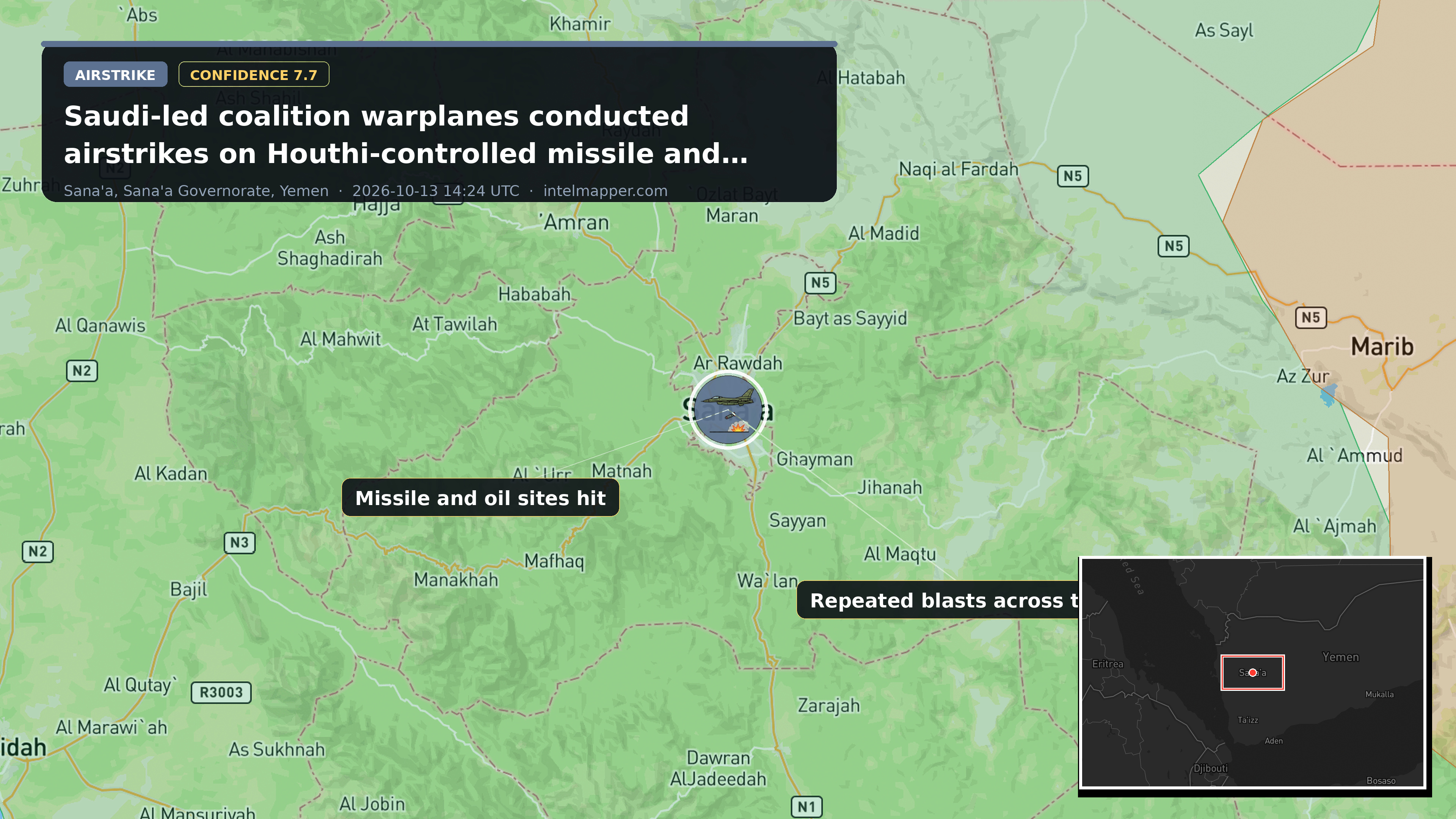
Saudi-led coalition warplanes conducted airstrikes on Houthi-controlled missile and oil facilities in Sana'a, including targets in the city
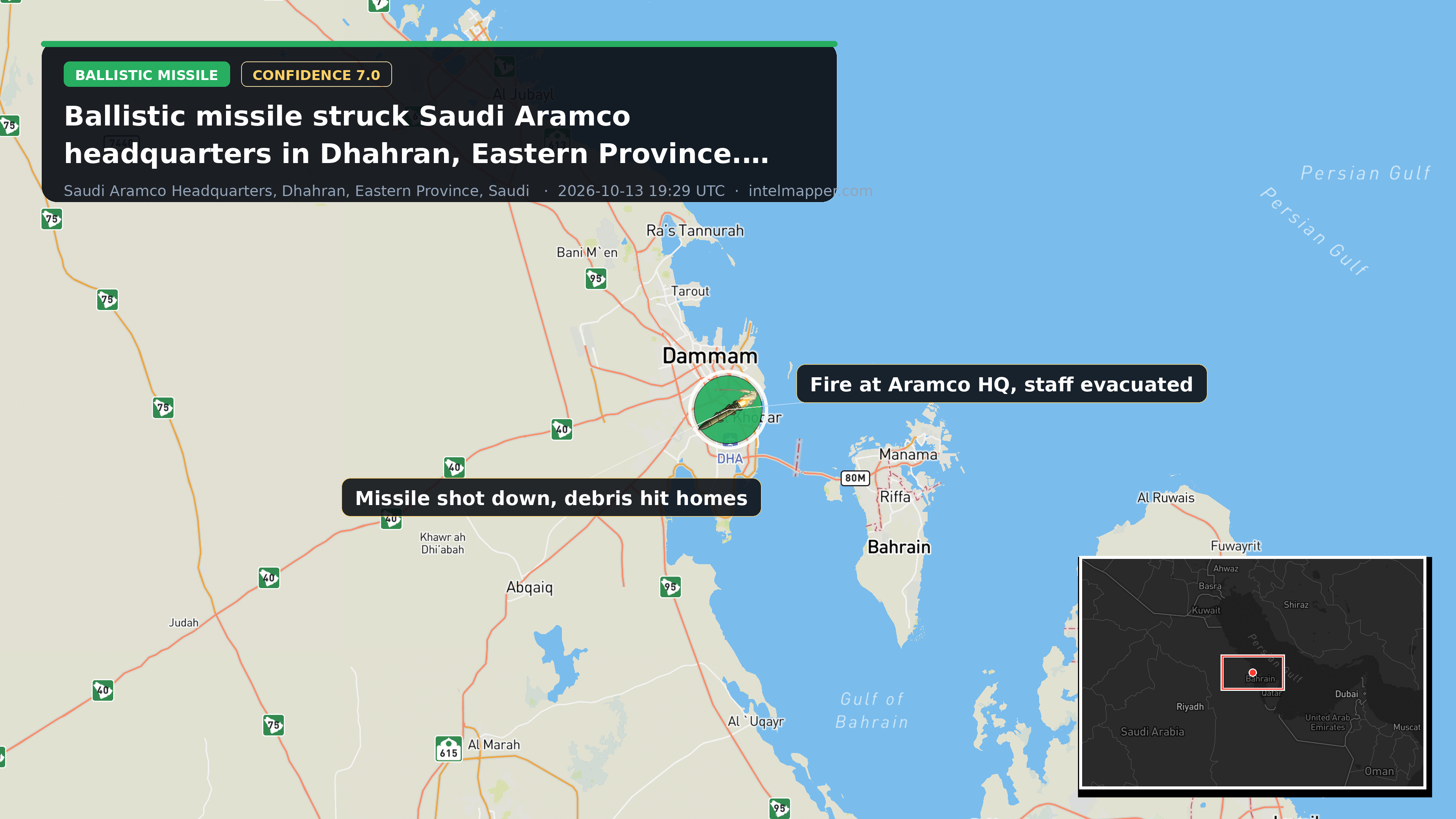
Ballistic missile struck Saudi Aramco headquarters in Dhahran, Eastern Province. Saudi air defense intercepted the incoming missile; debris
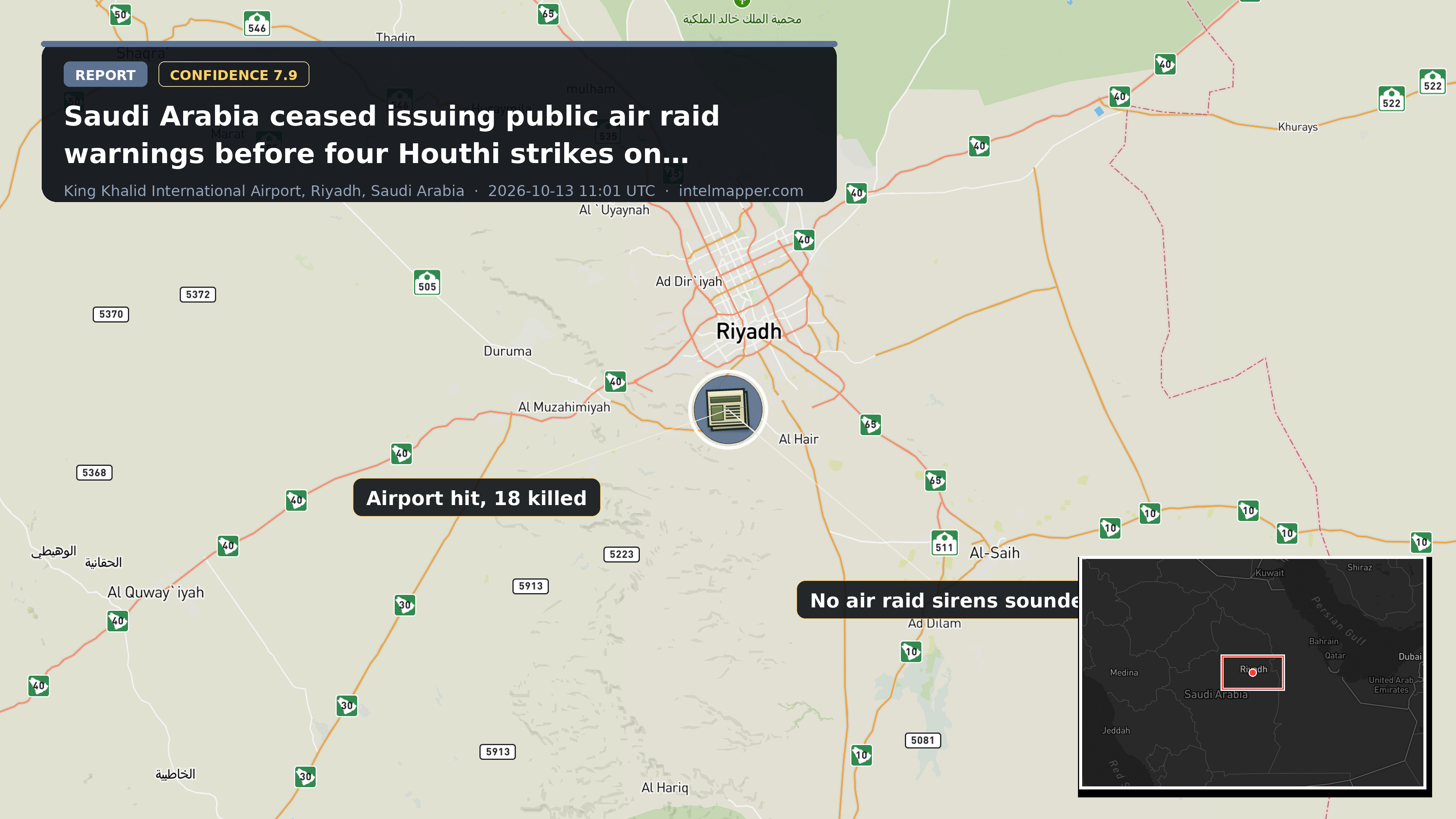
Saudi Arabia ceased issuing public air raid warnings before four Houthi strikes on Riyadh airport that killed at least 18 and wounded over 3
Saudi Arabia and the Houthi movement entered a new phase of tit-for-tat military strikes on 13 October. The Saudi-led coalition conducted airstrikes on Houthi-controlled missile and petroleum facilities in Sana'a, including the Yemen Petroleum Company's Al-Sabaha Central Station, following Houthi evacuation threats against King Khalid International Airport in Riyadh, Aramco headquarters in Dammam, and Aramco refineries in Riyadh. The Houthis responded with loitering munition attacks against Saudi military positions and named three specific Saudi targets for retaliation. Air traffic disruptions continued over Jeddah, indicating sustained pressure on regional civilian aviation infrastructure. Saudi air defense reportedly intercepted three drones north of Riyadh, though specific origins remained unconfirmed.
Recent events underscore critical vulnerabilities in Saudi civilian protection measures. Western officials attributed Saudi Arabia's cessation of public air raid warnings to resident complaints, despite mounting Houthi drone capabilities that killed at least 18 people and wounded over 300 in previous strikes on King Khalid International Airport. This represents a strategic choice to prioritize public morale over early warning systems—a trade-off with measurable human cost. Regional partners moved to strengthen the Saudi position: Turkey's President Erdoğan reaffirmed support, Egypt pledged unconditional assistance citing threats to the Suez Canal, and the Saudi Cabinet issued stern warnings of consequences for continued attacks on airports, holy cities, and maritime lanes.
The conflict reflects broader regional polarization and extraregional interest. President Trump characterized Houthis as having 'acted very badly' and reportedly told Israeli PM Netanyahu to 'prepare' for renewed Iranian strikes before Israeli elections, signaling potential expansion of conflicts. Trump also suggested requesting Turkish participation in Yemen operations, indicating possible NATO-aligned involvement in an Arabian Peninsula conflict. Iran's Foreign Ministry denied allegations of responsibility for an attack on RAF Fairford, while Turkish and Iranian foreign ministers discussed de-escalation. These diplomatic crosscurrents suggest the Yemen conflict operates as a proxy theater for multiple power competitions simultaneously.
Key developments
- Saudi-led coalition airstrikes targeted Houthi petroleum and missile infrastructure in Sana'a; Houthis responded with drone strikes and named three Saudi targets for retaliation.
- Ukraine received no advance Western intelligence warning of Russian ballistic missile attack on Kyiv; U.S. attributed this to weather while Zelenskyy rejected the explanation.
- Approximately 20+ Russian Shahed-type drones transited multiple Ukrainian oblasts targeting population centers; Russian tactical aircraft maintained active operations in northeastern Ukraine.
- Israeli PM Netanyahu reportedly discussed with President Trump resuming military strikes against Iran before Israeli elections, with Trump reportedly telling Netanyahu to 'prepare.'
- Saudi Arabia discontinued public air raid warnings despite mounting Houthi drone capabilities, reportedly due to resident complaints—a strategic choice with documented civilian casualties.
- Turkey indicated readiness for Yemen operations if requested by the U.S.; multiple regional powers reinforced Saudi Arabian support amid Houthi escalation.
- Iran denied RAF Fairford attack allegations; Turkish and Iranian foreign ministers discussed regional de-escalation amid broader proxy competition dynamics.
What to watch
Monitor Saudi-Houthi escalation trajectory: whether coalition responds to named retaliation threats and whether Houthis execute promised strikes on Dammam, Riyadh, or Jeddah. Track U.S. diplomatic messaging regarding potential Turkish involvement in Yemen and Israeli operations against Iran before Israeli elections. In Ukraine, assess whether Western intelligence sharing improves following the Kyiv warning incident and monitor Russian drone sortie tempo for signs of sustained operational intensity or degradation. Watch for Syrian diplomatic moves with OPCW following Foreign Minister meetings on chemical weapons accountability. Iran-linked activity remains elevated; monitor for escalation following nuclear program discussions and RAF incident denials.
Sources
This brief is compiled from the day's verified events; each entry links to the event page with media, confidence score and original reporting.
- Ballistic missile struck Saudi Aramco headquarters in Dhahran, Eastern Province. Saudi air defense intercepted (Ballistic Missile, Saudi Aramco Headquarters, Dhahran, East)
- Qatar's Emir Sheikh Tamim bin Hamad Al Thani warned of the dangers of settler attacks on Palestinians in the W (Statement, Doha, Qatar)
- PM Netanyahu at Seam Line in Samaria warns adversaries Israel is prepared for any scenario and possesses unmat (Statement, Seam Line, Samaria, West Bank)
- Israeli Defense Minister Israel Katz to sign security directive Sunday restricting fiber-optic and SIM-control (Statement, Jerusalem, Israel)
- Houthi leadership names three Saudi targets for retaliation if Saudi-led coalition strikes Sana'a oil depot: A (Statement, Aramco Headquarters, Dammam (evacuation )
- Saudi-led coalition issues evacuation warning for Al-Sabaha oil company central station in Sana'a, signaling i (Statement, Al-Sabaha / Sabahah / Sabaheen Central S)
- Turkish President Erdogan held phone call with Saudi Crown Prince Mohammed bin Salman condemning Houthi attack (Statement, Ankara, Turkey)
- Egypt's Foreign Minister Badr Abdelatty pledges unconditional support to Saudi Arabia against Houthis, offerin (Statement, Cairo, Egypt)
- Saudi Arabia ceased issuing public air raid warnings before four Houthi strikes on Riyadh airport that killed (Report, King Khalid International Airport, Riyad)
- Syrian Foreign Minister Asaad al-Shaibani reiterates condemnation of Iranian and Houthi attacks, stating regio (Statement, )
- Syrian Foreign Minister Asaad Al-Shebani condemns Israeli violations within Syrian territory during press conf (Statement, Damascus, Syria)
- New fuel shipment arrived at Banyas port amid tightened monitoring procedures. Part of ongoing fuel supply ope (Humanitarian Aid, Banyas, Tartous Governorate, Syria)
- Heavy rainfall across Syria yesterday caused water accumulation in Wadi al-Shula, Deir ez-Zor Governorate. Met (Report, Wadi al-Shula, Deir ez-Zor Governorate, )
- Israeli PM Netanyahu discussed with U.S. President Trump a possible resumption of military strikes against Ira (Statement, Jerusalem, Israel)