Iran-US escalation intensifies amid Gaza stalemate; Ukraine reports major drone attack
Key developments
- Iran claimed ballistic missile strikes on US military installations in Iraq and Bahrain in response to reported US airstrike killing four persons at a wedding in Iran; US officials escalated economic and military threats.
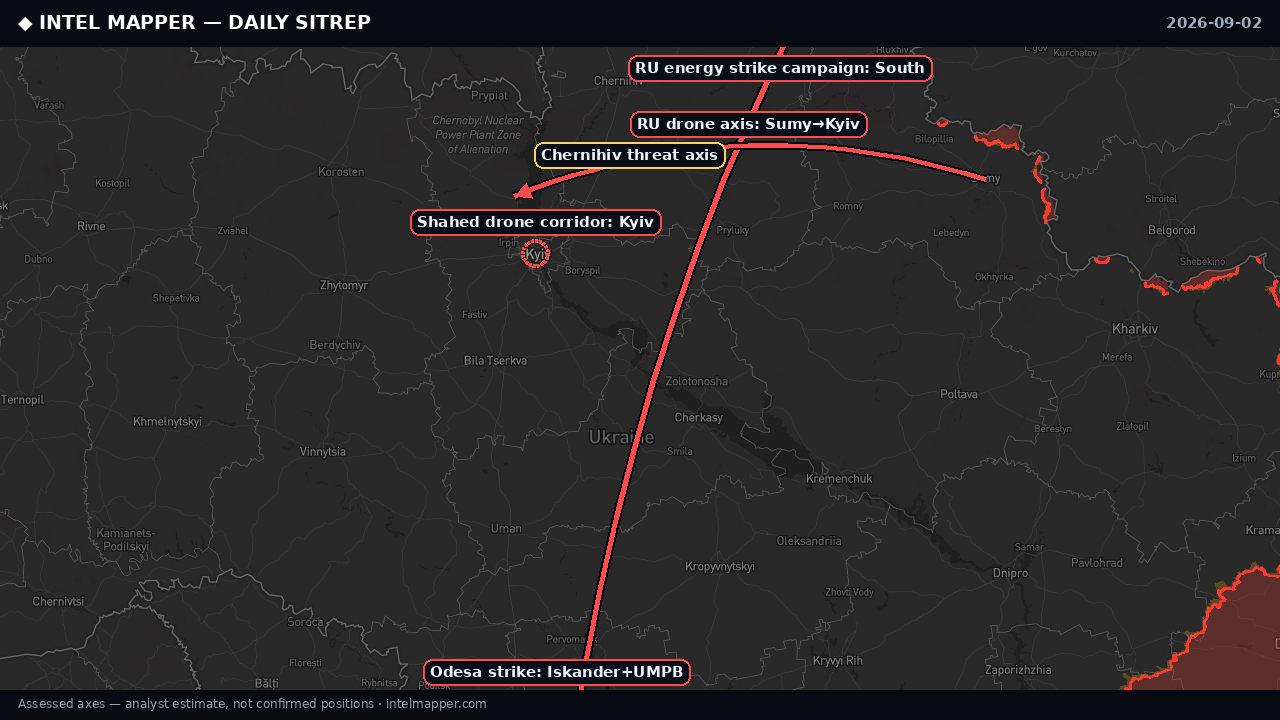
- Ukraine endured massive Russian overnight attack comprising 174 Shahed-type UAVs plus Iskander and Kh-59 missiles; 178 Russian ground engagements occurred across eastern fronts.
- Syrian authorities discovered 73 tonnes of uranium from Assad-era nuclear program; IAEA closed investigation following HTS cooperation.
- Armed confrontation between Ukrainian SBU and HUR security services in Kyiv resulted in three wounded and one reportedly killed, signaling internal Ukrainian friction.
- German Navy reportedly conducted test of Israeli LORA ballistic missile; Germany approved air defense weapon delivery to Ukraine for October 2026.
- Israeli PM Netanyahu stated IDF controls 60% of Gaza and vows no withdrawal pending Hamas disarmament; Trump called for cessation of Ukraine-Russia war.
- Norway seized Russian vessel on behalf of Ukrainian Naftogaz to enforce 4.22 billion dollar arbitration award; Ukrainian Defense Forces struck Russian energy infrastructure including Ust-Luga refinery.
Middle East 30 tracked events
US-Iran military tensions reached critical levels on 2 September with multiple concurrent escalations. Iranian officials reported a US airstrike on a wedding ceremony in Kuhestan, Hormozgan Province, killing four persons including a child and wounding 53 others. Iran's Foreign Ministry characterized this as part of ongoing US military operations. Concurrently, Iran claimed successful ballistic missile strikes against US military installations—specifically Erbil Air Base in Iraq and the Naval Headquarters of US 5th Fleet in Bahrain, with reports of satellite imagery confirming impacts. These strikes appear framed as retaliation for prior US actions. US officials, including Trump and Treasury Secretary Bessent, escalated rhetoric in response, with Bessent announcing intent to sever all Iranian foreign economic ties and Trump reiterating comprehensive surveillance capabilities. Netanyahu issued explicit threats, stating Iranian attack would constitute "one of their last decisions" and predicting regime collapse.
Syrian territorial and nuclear issues emerged as secondary priority concerns. Syrian authorities announced discovery of 73 tonnes of uranium, reportedly from Assad-era nuclear program facilities, with storage location and investigative details withheld pending examination. The International Atomic Energy Agency closed its investigation into alleged Syrian secret nuclear activities following cooperation with the new HTS-led government, signaling normalization of nuclear oversight. Separately, Israeli-Syrian negotiations over security agreements reportedly failed, with Syrian interest diminished following sanctions relief. Israeli forces maintained visible operational presence in southern Syria, with a patrol of approximately ten vehicles reported advancing toward Ain Ziyawan village in Quneitra Governorate. Turkish President Erdoğan reaffirmed commitment to Syrian territorial integrity while calling for dissolution of the SDF, indicating Turkey's continued focus on Kurdish militia elimination.
Gaza operations continued without major tactical changes. Netanyahu stated IDF controls 60% of Gaza Strip and vows no withdrawal pending Hamas disarmament and demilitarization, claiming ongoing elimination of Hamas operatives including assassination of a security chief. Israeli Defense Minister Katz indicated preparedness to facilitate Gaza evacuation, though Trump's plan remains frozen with no operational timeline provided. Syria's post-conflict recovery progressed measurably: civilian aircraft transits through Syrian airspace reached 21,971 in August versus 20,315 in July, reflecting stabilization of air traffic. Syria-Germany and Syria-EU diplomatic engagements advanced, with discussions of economic cooperation, investment, and banking sector development. Iraqi authorities released 457 Syrian detainees, advancing bilateral repatriation efforts. These developments suggest Syria's transition toward normalized international relations, contrasting sharply with ongoing Middle East military confrontations.
- Former US President Trump reiterates US surveillance of Iran, claiming comprehensive monitoring of Iranian act
- Israeli PM Netanyahu threatens Iran in exclusive interview, declaring that if Iran attacks Israel, it will be
- Israeli official reports failed negotiations with Syrian government over security agreement. Syria's interest
- USS Abraham Lincoln aircraft carrier arrived in Thailand after 286 days at sea and months of Middle East opera
- Syrian authorities announced discovery of 73 tonnes of hidden uranium in Syria, likely from Assad-era nuclear
- Israeli PM Netanyahu claims IDF controls 60% of Gaza Strip and vows not to withdraw. States elimination of Ham
Ukraine 30 tracked events
Ukraine endured sustained Russian air and drone assault on 2 September within context of broader military stalemate. Russia launched a massive overnight attack comprising two Iskander-M ballistic missiles, two Kh-59/69 cruise missiles, and 174 Shahed-type unmanned aerial vehicles—including 87 reactive variants—directed from Crimean and Russian territory. Multiple separate Shahed-136 reactive drone transits were tracked over Ukrainian territory heading toward Vinnytsia, Kyiv Oblast, Zhytomyr, and Kirovohrad regions, with air raid alerts issued to civilian populations. This operational tempo reflects Russia's continued investment in attrition-focused drone and missile campaigns against Ukrainian infrastructure despite mounting losses. US Ambassador to NATO Matthew Whitaker assessed Russia's military position as operationally stalled with limited near-term NATO threat capability, though he cautioned Russia remains unpredictable and capable of aggressive action. Russian ground operations maintained intensity with 178 combat engagements across eastern Ukrainian fronts on 2 September, supported by 71 airstrikes delivering 243 guided bombs and 6,548 kamikaze drone deployments.
Internal Ukrainian security tensions surfaced amid external military pressure. An armed standoff erupted overnight between SBU and HUR personnel in a Kyiv residential area, resulting in three HUR fighters wounded and one reportedly killed. The clash reportedly triggered by SBU detention of a Russian volunteer, indicating friction within Ukrainian security services. Ukrainian authorities implemented formal air threat differentiation system for civilian population, adopting improved monitoring protocols to enhance air raid alert accuracy. Ukrainian Defense Forces conducted deep strikes against Russian military assets, destroying a MiG-29 fighter near Millerovo Air Base and a Ka-27 helicopter near Yeisk Airfield, and striking the NOVATEK Ust-Luga oil refinery in Leningrad Oblast, where fire was confirmed. These strikes align with US Treasury Secretary Yellen's acknowledgment that Ukraine has decided to target Russian energy facilities, creating upward pressure on global energy prices.
Western diplomatic and military support remained steady despite conflict stagnation. German Foreign Ministry engaged in escalatory diplomatic exchange with Russia following summoning of Germany's acting chargé d'affaires over alleged anti-Russian actions and statements. Germany approved delivery of air defense weapons to Ukraine scheduled for October 2026, continuing NATO allied military assistance. Polish PM Donald Tusk reaffirmed Poland's commitment to Ukrainian survival while cautioning against repetition of historical Eastern European strategic errors. EU Commission President von der Leyen pledged Europe and NATO commitment to increase pressure on Russia until it ceases bombing and civilian casualties in Ukraine. Trump publicly called for cessation of hostilities, stating 'they ought to stop that stupid war,' reflecting his longstanding position favoring rapid conflict resolution. Norway seized Russian vessel Professor Molchanov in Svalbard on behalf of Ukrainian energy firm Naftogaz as enforcement of 4.22 billion dollar arbitration award against Russia for Crimea asset seizure.
- Former US President Trump publicly calls for cessation of Ukraine-Russia war, stating 'they ought to stop that
- Russia summoned Germany's acting chargé d'affaires to the Foreign Ministry over alleged anti-Russian actions a
- Armed standoff erupted overnight between Ukrainian SBU and HUR personnel in a Kyiv residential street. Three H
- Russia launched massive overnight attack on Ukraine: 2× Iskander-M ballistic missiles, 2× Kh-59/69 cruise miss
- Ukrainian President Zelensky states that following his warnings, international airlines have begun halting fli
- U.S. Ambassador to NATO Matthew Whitaker assesses Russia's military position in Ukraine as stalled with limite
What to watch
Monitor development of Iran-US military escalation trajectory; assess whether reported Iranian strikes prompt retaliatory US action or diplomatic off-ramp. Track Ukrainian security service dynamics following SBU-HUR confrontation for indicators of institutional fragmentation. Observe Russian maintenance of drone-and-missile attrition campaign intensity and associated logistical sustainability. Watch for German-Israeli military cooperation expansion following reported LORA test. Monitor Netanyahu's Gaza posture ahead of Israeli elections and Trump's continued peace rhetoric versus operational Ukrainian-Russian dynamics. Track Syrian nuclear material handling and international oversight mechanisms under HTS administration.