Saudi pipeline struck; Ukraine targets Russian refining capacity amid sustained frontline pressure
Key developments
- Saudi Arabia's East-West Pipeline struck by ballistic missiles; kingdom forced to shut down critical crude export infrastructure bypassing the Strait of Hormuz.
- Ukrainian drone and cruise missile strikes targeted Russian Saratov Oil Refinery, Lukoil Volgograd refinery, chemical plants, and port facilities in coordinated overnight campaign.
- Crown Prince Mohammed bin Salman requested US military intervention against Houthis twice; Trump rejected both requests; US maintains measured posture despite ally pressure.
- Russian forces sustained 207 combat engagements and deployed 6,395 kamikaze drones on 11 September; Ukrainian forces reported advances in Lyman direction.
- UK intelligence estimates 500,000 Russian soldiers killed and 1.5 million total casualties since February 2022 invasion.
- Syria's President al-Shara scheduled to address Atlantic Council at UN General Assembly, signaling Damascus re-engagement; international pressure continues on Israeli occupation policies.
- Russian Kremlin threatened nuclear strikes against Lithuania if it deploys nuclear weapons; reportedly Ukraine intercepted 138 drones overnight despite sustained Russian air campaign.
Middle East 30 tracked events
Saudi Arabia's East-West Pipeline sustained significant damage from ballistic missile strikes on 11 September, triggering fires at pumping stations along the route to the Red Sea port of Yanbu. US officials assessed the strikes as ballistic in nature, while Iraqi resistance groups and Houthis claimed responsibility. Saudi authorities subsequently announced a forced shutdown of the critical infrastructure, representing a major disruption to the kingdom's crude export capacity and its primary bypass route around the Strait of Hormuz. The attack underscores the vulnerability of Saudi energy infrastructure to coordinated strikes and reflects escalating proxy pressure against Riyadh.
Crown Prince Mohammed bin Salman made two separate requests to President Trump for direct US military intervention against Houthis in Yemen; both were rejected, with US officials confirming no plans for escalated involvement. Concurrently, Saudi and Yemeni government forces conducted airstrikes on Houthi positions, including strikes on Mokha airport and port facilities following reported Houthi advances in the region. Houthi forces also seized ammunition shipments from Saudi-backed government units. These developments indicate a tactical stalemate in Yemen despite Saudi air superiority, with the Trump administration maintaining a measured posture despite allied pressure for deeper intervention.
Regional diplomatic activity reflects shifting power dynamics. Syrian President Ahmad al-Shara is scheduled to address the Atlantic Council during UN General Assembly margins on 23 September, signaling Damascus's international re-engagement. Israeli artillery fire continued in western Rif Dimashq, and Finance Minister Smotrich warned that Iranian axis collapse could empower a rising Sunni threat. UK sanctions targeting Israeli settlements in occupied Golan Heights and France's call for Israeli military withdrawal indicate international pressure on Israeli occupation policies. Turkish Foreign Minister Fidan discussed recent regional developments with Saudi counterpart Faysal bin Ferhan, highlighting diplomatic coordination among key actors.
Additional tensions emerged with multiple explosions reportedly occurring in the Strait of Hormuz region off Iran's coast, though origin and cause remain unclear. US Treasury Secretary Scott Bessent stated sanctions are constraining Iran's economy significantly, claiming Iranian oil exports have reached zero while 10 million barrels daily transit Hormuz. Iranian Foreign Ministry spokesperson Esmail Baghaei accused the US of regional interference, stating Yemeni patience has expired. These rhetoric exchanges underscore sustained US-Iran strategic competition despite the absence of direct military escalation, with economic pressure and proxy activities remaining the primary mechanisms of conflict.
- Saudi Arabia's East-West Pipeline struck by projectiles on Thursday, damaging pumping stations and triggering
- Security tensions and attacks on internal security force vehicles reported in Ayn al-Arab (Kobane), Aleppo. Al
- Saudi Arabia announces forced shutdown of critical East-West Pipeline following ballistic missile strikes. Pip
- Anthropic reports detecting an Iran-linked group using Claude AI to track U.S. Navy warships by analyzing tran
- UK government imposes sanctions on illegal Israeli settlements in occupied Syrian Golan Heights, including imp
- US Treasury Secretary Scott Bessent stated that sanctions are strangling Iran's economy, claiming 10 million b
Ukraine 27 tracked events
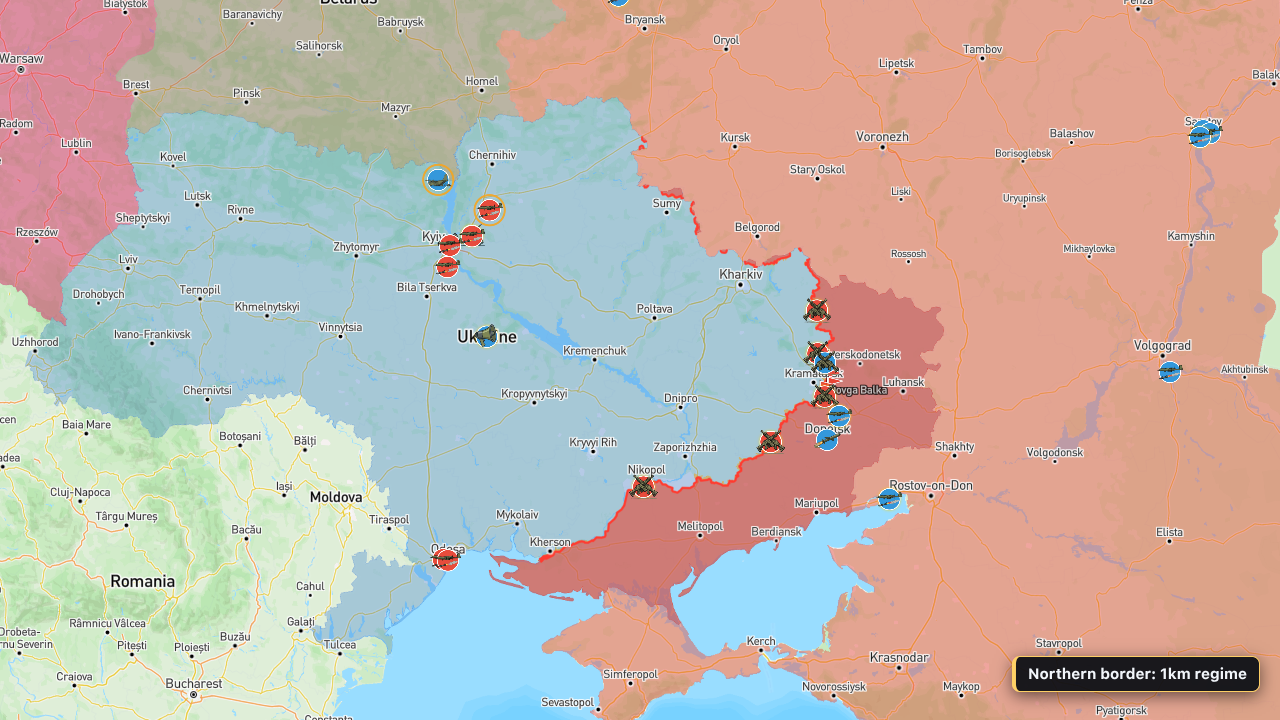
Ukrainian forces executed a coordinated overnight strike campaign targeting Russian energy and civilian infrastructure on 10-11 September. Primary confirmed targets included Saratov Oil Refinery (processing ~7 million tonnes crude annually), Lukoil's Volgograd refinery, Uralkhim Azot chemical plant in Berezniki, and Ozon's Saratov distribution center (100,000+ m² facility handling 900,000+ daily orders). Multiple explosions were also reported across Saratov, Volgograd, Kaspiysk, and occupied Shakhtarsk. Ukrainian drone strikes additionally targeted Engels strategic bomber base and Kaspiysk and Makhachkala port facilities in Dagestan. The breadth and coordination of strikes indicates sustained Ukrainian deep-strike capability despite logistical constraints.
Russian forces maintained high operational tempo across the eastern frontline with 207 combat engagements recorded on 11 September alone. Russian operations included 78 airstrikes (233 guided bombs), deployment of 6,395 kamikaze drones, and 2,953 shelling attacks. Ukrainian air defense intercepted 138 Russian drones and one cruise missile overnight 10-11 September, demonstrating resilience but indicating sustained attrition on both sides. UK military intelligence estimates Russian military casualties at 500,000 killed and 1.5 million total since February 2022, with Air Chief Marshal Knighton characterizing losses as a 'senseless waste.' Ukrainian forces reported significant advances in the Lyman direction, though territorial gains remain contested.
Ukraine implemented enhanced border security measures, establishing a special regime across a 1-kilometer zone along the northern border with Russia and Belarus. Russian Shahed-type reactive drones continued transiting Ukrainian airspace in multiple sectors (Kyiv, Odesa, Chernihiv), with Ukrainian air defense maintaining continuous monitoring and intercept operations. Lukashenko announced military restructuring and readiness for mobilization in Belarus, while Czech AH-1Z Cobra attack helicopters conducted operations near the Belarus border region. Commander-in-Chief Budanov reaffirmed Ukraine's commitment to continue fighting; the conflict remains in its 1,661st day of full-scale operations.
- Ukrainian forces (1st Separate Centre for Unmanned Systems, SBU, GUR) struck Saratov Oil Refinery on night of
- Russian Kremlin warns Lithuania that deploying nuclear weapons on its territory would make Lithuania a target
- Medvedev claims Russia requires no mobilization, stating Ukrainian Armed Forces units are at only 20–30% staff
- Ukrainian drones struck Uralkhim Azot chemical plant in Berezniki, Perm Krai. Additional explosions reported a
- Ukrainian drone strikes hit Lukoil's Volgograd refinery overnight, confirmed by regional governor. Strikes als
- Ukrainian attack drones struck Ozon's distribution center in Saratov, setting it ablaze. The facility, spannin
What to watch
Monitor for secondary effects of Saudi pipeline damage on global crude markets and Riyadh's emergency export routing options in next 24-48 hours. Track ongoing Russian-Ukrainian deep-strike campaigns for indicators of either side reaching attrition ceilings or logistical collapse. Observe Syrian President al-Shara's UN General Assembly remarks on 23 September for signals regarding Damascus's post-conflict state-building trajectory and regional alignment. Note any escalation in Houthi-Saudi military operations following rejected US intervention request. Watch for Russian nuclear rhetoric escalation following Lithuanian policy changes and potential NATO response.