Gulf energy infrastructure damaged amid diplomatic initiatives; Ukraine sustains long-range strikes
Key developments
- Saudi Arabia's East-West Pipeline suffered heavy damage to pump stations near Yanbu and Medina; pipeline expected offline 3–5 weeks, reducing daily export capacity by 4–5 million barrels.
- Ukraine struck major Russian energy infrastructure including Saratov and Slavyansk-on-Kuban refineries and Novy Urengoy gas plant; claims include damage to Novorossiysk Naval Base vessels.
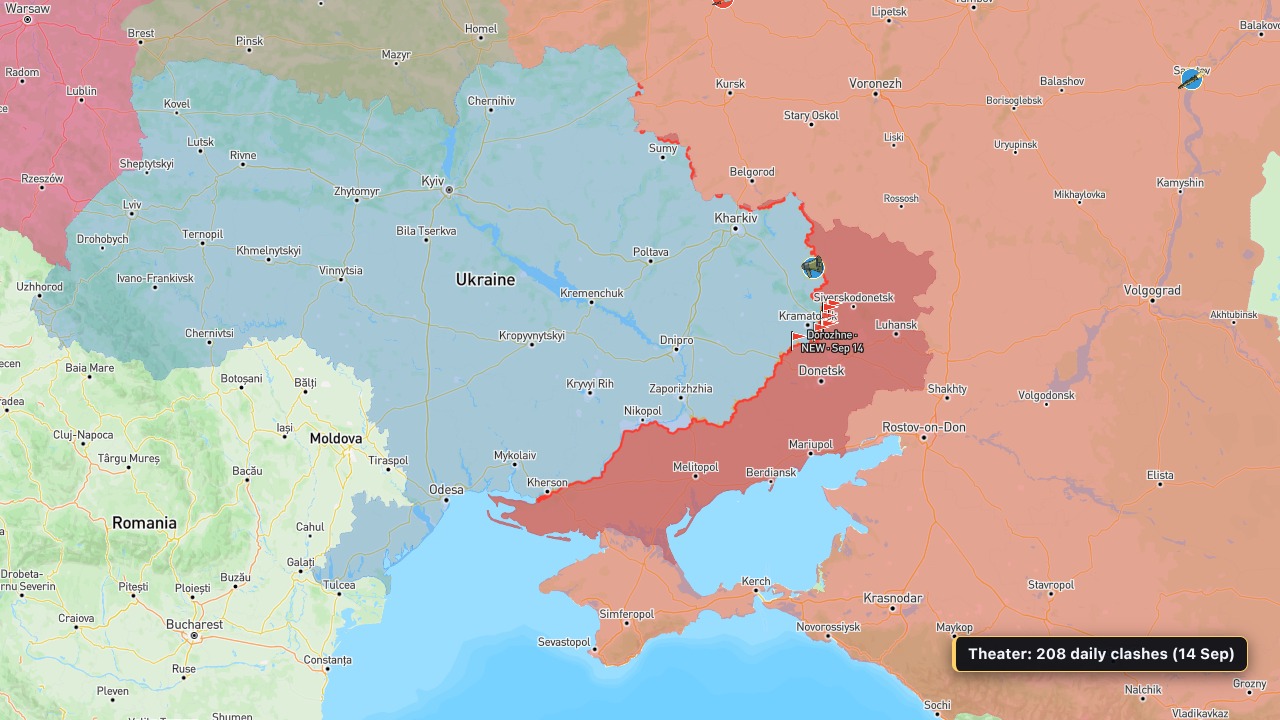
- Russia maintained extreme operational tempo: 225 combat clashes, 6,183 kamikaze drones, and 1,724 artillery barrages on September 14 alone; Ukrainian air defenses suppressed 85 drones overnight.
- Trump claimed Ukraine-Russia agreement on mutual restraint from energy infrastructure strikes, but no independent verification; Zelensky proposed conditional de-escalation contingent on verified Russian compliance.
- Turkish diplomacy deepened with Syria and Saudi Arabia; Erdoğan announced trilateral Turkey-Saudi-Pakistan initiative; UK considering enhanced military support to Saudi Arabia.
- IRGC claimed shootdown of US MQ-1 drone over Strait of Hormuz and loss of supertanker EL GAIA to sea mine; claims lack independent confirmation.
- NATO reinforcement announced: German troops deploying to eastern flank for first time without volunteer status; Rutte warned Russian recruits of high casualty rates and reaffirmed NATO support for Ukraine.
Middle East 30 tracked events
Saudi Arabia's critical petroleum infrastructure sustained significant damage on September 14 following drone and ballistic missile strikes on the East-West Pipeline pumping stations near Yanbu and Medina. Satellite imagery confirms heavy damage to at least two pump stations; the pipeline, which transports approximately 4–5 million barrels daily, is expected to remain offline for 3–5 weeks. This constitutes a material disruption to global oil supply. Separately, the IRGC Navy reportedly claimed responsibility for shooting down a US MQ-1 reconnaissance drone over the Strait of Hormuz using newly deployed air defense systems, though no US confirmation has been provided. The IRGC also claimed that the supertanker EL GAIA struck a sea mine in a prohibited zone south of the Strait, resulting in fires and loss of the vessel—a claim requiring independent verification. These incidents underscore persistent vulnerability of regional maritime and energy chokepoints.
Diplomatic activity intensified across multiple fronts, suggesting attempts to manage escalation despite ongoing military operations. President Erdoğan announced a trilateral partnership between Turkey, Saudi Arabia, and Pakistan regarding the Mecca Agreement, framed as signaling unity to the Islamic world. Turkish Foreign Minister Fidan conducted high-level visits to Damascus, touring historical sites and meeting Syrian officials, reflecting Turkey's diplomatic deepening with post-Assad Syria. Iraq's PM al-Zaidi declared that Baghdad will not serve as a launchpad for regional attacks and offered to facilitate dialogue and de-escalation. Meanwhile, UK Prime Minister Burnham is considering Saudi requests for enhanced military support, including British military advisers deployment and assistance defending oil infrastructure and the Bab el-Mandeb Strait. Vice President Vance announced direct conversations with Houthis and commitment to monitoring Yemen.
Washington's diplomatic posture suggests openness to negotiated restraint. Trump stated that Ukraine and Russia had agreed to halt strikes on energy targets with reciprocal restraint, though no independent confirmation exists. Trump also claimed Iran wishes to make a deal quickly and expressed US openness to engagement. However, actual combat operations continued unabated: Ukraine struck Saudi infrastructure on September 10–13; Russia maintained intensive drone and artillery campaigns; and Houthi operations continued against shipping. Syrian developments included removal of industrial chlorine cylinders from a school in Deir ez-Zor and Syrian Foreign Minister Asaad Shaaban's statement at the IAEA conference that 73 tonnes of uranium will remain secure under the new government. Domestic tensions in Syria surfaced with fuel price protests near the Turkish border and reported deaths in As-Suwayda.
- President Erdoğan announces trilateral initiative by Turkey, Saudi Arabia, and Pakistan regarding the Mecca Ag
- UK PM Andy Burnham considering Saudi requests for military support against Houthis, including oil infrastructu
- Iraqi PM Ali al-Zaidi declared Iraq will not serve as a launchpad for attacks against neighboring countries an
- Turkish Foreign Minister Hakan Fidan visited Damascus, touring the Saladin al-Ayyubi Mausoleum and Turkish Air
- Iran's IRGC claims it shot down a US MQ-1 reconnaissance drone over the Strait of Hormuz using a newly deploye
- Satellite imagery confirms heavy damage to Saudi Arabia's East-West Petroleum Pipeline pumping station near Ya
Ukraine 30 tracked events
Ukrainian strike operations demonstrated sustained reach into Russian territory on September 14 and preceding nights. Forces struck the Slavyansk-on-Kuban Oil Refinery (5.2 million tons annual capacity) on September 12–13, the Saratov Oil Refinery (7 million tons capacity) on September 10–11, and the Novourengoyskyy ZPKT gas condensate plant (19.5 million tons capacity) in Novy Urengoy on September 10–11—the latter strike occurring over 3,000 km from Ukrainian territory. Naval strikes damaged a Mangust-class patrol boat in Sevastopol and reportedly inflicted damage on vessels at Novoressiysk Naval Base including the minesweeper Zheleznyakov. These operations indicate Ukraine's continued ability to project long-range precision strikes despite attrition and resource constraints.
Russian operational intensity remained exceptionally high. The General Staff reported 225 combat clashes across all fronts on September 14, with Russia conducting 55 airstrikes using 190 guided bombs and deploying 6,183 kamikaze drones and 1,724 artillery barrages. On September 13–14 alone, Ukrainian air defenses suppressed or shot down 85 Russian attack drones from launches totaling 108 units. Russian drone operations continued to target civilian infrastructure: a Geran-2 drone struck a civilian road section in Pavlohrad, and on September 13 a drone attacked a civilian train near Yahodyn station on the Ukraine-Poland border. NATO Secretary General Rutte condemned the passenger train attack and reaffirmed NATO commitment to increased support, rejecting pressure to limit aid. German Chancellor Merz announced deployment of German troops to NATO's eastern flank for the first time without volunteer status.
Tentative diplomatic signals emerged regarding potential restraint on energy infrastructure targeting, though verification remains uncertain. President Zelensky conditionally proposed mutual de-escalation: if US partners ensure Russia genuinely halts strikes on Ukrainian energy, food, and transportation infrastructure, Ukraine would reciprocate by halting strikes on Russian energy targets. Trump claimed Ukraine and Russia had already agreed to such terms, attributing global diesel price rises to the war rather than Iran. However, Ukrainian forces continued infrastructure strikes, and no independent confirmation of any ceasefire agreement exists. Defensively, Ukrainian General Staff reports progress on developing jet-powered Shahed-variant drone interceptors, with tests underway. The threat assessment for September 15 indicates above-average ballistic missile threats from Bryansk Oblast and continued UAV strike risk.
- Ukrainian forces struck the Slavyansk-on-Kuban Oil Refinery in Krasnodar Krai on the night of September 12-13.
- Trump claims Ukraine agreed to halt strikes on Russian energy targets and Russia pledged reciprocal restraint.
- Ukrainian General Staff reports progress on developing new-generation drone interceptors to counter Russian je
- Analysis report asserts Ukrainian strike on Russian command post in Donetsk killed multiple top Russian milita
- Ukrainian General Staff operational update (22:00, Sept 14): 225 combat clashes across all fronts. Russia cond
- President Zelensky conditionally proposes mutual de-escalation: if US partners ensure Russia genuinely halts s
What to watch
Monitor next 24–48 hours for: confirmation of any Ukraine-Russia restraint agreement on energy infrastructure, given continued Ukrainian strikes; Saudi pipeline repair timeline and impact on global oil markets; Russian drone intensity against Ukrainian electrical grid and civilian targets; NATO's troop deployment pace and posture along eastern flank; Turkish-Syrian diplomatic deepening and potential implications for broader regional alignment; verification of IRGC claims regarding drone shootdown and vessel loss; Houthi operational patterns following VP Vance's stated engagement; and any statements from Trump administration clarifying specifics of reported ceasefire terms.