US-Iran tensions escalate amid B-1B deployments; Ukraine sustains refinery strikes and drone campaign
Key developments
- U.S. B-1B Lancer departed RAF Fairford with full weapons load and afterburners; Trump reviewed military strike options against Yemen at Camp David, signaling active escalation planning.
- Iran issued seven conditions via Qatar and threatened 'decisive war,' while U.S. embassies across the Middle East issued coordinated security alerts and warned of airspace closures.
- Houthis claimed dual ballistic and cruise missile operations against Riyadh and Saudi Aramco; Saudi coalition responded with airstrikes on Marib positions, maintaining escalatory cycle.
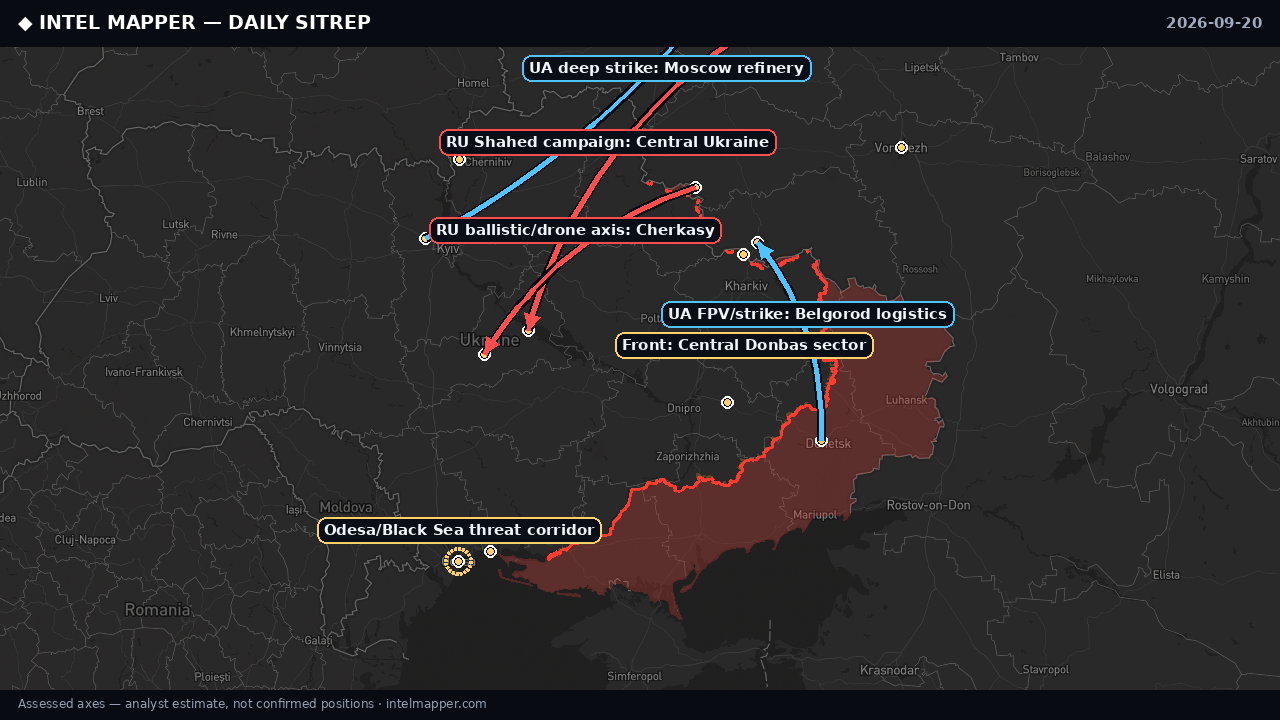
- Ukrainian drone confirmed to strike Kapotnya oil refinery near Moscow with fire damage; Ukrainian forces also targeted Russian air defense and logistics infrastructure in Belgorod.
- Russia launched 138 UAVs in 14-hour massed attack; Ukraine intercepted or suppressed 101 drones (73 percent rate); sustained nightly Shahed-136 operations continue from Oryol and Donetsk.
- U.S. deployed multiple C-17 cargo aircraft to Al Asad Air Base and positioned strategic assets; Israeli airstrikes on Lebanon and air defense alerts in Syria indicate regional-wide tension.
- Both theaters show escalation signaling paired with operational attrition cycles; neither side has committed to major threshold-crossing action, but conditions favor rapid escalation if political signaling hardens.
Middle East 13 tracked events
Strategic indicators of escalation in the U.S.-Iran confrontation intensified on 20 September. A U.S. Air Force B-1B Lancer departed RAF Fairford with full afterburners—a signal of immediate operational readiness and heavy weapons load—while President Trump departed Camp David early without public explanation, reportedly to review military options against Yemen. Simultaneously, Iran issued seven conditions via Qatar and threatened 'decisive war' if rejected, establishing explicit red lines for potential escalation. The timing and coordination of these moves suggest active contingency planning by both powers, though neither has committed to irreversible action.
Operational preparations accelerated across the region. U.S. Central Command issued coordinated security alerts across Middle East embassies, advising Americans to exercise heightened vigilance and prepare for airspace closures and flight cancellations. Multiple C-17 cargo aircraft deployed toward Al Asad Air Base in Iraq, indicating logistics buildup. The Houthis conducted claimed dual-target operations on 19-20 September, with spokesman Yahya Seri announcing ballistic and cruise missile strikes on 'sensitive facilities' in Riyadh and a separate operation targeting Saudi Aramco infrastructure. Saudi air defenses and coalition forces responded with airstrikes on Houthi positions in the Marib governorate, maintaining the tit-for-tat pattern that has characterized the conflict for months.
Israeli operations and Syrian air defense alerts suggest broader regional tension. Israel conducted unreported airstrikes against southern Lebanon targets, continuing a pattern of limited operations outside the primary Yemen-Saudi theater. Unconfirmed reports indicated air defense activation at Kharab al-Jir military base in northeastern Syria—a known Iranian-aligned position—though no strikes or impacts were confirmed. These developments reflect a region on heightened alert: U.S. and Iranian signaling appears deliberately public and escalatory, while proxy forces (Houthis, Israeli operations) maintain operational pressure, creating conditions where miscalculation or deliberate escalation could rapidly expand the conflict beyond current bounds.
- U.S. B-1B Lancer strategic bomber observed departing RAF Fairford with full afterburners, indicating heavy wea
- Trump departed Camp David early Saturday with no public explanation. Analysis suggests Iran escalation: Tehran
- U.S. State Department issues coordinated security alerts across Middle East embassies. Americans advised to ex
- U.S. State Department warns that Iran-backed Houthis have conducted hostile acts against Saudi Arabia, includi
- U.S. Embassy in Baghdad warns Americans of potential escalation in Middle East tensions. Advises caution and a
- Multiple U.S. C-17 cargo aircraft deployed toward Middle East in response to escalating regional tensions, fol
Ukraine 19 tracked events
Ukrainian offensive infrastructure targeting demonstrated sustained capability against Russian rear areas. A confirmed Ukrainian drone strike struck the Kapotnya oil refinery near Moscow, igniting fires at the facility—a continuation of the systematic targeting of Russian energy and logistics infrastructure that has characterized the campaign since mid-2024. The strike underscores Ukrainian ability to project strikes deep into Russian territory despite air defense improvements. Simultaneously, Ukrainian forces released footage of FPV-kamikaze drone strikes against Russian air defense systems in Donetsk Oblast, and reportedly destroyed a fuel and ammunition depot in Belgorod Oblast, indicating diversified targeting across supply lines and active defense positions.
Russian massed drone operations sustained maximum pressure across Ukrainian territory. Over a 14-hour period (18:00 19 Sep – 08:00 20 Sep), Russia launched 138 UAVs, of which Ukrainian air defense shot down or suppressed 101 drones across multiple sectors—a 73 percent intercept rate representing continued operational strain on Ukrainian air defenses despite their effectiveness. The attacks included ballistic missile volleys (Iskander/S-400 systems) from Kursk Oblast and multiple Shahed-136 variant strikes, particularly against Odesa, Cherkasy, Pavlograd, and coastal regions. Russian air monitoring confirmed continued shift operations and reactive (jet-powered) Shahed-136 launches from Oryol and Donetsk, indicating sustained production and operational tempo despite losses.
Both sides demonstrated technical adaptation and attrition cycles characteristic of prolonged attritional warfare. Russian air defense shot down one Flamingo (jet-powered Shahed variant) over Moscow Oblast, indicating Ukrainian penetration of Russian airspace despite Moscow's layered defenses. The detection of Russian Oreshnik ballistic missiles transiting over Moscow Oblast, Voronezh, Lipetsk, Tambov, and Ryazan—confirmed via multiple sightings—suggests operational integration of newer systems into strike patterns. The 24-hour cycle of massed drone launches, intercepts, Ukrainian deep strikes, and Russian retaliatory operations reflects a stabilized but unsustainable equilibrium: both sides are inflicting damage at scale while air defense effectiveness constrains but does not prevent strikes.
- Ukrainian drone strike confirmed on Kapotnya oil refinery near Moscow. Fire erupted at the facility following
- U.S. Air Force B-1B Lancer strategic bomber confirmed departing RAF Fairford, UK. Destination unknown; indicat
- Ukrainian air defense shot down or suppressed 101 Russian Shahed, Gerbera, and decoy drones across multiple se
- Russian air defense shot down one Flamingo (Shahed-136 variant) drone over Moscow Oblast. Designation confirms
- Russian air-monitoring channel reports shift changes and continuation of reactive (jet-powered) Shahed-136 dro
- One Russian reactive (jet-powered) Shahed-136 variant drone detected transiting toward Cherkasy/Smila sector.
What to watch
Monitor whether U.S. military action against Yemen materializes within 24-48 hours following Trump's Camp David meeting. Track Iranian response to any U.S. strikes and whether Tehran initiates direct action or maintains proxy-channel escalation. In Ukraine, watch for changes in Russian drone launch tempo or introduction of new systems (Oreshnik integration patterns). Assess whether U.S. B-1B deployment to European theater correlates with Middle East operations or signals increased NATO-Russia confrontation posture. Monitor Saudi/coalition air defense performance and Houthi operational claims for evidence of escalation or de-escalation signaling.