Trump signals Iran talks as Middle East tensions peak; Ukraine sustains refinery campaign
Key developments
- Trump administration signals willingness to meet Iranian President Pezeshkian while simultaneously threatening overwhelming military action and demanding NATO base access for potential Iran operations.
- Syrian President al-Shara engaged in high-level US diplomacy and UN assembly participation, marking significant regional reintegration despite Israel establishing checkpoints on Syria's border.
- Ukraine sustained deep-strike campaign against Russian oil refineries (Samara, Ufa) and military drone facilities while reporting 186 Russian targets destroyed/suppressed in 21-22 September air defense operations.
- NATO reinforcement in Eastern Europe accelerated with Lithuania authorizing nuclear weapons deployment, Poland receiving planned 15,000 permanent US troops, and critical infrastructure hardening against Russian hybrid threats.
- Kremlin rejected Ukraine ceasefire proposal as pointless while maintaining diplomatic channels with Turkey on Black Sea grain corridors and reportedly signaling willingness to discuss Strait of Hormuz reopening.
- Saudi Arabia resumed strategic pipeline exports after Houthi damage; Iraq banned Iranian aircraft per US sanctions; Yemen's Saudi-backed forces conducted drone strikes in Red Sea corridor.
- UN Secretary-General warned against disappearance of two-state solution as Israeli-Palestinian diplomatic positions hardened during General Assembly sessions.
Middle East 30 tracked events
The Trump administration intensified pressure on Iran while simultaneously signaling openness to direct negotiations at the UN General Assembly. President Trump warned of an imminent 'big decision' on Iran—either negotiated settlement or overwhelming military action—and condemned Iran's October 2015 attack (1,200 civilian deaths), domestic repression, and ballistic missile capabilities. State Secretary Rubio stated Trump is willing to meet Iranian President Pezeshkian if conditions permit, though no formal meeting is scheduled. Iran's Foreign Minister reportedly requested US diplomatic protection during the assembly. Concurrently, Trump administration officials warned NATO allies that denial of overseas military bases for potential Iran operations would prompt reconsideration of US NATO commitment, signaling preparation for possible escalation.
Regional diplomatic activity accelerated amid the UN General Assembly session. Syrian President Ahmad al-Shara attended high-level sessions and met US Congressional members to discuss reconstruction and bilateral relations, marking significant engagement following Syria's regional reintegration. Turkish President Erdoğan delivered pointed statements on Gaza's humanitarian toll and Palestinian representation, with the Israeli delegation walking out during his address. UN Secretary-General Guterres warned against the disappearance of the two-state solution and condemned Israeli settlement expansion. King Abdullah II of Jordan characterized Israeli West Bank actions as war crimes and forced displacement. These statements reflect hardened positions on Palestinian issues despite diplomatic activity on other fronts.
Operational and energy infrastructure developments continued. Saudi Arabia restarted its strategic East-West Pipeline following Houthi damage, with exports from Yanbu resuming at reduced rates. Iraqi officials announced an immediate ban on Iranian aircraft in compliance with US sanctions. Yemen's Southern Giants Forces (UAE/Saudi-backed) reportedly conducted drone strikes against Houthi positions near Bab al-Mandab strait, maintaining pressure in the Red Sea corridor. An Iranian official reportedly offered to reopen the Strait of Hormuz within seven days if the US eased military pressure, proposing renewed talks. These tactical operations underscore ongoing resource competition and sea lane vulnerability amid broader diplomatic maneuvering.
- US President Trump condemns Iran's October 7 attack (1,200 civilian deaths), Iran's domestic repression (72,00
- Iraqi official announces that Iraqi airports have been instructed to ban Iranian aircraft effective immediatel
- Syrian President Bashar al-Shara and Foreign Minister Hasan Shayyah attended the 81st session of the UN Genera
- Turkish President Erdoğan addresses UN General Assembly, condemning Gaza as world's largest children's graveya
- Israeli delegation walked out of UN General Assembly during Turkish President Erdoğan's address, in response t
- Turkish President Erdoğan addresses UN General Assembly, noting Mahmud Abbas has been absent from the body for
Ukraine 30 tracked events
Ukrainian forces sustained their deep-strike campaign against Russian energy infrastructure and military assets. Ukrainian drones struck the Kuibyshev Oil Refinery in Samara, with fires confirmed at primary processing units; the Bashnefte-UNPZ refinery in Ufa was also targeted with reported fire damage. A drone facility near Tsimbulatovo in Orel Oblast sustained confirmed damage to at least three storage buildings. These strikes continue Ukraine's strategy of degrading Russian refining capacity and logistics capabilities despite geographic distance. Ukraine's air defense reported destroying or suppressing 186 Russian targets during a 21-22 September overnight attack involving Kalibr cruise missiles and ballistic systems. Russian forces concurrently struck an oil and gas facility in Poltava region with critical damage reported.
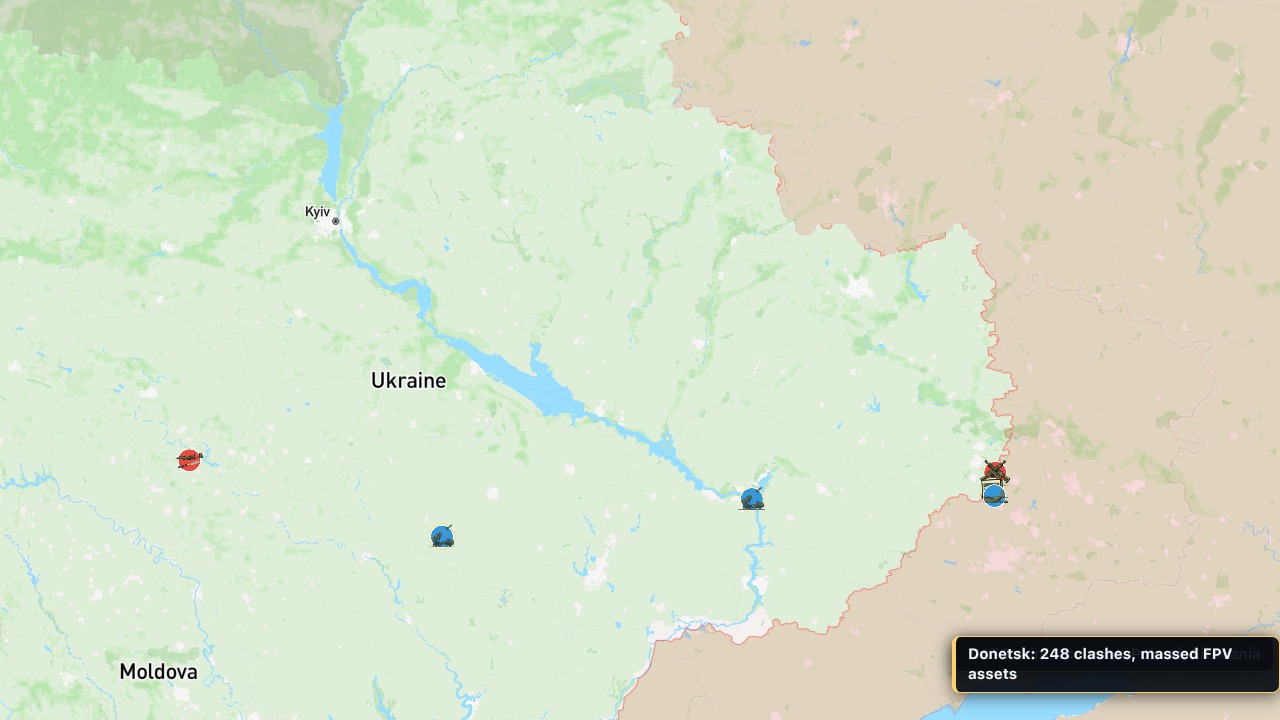
Front-line combat showed modest territorial shifts with no major breakthroughs. Ukrainian forces regained approximately 6 km² in the Zapadne sector, while Russian forces advanced roughly 7 km² in the Minkivka sector, with no settlement centers changing hands in either area. Dozens of Ukrainian FPV drones were documented positioned near the Donetsk front line, suggesting massed drone asset preparation for potential operations. The Kremlin rejected Ukraine's ceasefire proposal as pointless, insisting underlying conflict issues must be addressed for sustainable peace. This hardened stance contrasts with Turkish and French diplomatic overtures supporting Ukraine's sovereignty and territorial integrity, outlined during UN General Assembly discussions.
NATO reinforcement in Eastern Europe accelerated amid regional security concerns. Lithuania announced arrival of a new US troop rotation and passed parliamentary amendments permitting nuclear weapons deployment on national territory. Polish media reported the US planned to permanently station 15,000 troops across multiple bases in Poland, representing significant NATO posture strengthening. Lithuania fortified critical electrical substations (Harmony Link and Gizai) with anti-ram fencing, tunnel sensors, and drone defenses following intelligence warnings of Russian false-flag threats. Ukraine participated in the STRONG GRIFFIN 2026 NATO exercise in Lithuania with approximately 2,500 troops and 500+ vehicles from eight nations, integrating Ukrainian combat experience into NATO operations. Belarus reportedly launched a hybrid attack on Lithuania using balloons toward Vilnius airport to test NATO air defense responses.
- Ukrainian armed forces conducted a drone strike on the Kuibyshev Oil Refinery (KNPZ) in Samara, Russia on 21–2
- Dozens of Ukrainian FPV drones documented waiting near front line in Donetsk, filmed by Russian drone operator
- Lithuanian President Nausėda announced arrival of new U.S. troop rotation to Lithuania. He expressed gratitude
- Lithuania is designing and fortifying the Harmony Link electrical substation near Kaliningrad to withstand dro
- Ukrainian President Zelensky arrived in New York for the UN General Assembly and held talks with US President
- Ukrainian President Zelensky met French President Macron at Macron's residence in New York during UN General A
What to watch
Monitor Russian-US diplomatic engagement at UN Assembly; assess whether Trump-Pezeshkian talks materialize and any negotiation parameters. Track Iranian response to escalatory rhetoric and US military positioning in Gulf region. Observe whether Kremlin diplomatic signals on grain corridors translate to Black Sea agreements. Watch for escalation in Ukrainian deep strikes on Russian infrastructure and any corresponding Russian retaliation on Ukrainian energy systems or civilian targets. Monitor NATO base access negotiations and Polish-US deployment implementation timelines. Assess Houthi operational tempo in Red Sea given pipeline restoration and Saudi resumed exports. Track Lithuanian infrastructure hardening progress and any Russian hybrid operations targeting Baltic critical infrastructure.