Russia sustains 122-target air assault on Ukraine; Syria's Shara pursues regional normalization
Key developments
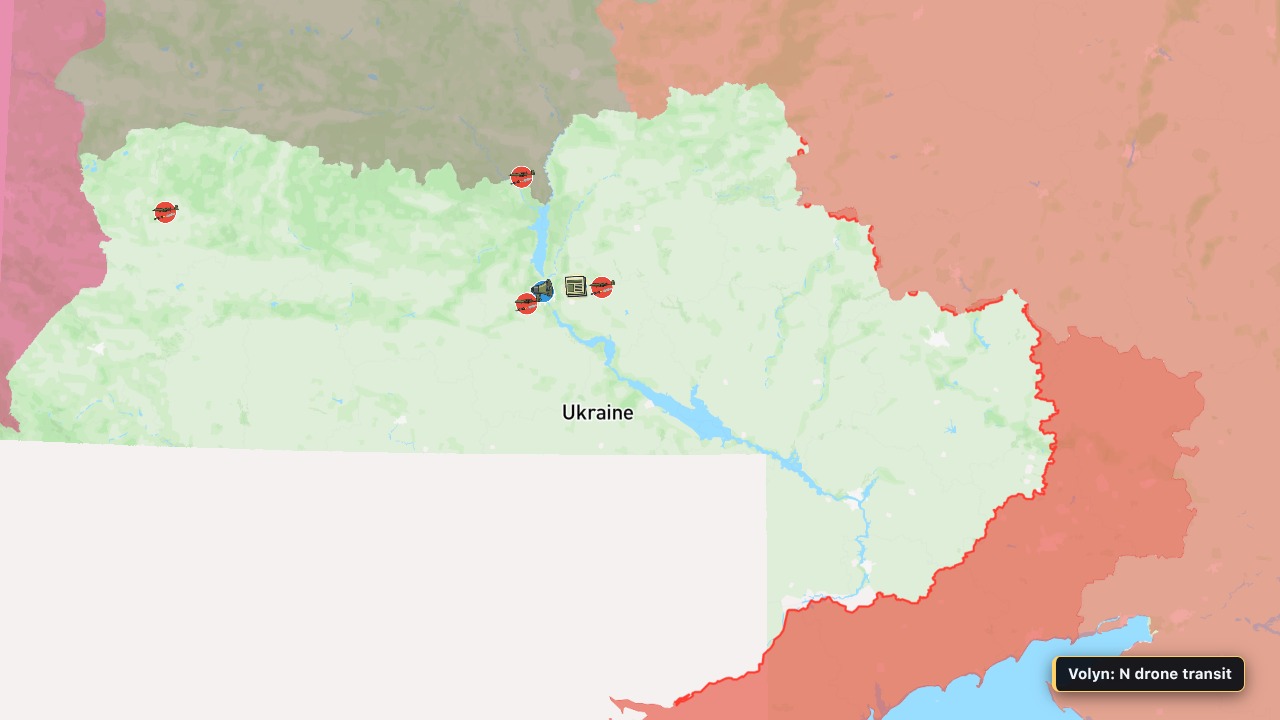
- Russia launched 161 drones at Ukraine overnight; Ukrainian air defense destroyed or suppressed 122 targets, maintaining approximately 76% intercept rate.
- Israeli forces expanded West Bank control by ~27 km², continuing territorial consolidation in occupied territories.
- Syrian President Shara engaged UN diplomatic engagement on refugee returns (3.8 million) and Turkish military base normalization discussions.
- Iranian President Pezeshkian condemned Israeli Gaza operations at UN, displaying civilian casualty documentation and exceeding 35,000 death claims.
- Russian forces advanced 2 km near Kalinove with reported encirclement risk; multiple Shahed drones tracked across central and northern Ukrainian oblasts.
- President Zelensky assessed China-Russia technology cooperation as strategic and transactional rather than ideologically driven.
Middle East 7 tracked events
Israel expanded territorial control in the West Bank by approximately 27 square kilometers on September 23, continuing incremental consolidation of occupied territory. Concurrently, Syrian President Ahmad al-Shara engaged in diplomatic outreach at the UN General Assembly, participating in a dialogue session with the Atlantic Council focused on Syria's post-conflict trajectory and regional relationships. UN Deputy Secretary-General Tom Fletcher commended Shara's administration, noting the voluntary return of 3.8 million Syrian refugees and emphasizing mine clearance initiatives. These developments reflect Syria's emerging diplomatic normalization under new leadership, distinct from prior regional isolation.
Iranian President Masoud Pezeshkian used the UN platform to condemn Israeli military operations in Gaza, displaying photographic documentation of civilian casualties and asserting that death tolls have exceeded 35,000. His address framed Iran's international posture in contrast to what he characterized as alternative approaches, signaling continued Iranian opposition to Israeli operations. The statement reflects Tehran's sustained rhetorical positioning on the Israel-Palestine conflict, maintaining public criticism while engaging within multilateral forums. Iranian messaging emphasizes civilian impact narratives as a centerpiece of diplomatic communication.
Syrian President Shara addressed historical and contemporary bilateral concerns at the UN, explicitly denying any connection to the September 11, 2001 attacks and expressing sympathy for American victims. He further reported that Turkish military presence in northwestern Syria has been reduced, with ongoing discussions to clarify the legal status of Turkish bases. These statements indicate Syria's effort to reset international perceptions and manage Turkish military positioning—a critical factor in Syrian sovereignty and regional balance. The normalization trajectory suggests Damascus is pursuing graduated rehabilitation within international structures.
- Israel forces expanded control (~27 km²) in the West Bank area per updated conflict control map.
- Syrian President Ahmad al-Shara participated in dialogue session with Atlantic Council at UN in New York discu
- UN Deputy Secretary-General Tom Fletcher praised Syrian President Ahmad al-Shara at UN General Assembly, notin
- Iranian President Pezeshkian addresses UN General Assembly, condemning Israeli strikes in Gaza and civilian ca
- Iranian President Pezeshkian addresses UN General Assembly, displays photos of women and children killed by Is
- Syrian President Ahmed Shara denies any connection to the September 11, 2001 attacks, stating he was 13 years
Ukraine 11 tracked events
Russian drone operations against Ukraine intensified on September 23, with overnight strikes deploying 161 total unmanned aerial vehicles from staging areas in Orel, Kursk, and Crimea. Ukrainian air defenses reportedly destroyed or suppressed 122 targets, comprising 119 Shahed/Geran-type drones and 3 cruise missiles, with 18 impacts recorded across central Ukraine. The successful intercept rate of approximately 76 percent reflects sustained Ukrainian air defense effectiveness, though the scale of Russian drone production continues to sustain attrition-based assault campaigns. Individual drone transits were detected across multiple oblasts including Odesa, Volyn, Kirovohrad, Kyiv, Poltava, and Dnipropetrovsk, indicating dispersed targeting patterns.
Russian ground operations near Kalinove in Kupiansk District registered a 2-kilometer advance, with reports suggesting potential encirclement development in the sector. This tactical progress represents continued Russian pressure along the northeastern front, where incremental gains have characterized recent operations. The advance occurs within broader Russian strategy of grinding attrition aimed at degrading Ukrainian defensive positions and exploiting logistical vulnerabilities. The Kupiansk sector remains one of the more kinetically active zones along the current contact line.
President Volodymyr Zelensky characterized Sino-Russian technology cooperation as transactional rather than ideological, asserting that China pragmatically shares military-relevant technology with Russia for mutual strategic benefit. This assessment reflects Ukrainian analysis of Beijing's calculated neutrality posture, distinguishing between formal non-alignment and material support through dual-use technology transfer. Zelensky's framing suggests Ukrainian understanding that Chinese cooperation represents strategic opportunism rather than ideological alignment, with implications for sanctions effectiveness and third-party supply chain dependencies.
- Ukrainian air defense destroyed/suppressed 122 enemy targets (119 Shahed/Geran drones, 3 cruise missiles) duri
- One Russian Shahed-136 reactive (jet-motorized) kamikaze drone detected in transit over Ovidiopol, Odesa Oblas
- President Zelensky claims China pragmatically shares technology with Russia for mutual strategic benefit, not
- One Russian Shahed-136 reactive (jet-motorized) kamikaze drone detected in transit from Stepan toward Kolky in
- One Russian Shahed-136 reactive (jet-motorized) kamikaze drone detected in transit over Kirovohrad District, K
- Russian forces advance 2 km near Kalinove in Kupiansk District. Possible encirclement developing.
What to watch
Monitor continuation of Russian drone surge patterns over next 24-48 hours; assess whether Ukrainian air defense sustainability persists under sustained attrition pressure. Observe Syrian-Turkish negotiations regarding legal status of military bases—outcomes will indicate Turkish willingness to reduce regional military footprint. Track Kupiansk sector for escalation or stabilization following reported Russian advances. Monitor UN engagement outcomes for Syrian diplomatic rehabilitation and international confidence restoration. Assess whether Iranian UN statements trigger diplomatic responses or escalation signaling from Western or Israeli representatives.