UN diplomacy fractures as Netanyahu addresses Assembly; Ukraine sustains intense drone/missile pressure
Key developments
- Netanyahu's UN address triggered mass diplomatic walkouts; Iran boycotted the speech entirely in protest, displaying Soleimani portrait.
- Ukraine reported intercepting/suppressing 227 Russian targets overnight including missiles and 219+ drones; 185–277 daily combat clashes across frontlines.
- China urged U.S.-Iran nuclear negotiations; Syrian leader signaled openness to talks with Trump and Zelensky while reasserting Golan Heights claim.
- U.S. intelligence warned European NATO members of potential Russian UAV operations from Mediterranean vessels and escalated threat assessments.
- Ukrainian intelligence assessed Russia preparing new northern frontline and massive eastern offensives; trilateral diplomacy reportedly scheduled in New York.
- France deployed troops and air defense to Saudi Arabia's Yanbu oil terminal following reported Houthi strike on critical energy infrastructure.
- Israel's sixth submarine arrived as deterrent messaging; Netanyahu defended genocide accusations and claimed destruction of Iranian nuclear facilities.
Middle East 30 tracked events
Israeli PM Netanyahu addressed the UN General Assembly on 24 September, declaring that Iran's regime will fall and asserting Israel's right to self-defense against regional threats. His speech triggered mass diplomatic walkouts by multiple delegations, with Netanyahu subsequently condemning departing representatives as 'immoral cowards.' The Iranian delegation boycotted his address entirely, displaying a portrait of assassinated commander Qassem Soleimani at their seats in symbolic protest. Netanyahu defended Israel against genocide allegations, stating 'Israel did not commit genocide—Israel prevented genocide,' and claimed to have destroyed Iranian nuclear facilities to prevent mutual destruction. He also arrived in New York despite an outstanding ICC arrest warrant, transiting through Greek, Italian, and French airspace.
Territorial disputes dominated bilateral exchanges at the UN. Netanyahu addressed Syrian leader Ahmad al-Sharaa, asserting Jewish historical presence in the Golan Heights since biblical times—a claim reasserting Israeli sovereignty over contested territory. Syrian President al-Sharaa simultaneously reaffirmed Damascus's claim to the Golan Heights at the assembly. Al-Sharaa characterized recent talks with President Trump and Arab leaders as 'acceptable' and separate discussions with President Zelensky as 'good,' signaling openness to broader diplomatic engagement. Meanwhile, Netanyahu accused Qatar and foreign states of spending billions to spread disinformation about Israel, referencing Qatar's hosting of Hamas leadership. Palestinian President Abbas called for international protection, end of occupation, and a two-state solution under international law.
Diplomatic engagement persisted alongside rhetorical escalation. Chinese President Xi Jinping urged U.S. President Trump to facilitate U.S.-Iran negotiations and revive nuclear accord frameworks to resolve regional conflict. Iranian Foreign Minister Abbas Araghchi held bilateral talks with UK Foreign Secretary Ed Miliband on the UN sidelines, continuing diplomatic channels. Israeli Defense Minister Yoav Katz announced the arrival of Israel's sixth submarine, INS Drakon, characterizing it as strategic messaging toward Iran and regional adversaries. France reportedly deployed troops, radars, and air defense systems to Saudi Arabia's Yanbu oil terminal following reported Houthi attack, protecting infrastructure previously exporting over 5 million barrels daily. Meanwhile, Syria's Civil Aviation Authority completed calibration of modern air navigation systems at Damascus and Aleppo airports, signaling infrastructure normalization under new governance.
- Netanyahu addresses UN General Assembly, declaring Iran's regime will fall and the Iranian people will overcom
- Netanyahu condemned walkout delegations at UN General Assembly as 'immoral cowards,' following mass diplomatic
- Netanyahu accuses Qatar and other foreign countries of spending billions to spread lies about Israel. Referenc
- Iranian delegation absent from Netanyahu's UNGA speech; portrait of Qassem Soleimani displayed at their seats
- Netanyahu addresses Syrian leadership (al-Sharaa), claiming Jewish historical presence in the Golan Heights si
- Iranian Foreign Minister Abbas Araghchi held bilateral talks with UK Foreign Secretary Ed Miliband on the marg
Ukraine 30 tracked events
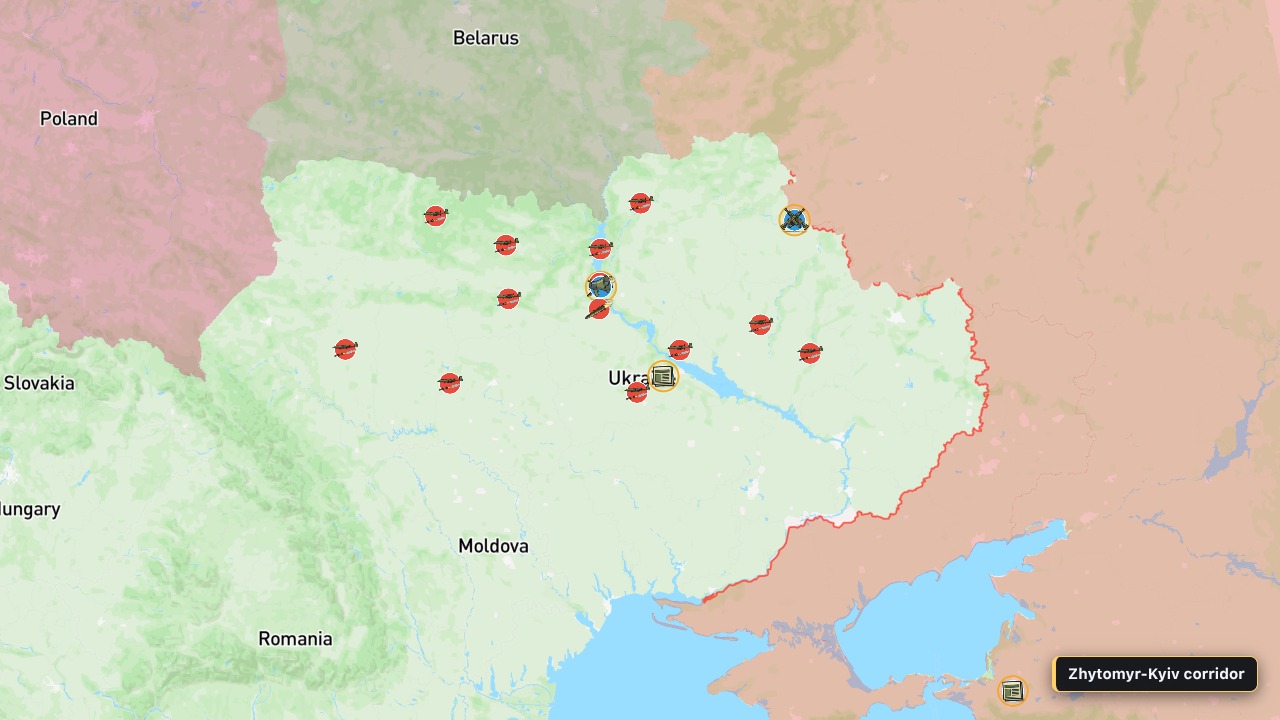
Ukraine sustained intensive Russian air and drone operations on 24 September, with air defense systems intercepting or suppressing 227 reported targets overnight including four Zircon anti-ship missiles, three ballistic systems, and 219 Shahed/Gerbera drones and similar platforms. Reported daily operational summaries indicated 185–277 combat clashes across all frontlines, with Russian forces executing 83 airstrikes, conducting 287 guided bomb drops, and deploying between 4,118 and 7,467 kamikaze drones. Russian drone strikes damaged multiple Kyiv data centers, reportedly knocking out internet service to approximately 100,000 households across multiple ISPs. Ukrainian forces reported destroying Russian supply infrastructure including fuel and lubricants storage depots in Zaporizhzhia Oblast, radar stations, and UAV preparation facilities near Donetsk. Multiple reactive Shahed-variant UAVs were tracked transiting across central Ukrainian oblasts including Cherkasy, Vinnytsia, Zhytomyr, and Ternopil, indicating sustained Russian drone operations across dispersed targets.
Intelligence assessments indicated potential Russian operational shifts and expanded threats. Ukrainian intelligence reportedly assessed Russia is preparing to open a new northern frontline and restart massive offensives in eastern Ukraine. U.S. intelligence warned European governments—Spain, France, Italy, Lithuania—of potential Russian UAV operations, including use of Gerbera drones launched from Mediterranean merchant vessels, signaling intelligence concern about Russian escalation targeting NATO members. CIA Director William Ratcliffe reportedly briefed European allies on these threats. Danish Defence Intelligence Service warned that Russia may conduct attacks on one or more neighboring NATO countries. NATO Secretary General Mark Rutte countered by reiterating that full-scale Russian invasion of NATO territory remains low probability and asserting NATO's military superiority, though acknowledging Putin's anticipated victory celebration has not materialized.
Diplomatic initiatives emerged amid sustained combat pressure. Ukrainian President Zelensky disclosed Trump administration proposals for restarting Russia-Ukraine diplomacy, including energy infrastructure ceasefires, Black Sea grain corridor reopening, and trilateral U.S.-Russia-Ukraine talks. A trilateral diplomatic meeting was reportedly scheduled in New York involving Ukrainian delegation members (Budanov, Umerov), Russian representative Dmitriev, and U.S. officials (Kushner, Witkoff, reportedly Rubio). Ukrainian Ministry of Defense appointed Colonel Artem Martienko as Deputy Commander-in-Chief, citing his IT expertise and role in developing the DELTA combat intelligence system. French President Macron warned that Russia views Europe as Ukraine's strategic depth and is targeting European infrastructure in retaliation for EU support, documenting years of Russian information warfare campaigns.
- NATO Secretary General Mark Rutte reiterates that full-scale Russian invasion of NATO territory is low probabi
- Ukrainian air defense intercepted/suppressed 227 Russian targets on night of 23-24 September: 4 Zircon anti-sh
- Macron warns that Russia views Europe as Ukraine's strategic depth and is targeting European infrastructure in
- Daily operational summary: 185 combat clashes across all fronts. Russia conducted 1 missile strike, 43 airstri
- Airborne assault forces (DSV) report systematic destruction of Russian occupying forces: personnel concentrati
- U.S. intelligence warns European governments (Spain, France, Italy) that Russia may be preparing UAV operation
What to watch
Monitor trilateral diplomatic talks in New York involving Ukraine, Russia, and U.S. officials for ceasefire framework developments. Track Russian drone operations targeting NATO members and Mediterranean vessel activity. Assess whether Israeli-Syrian rhetoric on Golan Heights escalates or if diplomatic engagement via Trump administration channels moderates positions. Watch for effectiveness of French air defense deployment in Saudi Arabia and potential Houthi response. Monitor Ukrainian intelligence warnings of northern frontline preparation for operational tempo changes. Track damage assessments from Kyiv data center strikes and potential impacts on Ukrainian command-and-control systems.