Ukraine secures €1.35bn German aid as frontlines shift; Yemen conflict spreads
Key developments
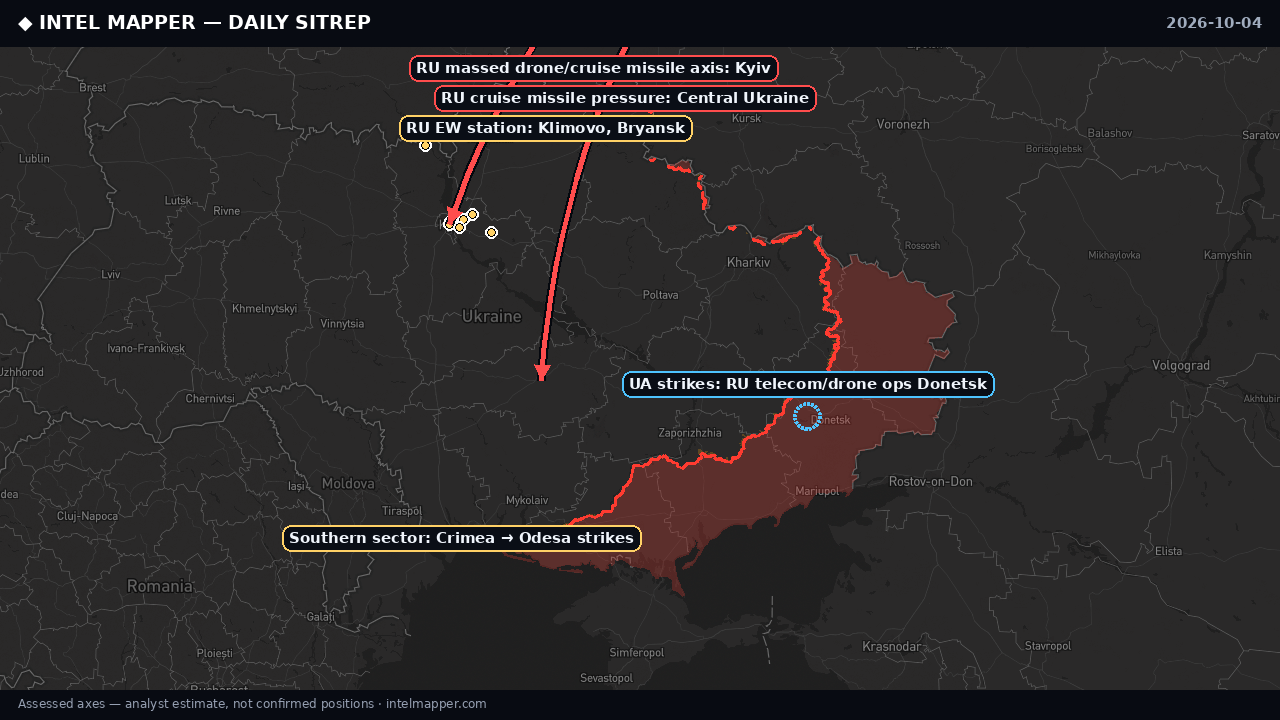
- Ukraine executed massed overnight drone strikes against Russian airfields and military installations across multiple targets (Maykop, Gvardeyskoe, Primorsk-Akht) in 3-4 October operation.
- Germany announced €1.35 billion Ukraine aid package (€1bn military, €350mn energy) during Chancellor Merz's Kyiv visit, signaling sustained Western support.
- Russian forces advanced ~6 km² in Udachne sector with no settlement changes; Shahed-136 drones reported over Kyiv residential areas.
- Yemen: PLC government forces gained ~9 km² (Al Bayda', Lahij) while Houthis expanded ~92 km² in Ta'izz Governorate on 4 October.
- U.S. Defense Secretary asserted American control of Strait of Hormuz and warned Iran against disruption via alleged blockade.
- Territorial changes in Yemen reflect localized force dynamics; Houthi gains in Ta'izz demonstrate sustained operational capacity despite attrition.
Middle East 4 tracked events
Yemen's civil conflict showed mixed territorial dynamics on 4 October, with government forces (Presidential Leadership Council) gaining modest ground in Al Bayda' and Lahij governorates—approximately 4 km² and 5 km² respectively—according to updated conflict control mapping. These gains represent continued PLC efforts to consolidate control in central and southern Yemen. Concurrently, Houthi (Ansar Allah) forces expanded significantly in Ta'izz Governorate, capturing approximately 92 km² in a single operational period. The disparity in territorial change reflects Houthi operational momentum in their stronghold region, though both sides remain locked in protracted competition for control of Yemen's fragmented territory.
U.S. Defense Secretary Pete Hegseth issued a declaratory statement on 4 October asserting American control of the Strait of Hormuz and warning Iran against disrupting maritime passage through the strategic waterway. Hegseth claimed the U.S. blockade has prevented Iranian transit, framing this as an assertion of American strategic dominance in the Persian Gulf. The statement reflects continued U.S. commitment to regional freedom-of-navigation messaging, though the characterization of a functional blockade against Iran warrants scrutiny given ongoing international shipping patterns through the waterway. The declaration underscores persistent U.S.-Iran tensions over sea-lane control.
The Yemen conflict remains characterized by fragmented control, humanitarian strain, and competing external interests. Territorial oscillations in Al Bayda', Lahij, and Ta'izz reflect localized force dynamics rather than strategic breakthrough by either belligerent. The Houthi's gains in Ta'izz suggest sustained operational capacity despite years of Saudi-led coalition pressure, while PLC advances indicate government forces retain some initiative in peripheral areas. Long-term resolution remains distant absent political settlement, and maritime security declarations alone do not address underlying governance deficits driving the conflict.
- Yemen Government (PLC) forces expanded control (~4 km²) in the Al Bayda' Governorate area per updated conflict
- Yemen Government (PLC) forces expanded control (~5 km²) in the Lahij Governorate area per updated conflict con
- Houthi (Ansar Allah) forces expanded control (~92 km²) in the Ta'izz Governorate area per updated conflict con
- U.S. Defense Secretary Pete Hegseth declares U.S. control of the Strait of Hormuz and warns Iran against disru
Ukraine 6 tracked events
Ukraine conducted an extensive massed drone strike operation spanning the night of 3-4 October, targeting multiple Russian airfields and military installations including Maykop, Gvardeyskoe, and Primorsk-Akht over a nine-hour window (21:00 to 04:00). The multi-target scope indicates Ukrainian capability to execute coordinated, deep-strike operations against Russian rear-area infrastructure despite Russian air defense and electronic warfare systems. Such operations, if successfully executed against strategic targets, disrupt Russian force projection and logistics. The operation represents escalation in Ukrainian willingness to target Russian territory far from the contact line, consistent with established patterns of attrition-focused Ukrainian strategy.
German Chancellor Friedrich Merz announced a €1.35 billion support package for Ukraine on 4 October during a Kyiv visit, comprising €1 billion in military assistance and €350 million in energy sector support. The package signals continued Western commitment to Ukrainian defense capability and critical infrastructure resilience heading into winter 2026-27. Germany's announcement represents the largest bilateral German commitment in the conflict to date and reflects Berlin's shift toward sustained Ukrainian support. The energy component addresses Ukraine's vulnerability to Russian winter strikes against power generation and distribution, a recurring Russian targeting pattern.
Russian forces advanced approximately 6 km² in the Udachne sector per front-line tracking sources, though no settlement centers changed hands, indicating incremental positional gains within ongoing attrition warfare. Concurrently, Ukrainian air monitoring reported multiple Russian Shahed-136 jet-powered drones transiting over populated areas of Kyiv—Bucha/Irpin, Pivnichnyi Bridge, and Troieshchyna district—with northwestward trajectories noted. Drone transits over Kyiv indicate continued Russian strikes against civilian infrastructure or military targets within the capital. The combined picture shows Russia maintaining offensive momentum on southern fronts while sustaining aerial operations against Ukrainian cities, though the rate of territorial change remains measured.
- Ukraine conducted a massed drone strike operation across multiple Russian airfields and military installations
- German Chancellor Friedrich Merz visits Kyiv to announce €1 billion military aid package and €350 million ener
- Russian reactive (jet-powered) Shahed-136 drone detected transiting over Bucha/Irpin area, Kyiv Oblast. Air mo
- Russian forces advanced (~6 km²) in the Udachne sector per DeepState frontline update. No settlement center ch
- Ukrainian air monitoring reports Russian reactive/jet-powered drone (Shahed-136 variant) detected transiting o
- One Russian Shahed-136 reactive drone detected transiting from Pohrebi over Troieshchyna District, Kyiv, headi
What to watch
Monitor Ukrainian drone strike damage assessments on Russian airfields over next 24 hours; assess Russian retaliatory strike intensity against Kyiv. Track German military aid implementation timeline and whether additional NATO pledges follow Merz's announcement. In Yemen, watch for PLC counteroffensives in Ta'izz to reclaim Houthi-gained territory, or consolidation of government gains in central governorates. Observe Russian front-line pressure in Udachne and Donbas sectors for potential escalation. Monitor Strait of Hormuz for any Iranian response to Hegseth's declaration.