Hormuz stays shut as Witkoff meets Putin; Russian drone and missile activity continues over Ukraine
Key developments
- Iran's Supreme National Security Council says Hormuz stays closed until six demands are met.
- Witkoff met Putin in St. Petersburg, and Russia released US citizen Stephen Hubbard.
- The FT reported Trump blocked a planned Israeli strike on Iran for October 10.
- Turkey will reportedly send air defense and electronic warfare technical staff to Saudi Arabia.
- Russian Geran-3 and Banderol missiles were tracked across multiple Ukrainian oblasts.
- US intelligence reportedly links Putin to expanded sabotage against NATO following the Leipzig attack.
- Iraq closed its Al Sheeb crossing with Iran, drawing a formal Tehran protest.
Middle East 30 tracked events
Iran's Supreme National Security Council said the Strait of Hormuz will stay closed until six demands are met, including an end to military operations, lifting of the blockade and removal of sanctions. Foreign Minister Abbas Araghchi said Iran had delivered its plan to Washington and wants US acceptance of its conditions. Separately, the Financial Times reported that Netanyahu planned a multi-day strike on Iranian nuclear, power and infrastructure sites for October 10, and that Trump reportedly blocked it over concerns about the midterm elections. A tanker off the Omani coast, about 11 nautical miles west of Bukha, was struck by fire from an unidentified source; UKMTO said the resulting blaze was extinguished. Iraq closed its Al Sheeb crossing with Iran for a security review, and Tehran protested the lack of notice. Each item points to a region where maritime, border and diplomatic measures are being used as leverage alongside military posture.
In Yemen, Houthi forces claimed a ballistic missile attack on El-Reyyan Airport in Mukalla, Hadramawt, and reportedly targeted Taiz city, with no casualty or damage figures released. A blast in Aden was attributed by the Houthis to an attack on a military camp, but its origin and damage remain unconfirmed. Saudi-led coalition air defenses downed a drone over the Eastern Province. In Syria, Israeli forces shelled the area east of Tal Ahmar in Quneitra with two artillery shells, according to local sources. Armed groups blocked Suwayda governorate employees at the Umm al-Zeitoun checkpoint, and two military engineers were injured, one seriously, by a legacy landmine near Ain Issa. Hama military police arrested six former-regime figures accused of abuses against civilians. Displaced residents at Al-Tuwaina camp blocked a sixth return convoy over omitted names. In Gaza, the IDF and Shin Bet said Hamas operative Musa Hamuda was killed in a Gaza City strike.
The day's pattern combines kinetic activity at the periphery, including Houthi launches, Israeli shelling in southern Syria and maritime incidents, with a diplomatic track centered on Iran's leverage over Hormuz. Erdogan publicly backed Syria's post-Assad order and the completion of SDF integration, and Turkey reported a live-fire test of Akinci-launched loitering munitions. Reports that Turkey will deploy technical staff for air defense and electronic warfare to Saudi Arabia under the Mecca Pact, and expand drone production centers to all 81 provinces, indicate a sustained rise in Turkish defense commitments. Macron said France is not party to the Iran war but opposes Iranian nuclear activity and criticized Israeli occupation of southern Lebanon. Iranian officials, including MP Ebrahim Azizi, signaled expectations of continued US hostility. A hacking claim by the Iran-linked group Handala against an IDF engineering unit remains single-sourced and unverified. Taken together, the day's reporting shows deterrence signaling and regional alignment hardening, without a clear shift toward wider open conflict.
- Turkey's first personnel sent to Saudi Arabia under the Mecca Pact will be technical staff helping with air de
- Macron says Israeli military occupation of southern Lebanon and pressure on Lebanon undermine its sovereignty,
- Erdogan congratulates Syrian and Turkish intelligence for capturing the suspect behind the Baniyas and Reyhanl
- FT reports Netanyahu planned a multi-day attack on Iran's nuclear, power and infrastructure sites for Oct 10;
- Houthi forces targeted Taiz city in Yemen; weapon type, casualties and impact were not specified.
- Houthi forces announced they targeted El-Reyyan Airport in Yemen with three ballistic missiles.
Ukraine 30 tracked events
Diplomacy dominated the Ukraine theatre. Russia released US citizen Stephen Hubbard, 74, after a visit by Trump envoy Steve Witkoff; Hubbard had been jailed for more than four years on disputed charges of fighting for Ukraine. Witkoff was received by Vladimir Putin at the Constantine Palace in St. Petersburg, where talks covered Ukraine and the Iran crisis. Putin said he would raise a possible Putin-Trump-Xi meeting in China and that Russia has further ideas to share. He also claimed that oil and world market prices fell 5 to 6 percent after both sides announced an agreement linked to the Iran crisis. The Kremlin said Putin would review every Witkoff proposal, while spokesman Dmitry Peskov said the energy-ceasefire position is unchanged, that Russia wants peace rather than a truce, and that the conflict cannot be resolved without Kyiv. Zelensky said Russia is not winning on the battlefield and welcomed the US-proposed ceasefire as a diplomatic path, while rejecting pressure to cede land.
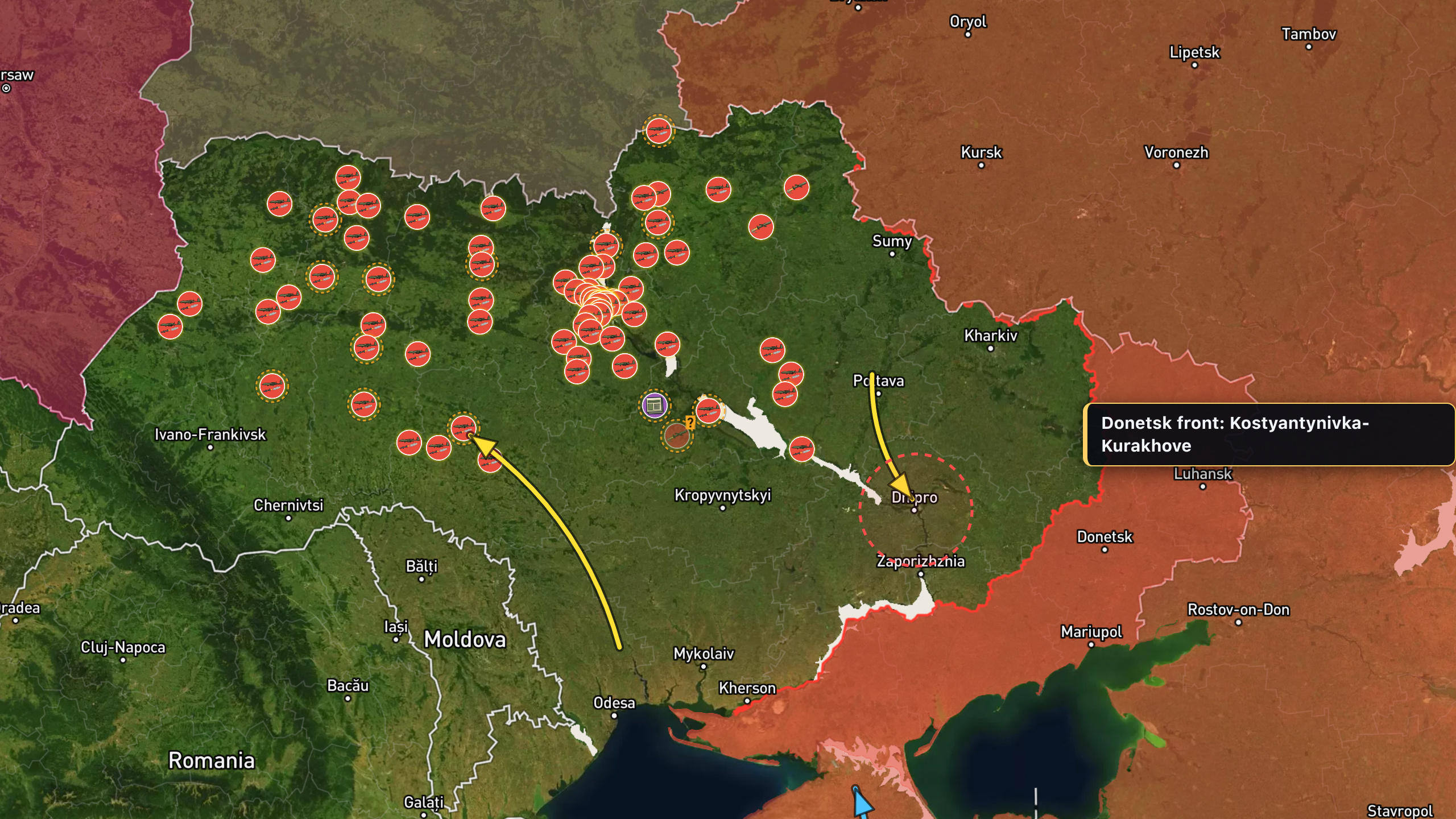
Ukrainian air monitoring recorded a steady flow of Russian aerial attacks overnight. Several jet-powered Geran-3 Shahed drones were tracked toward Vinnytsia, Kyiv, Khmelnytskyi, Zhytomyr and Chernihiv oblasts, as well as Solone and Raukhivka. Banderol mini cruise missiles were tracked from Kharkiv and northern Dnipropetrovsk toward Poltava and Dnipro, with shelter warnings issued for Poltava. A Banderol was also tracked passing Kharkiv heading south, and a Shahed-type drone passed eastern Kharkiv and eastern Dnipropetrovsk oblasts. On the Ukrainian side, the General Staff reported strikes overnight on October 20 to 21 on a Russian material-technical supply depot near Yani-Kapu in occupied Crimea, reportedly disrupting unit supply, and on a Russian unit command post near Kurakhove in Donetsk Oblast, reportedly disrupting troop control. Individual unit-level claims remain difficult to verify independently.
The day's pattern shows Moscow pursuing a parallel track of negotiations and sustained long-range strikes, while Kyiv continues deep strikes in occupied areas. A US intelligence assessment, reported by two sources, says Putin ordered escalated sabotage across NATO after a failed explosive-drone attack on Leipzig-Halle airport in August, now reportedly expanding to military suppliers and communications. The Bundeswehr reportedly raised its threat level to second-highest, assessing an imminent sabotage attack on German bases or Ukrainian-linked production facilities. Finland plans to buy one million domestically produced anti-personnel landmines, earmarking about 100 million euros, with domestic production targeted by 2028. AfD leader Alice Weidel called Ukrainian deep strikes on Russian refineries and Moscow-area buildings a dangerous provocation and urged pressure on Zelensky to end the war. These developments suggest European governments are treating hybrid threats and defensive procurement as near-term priorities, even as US-led talks continue.
- Russia released US citizen Stephen Hubbard, 74, after a visit by Trump envoy Steve Witkoff. Hubbard had been j
- Putin tells envoy Witkoff that Russia values its trust-based relationship with Iran and that Trump attaches im
- Putin received US envoy Steve Witkoff at the Constantine Palace in St. Petersburg; talks are underway on Ukrai
- Finland plans to buy one million anti-personnel landmines from domestic manufacturers, earmarking about €100 m
- Zelensky says Russia is not winning on the battlefield, rejects pressure to leave occupied-threatened land, an
- Kremlin says Putin will review and assess every proposal presented by U.S. envoy Steve Witkoff, amid Ukraine-w
What to watch
Over the next 24 to 48 hours, attention should focus on whether Iran's Hormuz position changes after Araghchi's plan was delivered to Washington, and whether any US response is publicly reported. Reports of a planned Israeli strike on Iranian nuclear and infrastructure sites, reportedly blocked by Trump, merit monitoring for signs of revived planning, though the source is a single investigative report. In Ukraine, observers should track whether the proposed ceasefire framework advances after the Witkoff visit, and whether the Kremlin's stated openness to a Putin-Trump-Xi meeting produces a concrete date. Continued Russian Shahed and Banderol launches in the Dnipro and Poltava corridors would indicate sustained strike tempo. Finally, German threat-level changes and any confirmed sabotage incidents near NATO defense sites would bear on European security posture.