Houthi strikes hit Saudi infrastructure; Ukraine air defense repels 187 drones amid escalating attacks
Key developments
- Houthis executed coordinated ballistic missile strikes against Yanbu petrochemical refinery and Abha International Airport in Saudi Arabia, prompting flight halt to Jeddah.
- U.S. naval forces issued fire warning to Chinese-flagged vessel in Strait of Hormuz with three-minute evacuation notice prior to reported engagement.
- Ukrainian air defense intercepted or suppressed 187 enemy drones in night attack involving 200 total aircraft, achieving defensive success despite seven impacts.
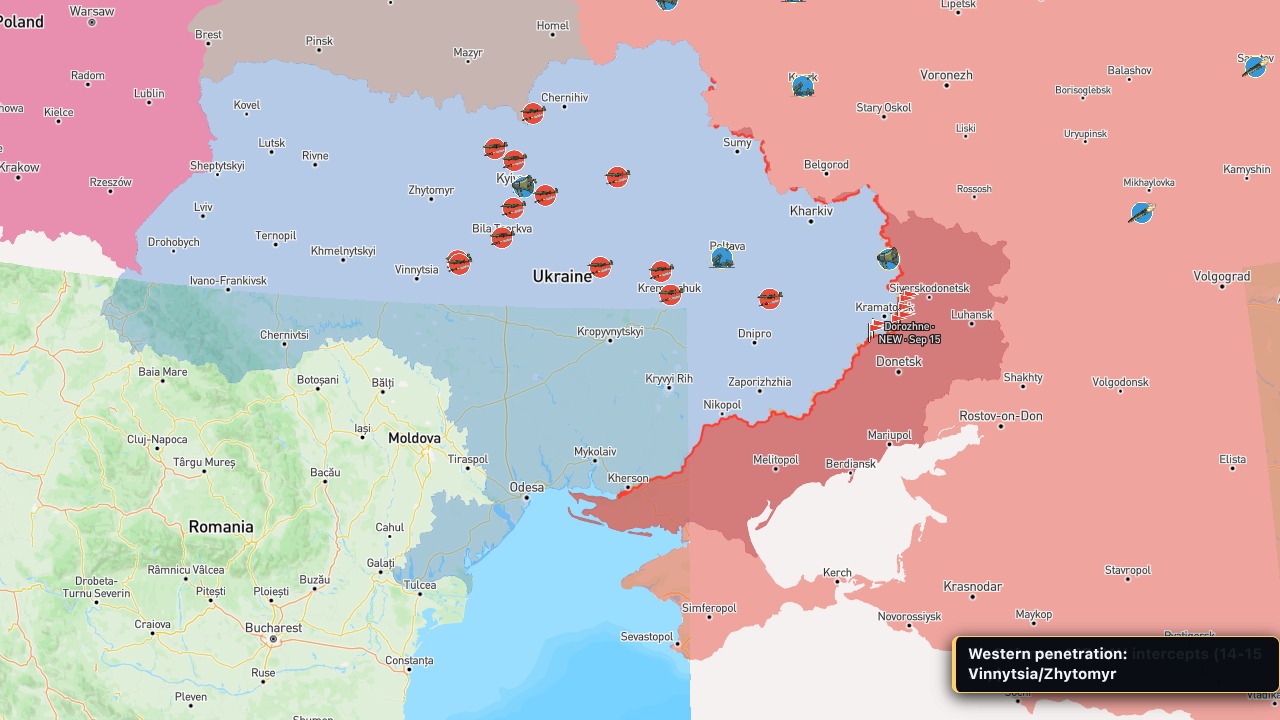
- Russian reactive Shahed-variant drones transited across multiple Ukrainian oblasts September 15, with tactical aircraft positioned for precision strikes on Odesa and Mykolaiv regions.
- Russian UMPC-5 guided munitions detected targeting Chornomorsk port; sustained multi-vector precision campaign continues against Ukrainian infrastructure.
- German Chancellor Merz warned of decisive weeks ahead for European security, emphasizing consequences of Russian success in Ukraine conflict.
Middle East 3 tracked events
Houthi forces conducted a coordinated dual-target ballistic missile attack against Saudi Arabia on September 15, striking the Yanbu petrochemical refinery and Abha International Airport. The attack on critical energy infrastructure and civilian aviation facilities represents a continuation of Houthi campaign patterns targeting Saudi economic and transportation nodes. Saudi authorities responded by implementing precautionary flight halts to Jeddah pending threat assessment, indicating elevated concern over continued air assault capability despite sustained regional air defense operations.
In the Strait of Hormuz, U.S. naval forces issued a warning to a Chinese-flagged vessel prior to engagement with a nearby oil tanker, reportedly providing a three-minute evacuation window before threatened use of force against the vessel's stern. The incident underscores persistent maritime security friction in one of the world's most critical chokepoints, where overlapping regional tensions and international naval presence create escalation risks. The specific circumstances and outcome of this engagement remain partially unclear from available reporting.
The September 15 cycle of Middle East events reflects sustained pressure on Saudi infrastructure and regional shipping routes. Houthi operational tempo remains consistent with previous months, while maritime incidents in the Persian Gulf continue to generate US-China interaction points with unpredictable escalation potential. Energy market implications from refinery strikes and aviation disruptions warrant close monitoring given broader global petroleum supply sensitivities.
- U.S. naval forces issued warning to Chinese-flagged vessel in Strait of Hormuz before engaging nearby oil tank
- Houthis launched ballistic missile strikes targeting Yanbu petrochemical refinery and Abha International Airpo
- Saudi authorities halted all flights to Jeddah due to a potential threat warning.
Ukraine 11 tracked events
Ukrainian air defense forces intercepted or suppressed 187 enemy drones during the night of September 14-15 in a large-scale Russian unmanned attack involving approximately 200 aircraft launched from multiple points. The engagement resulted in seven confirmed impacts and three debris-related incidents, indicating Ukrainian defensive capacity absorption of the assault, though not without localized effects. The attack employed mixed drone types including Shahed variants and decoy-type unmanned systems, consistent with Russian tactics of saturating defenses through volume and diversity.
Subsequent tracking on September 15 identified multiple Russian reactive (jet-powered) Shahed-variant drone transits across Ukrainian airspace targeting multiple oblasts including Kyiv, Odesa, Dnipropetrovsk, Poltava, and Cherkasy. Concurrently, Russian tactical aviation assets positioned at Saky Air Base in Crimea prepared for probable strikes employing guided air-to-surface missiles and guided bombs against Odesa and Mykolaiv Oblast targets. Russian UMPC-5 guided aerial munitions were detected in flight vectors toward Chornomorsk port infrastructure, indicating sustained multi-vector precision strike campaigns.
The September 15 operational picture demonstrates Russian persistence in high-frequency drone and precision-guided munitions campaigns targeting Ukrainian civilian infrastructure, military logistics, and port facilities. Ukrainian air defense continues absorbing significant attack volumes while maintaining operational continuity, though cumulative attrition effects on air defense systems and personnel remain an underlying concern. German Chancellor Merz's statement characterizing the conflict as entering decisive weeks emphasizes European perception of escalating stakes and potential consequences of conflict outcomes.
- Ukrainian air defense intercepted/suppressed 187 enemy drones (Shahed, Gerbera, decoy-type) on night of Septem
- One Russian reactive (jet-powered) Shahed-variant drone detected transiting toward Podil District, Kyiv. Ukrai
- Three Russian reactive (jet-powered) Shahed-variant drones detected transiting past Kagarlyk toward Vasylkiv,
- Three Russian reactive (jet-powered) Shahed-variant drones detected transiting past Cherkasy, Cherkasy Oblast.
- Two Russian Shahed-variant (jet-powered) drones detected transiting from Ruzhin toward Pohrebysche area, Vinny
- Russian UMPC-5 guided aerial munitions detected in flight vector toward Chornomorsk port area, Odesa Oblast. I
What to watch
Monitor Saudi air defense response to continued Houthi strike capability and potential energy market impact from refinery operations disruption. Track U.S.-China maritime interaction dynamics in Hormuz with attention to escalation triggers. In Ukraine, observe Russian air campaign intensity over next 48 hours given concurrent drone and manned aircraft activity; assess Ukrainian air defense attrition rates and sustainability. Watch German and broader European diplomatic positioning regarding Ukraine conflict trajectory given Merz's emphasis on decisive period.