Russia sustains deep strikes on Ukraine; Saudi Arabia reports critical air-defense shortfall amid Yemen escalation
Key developments
- Saudi Arabia disclosed critically low air-defense interceptor stocks due to Houthi attacks, requesting emergency resupply from multiple nations.
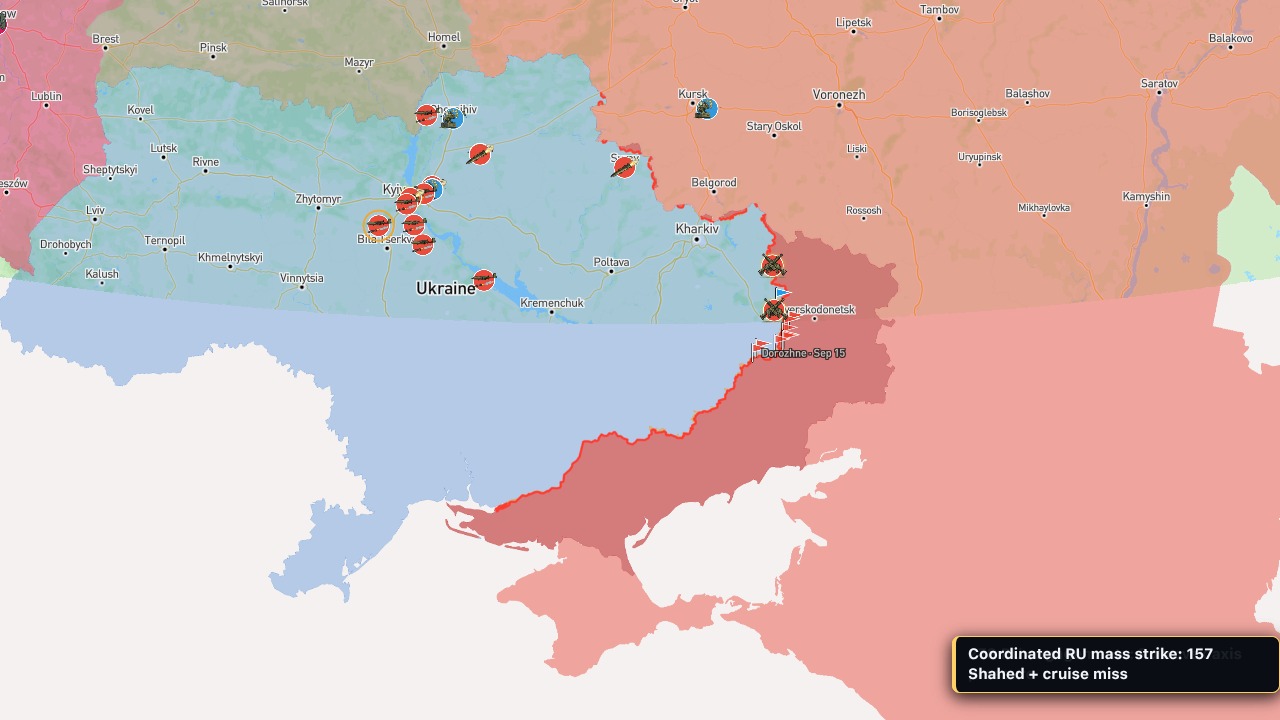
- Russia launched coordinated attack on Ukraine with hypersonic missiles, ballistic systems, and 7,106 kamikaze drones across multiple regions.
- Ukrainian forces struck Rostov-on-Don air base with 23 confirmed Oreshnik missile impacts and targeted Yaroslavl oil refinery causing industrial fire.
- Over 122,000 people displaced in Yemen as Saudi Arabia intensified airstrikes against Houthi-controlled Al-Mokha port in Bab al-Mandab Strait.
- Military officials from nine Middle Eastern and Western nations reportedly met in Germany to discuss Iran conflict and regional developments.
- Russian strikes on Odesa residential building and Zaporizhzhia industrial facility caused civilian casualties including a child.
- Ukrainian air defense engaged sustained Shahed kamikaze drone operations transiting from Bryansk toward Kyiv and Kyiv Oblast regions.
Middle East 4 tracked events
Saudi Arabia reported critically depleted air-defense interceptor stocks on September 17, attributing the shortage to sustained Houthi attacks and requesting immediate resupply from France, Britain, Pakistan, and Egypt. The announcement reflects cumulative pressure from Yemen-based drone and missile operations against the kingdom's critical infrastructure. This disclosure, typically sensitive for strategic reasons, underscores the operational tempo and effectiveness of Houthi capabilities. The request for multinational support indicates Saudi Arabia's assessment that current inventories cannot sustain both defensive operations and strategic deterrence posture simultaneously.
Saudi Arabian air forces conducted large-scale strikes against Al-Mokha port in Taiz Governorate, recently captured by Houthi forces, targeting a position controlling the Bab al-Mandab Strait. The operation reflects efforts to contest Houthi territorial gains and disrupt logistics through a chokepoint controlling approximately 12 percent of global maritime trade. The campaign's intensity aligns with Saudi Arabia's broader objective to prevent Houthi consolidation of strategic maritime infrastructure. Sustained operations against the port suggest ongoing assessment of Houthi capability to threaten commercial shipping and regional maritime security.
Over 122,000 people were displaced due to intensified conflict in Yemen, expanding the existing humanitarian crisis driven by multi-sided fighting. Concurrently, military officials from nine Middle Eastern and Western nations reportedly held a secret meeting in Germany to discuss potential Iran conflict and regional developments, per Axios. The diplomatic engagement indicates broader regional concerns about escalation dynamics, though specific outcomes remain unclear. The meeting underscores ongoing strategic coordination among regional actors regarding long-term stability trajectories and potential contingency planning.
Saudi Arabia's reported critical air-defense interceptor shortage represents a significant tactical vulnerability with strategic implications for regional deterrence. The simultaneous intensification of operations in Yemen's Bab al-Mandab region and disclosed ammunition shortages suggest Saudi Arabia is managing competing operational demands under constrained resources. Whether current shortfall impacts Saudi Arabia's ability to sustain both offensive and defensive operations warrants continued assessment.
- Military officials from nine Middle Eastern and Western nations held a secret meeting in Germany to discuss po
- Saudi Arabia reports critically low air-defense interceptor stocks due to sustained Houthi attacks. Requested
- Over 122,000 people displaced due to intensified conflict in Yemen. Humanitarian crisis driven by ongoing figh
- Saudi Arabian Air Force conducting large-scale airstrike campaign against Al-Mokha port in Taiz, recently capt
Ukraine 10 tracked events
Russia conducted a coordinated massive missile and drone attack on Ukraine during the night of September 16-17, deploying hypersonic Kinzhal missiles and Iskander ballistic systems against Kyiv, alongside KN-23 variants targeting Zaporizhzhia. The operation involved an estimated 7,106 kamikaze drone sorties according to Ukrainian general staff reporting, representing sustained high-tempo offensive operations. Russian forces conducted 278 combat engagements on Day 1667 of the invasion with 106 airstrikes and 2,366 artillery strikes. Ukrainian air defense systems engaged incoming threats, with reported interceptions of Shahed-variant kamikaze drones transiting toward Kyiv and Kyiv Oblast, though impact casualties were reported in Odesa and Zaporizhzhia.
Ukrainian forces struck Rostov-on-Don air base with Oreshnik ballistic missiles, reporting at least 23 confirmed impacts on facilities housing the 30th Separate Mixed Transport Aviation Regiment according to dual-sourced reporting. Additionally, Ukrainian operations targeted the Yaroslavl oil refinery, reportedly one of Russia's largest facilities with 15 million tonnes annual capacity, causing industrial fires. These strikes demonstrate Ukrainian capability to conduct deep-penetration strikes against Russian rear-area infrastructure and military assets. The targeting pattern suggests efforts to degrade Russian aviation sortie generation capacity and fuel production supporting military operations.
Russian strikes on civilian infrastructure continued, with reported impacts on a 19-storey residential building in Odesa injuring three persons including a child, and strikes on Zaporizhzhia injuring three additional civilians. The pattern of strikes on mixed civilian-industrial targets indicates either targeting of dual-use infrastructure or indiscriminate employment of standoff weapons against populated areas. Sustained high-tempo operations by both sides—averaging 278 daily engagements for Russia with 7,106 drone sorties—indicate no near-term reduction in operational intensity despite apparent resource constraints on both sides.
- Russia launched coordinated massive missile and drone attack on Ukraine during night of Sept 16-17. 2× Kinzhal
- Ukrainian forces struck Rostov-on-Don air base with Oreshnik ballistic missiles. At least 23 confirmed impacts
- Ukrainian drone or airstrike targeted Yaroslavl oil refinery, one of Russia's largest facilities (15M tonnes/y
- Russian airstrikes struck Zaporizhzhia, injuring three people. Missile strike caused fire at an industrial fac
- Russian missile strike hit a 19-storey residential building in Odesa, injuring 3 people including a child. Par
- Russian forces conducted 278 combat engagements across Ukraine on Day 1667 of the invasion. 106 airstrikes, 7,
What to watch
Monitor whether Saudi Arabia receives rapid air-defense resupply and assesses ability to sustain dual offensive-defensive operations in Yemen. Track Russian and Ukrainian deep-strike operations for indicators of weapons system depletion or logistics stress. Observe outcomes of reported nine-nation diplomatic engagement in Germany for potential policy shifts regarding Iran contingency planning. Watch Bab al-Mandab maritime security dynamics as Houthi control of Al-Mokha potentially threatens commercial shipping transits. Monitor civilian casualty trends in both theatres for potential escalation signaling or tactical shifts.