Israel advances in Lebanon; Russia sustains massive drone campaign as North Korean forces engage in Kursk
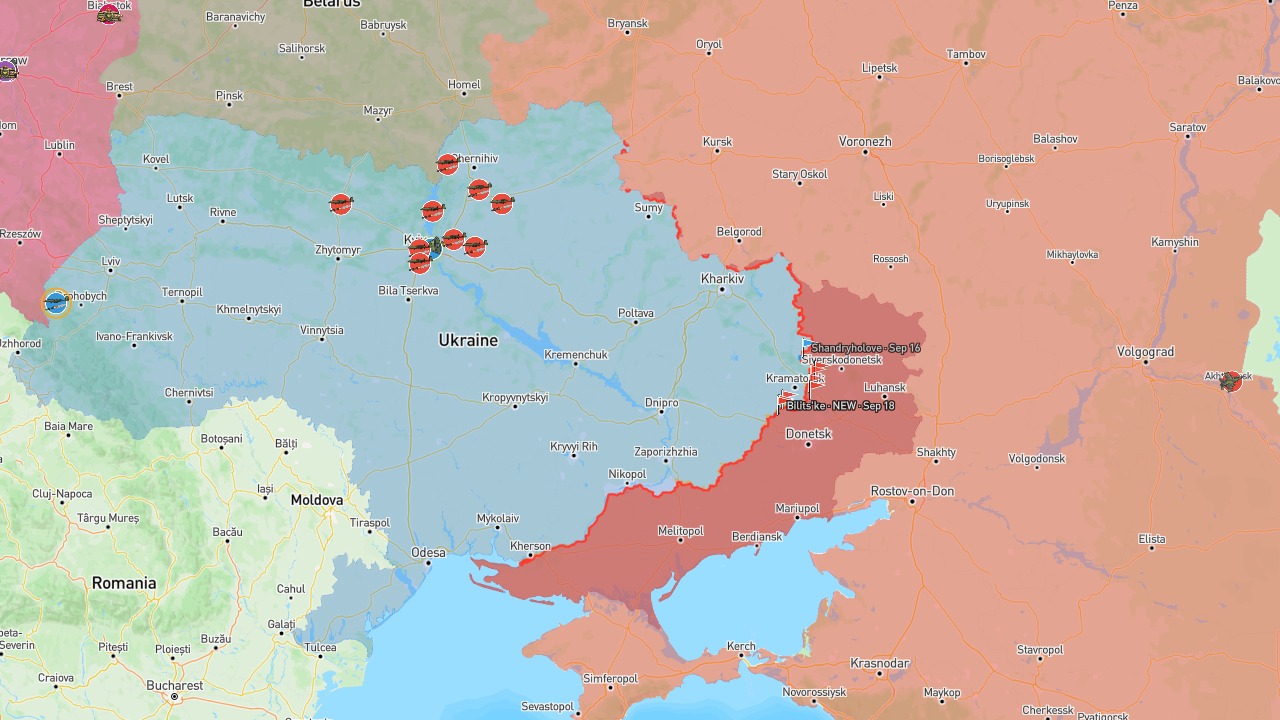
Key developments
- Israeli forces expanded control in Nabatîyé area (8 km²) while Hezbollah gained 17 km² in Liban-Sud, indicating continued territorial competition in southern Lebanon.
- Russian forces executed 230+ combat engagements on 17 September with 9,614 kamikaze drone sorties, sustaining attrition-based offensive operations across Ukraine.
- Ukrainian air defenses achieved 77% interception rate (72 of 93 drones) overnight, though 13 impacts registered across multiple fronts.
- North Korean combat personnel confirmed actively fighting alongside Russian forces in Kursk region, marked with red insignia for force identification.
- Ukrainian anti-logistics operations continued with drone strikes on Russian motor transport and ballistic missiles striking Rostov-on-Don area.
- Trump administration rhetoric characterized Iran as worst country while expressing confidence in undefined path to U.S. victory, maintaining maximum pressure posture.
- Russia sustained massive kinetic tempo (95 airstrikes, 295 guided munitions, 2,770 artillery strikes) indicating continued prioritization of attritional warfare strategy.
Middle East 3 tracked events
Israeli forces expanded territorial control by approximately 8 square kilometers in the Nabatîyé area of southern Lebanon on 18 September, continuing incremental advances in the ongoing Israel-Hezbollah conflict. Concurrently, Hezbollah forces registered a larger territorial gain of roughly 17 square kilometers in Liban-Sud, indicating contested and fluid frontlines characteristic of the broader regional escalation that has intensified since early 2024. The pattern of reciprocal territorial adjustments reflects the grinding nature of current operations, with neither side achieving decisive breakthrough but both maintaining offensive pressure across southern Lebanese territory.
U.S. President Donald Trump characterized Iran as the world's worst country during remarks on 18 September, reiterating hardline positioning toward the Islamic Republic while expressing confidence in ultimate U.S. strategic success. Trump's statement left ambiguous whether this success would materialize through negotiated settlement or unspecified alternative means, reflecting continued uncertainty regarding U.S. policy posture toward Iran amid broader Middle Eastern tensions. Such rhetoric typically signals maintenance of maximum pressure strategies, though the absence of specificity regarding implementation pathways suggests potential policy deliberation within the U.S. administration.
The Israel-Lebanon theater remains characterized by sustained but limited territorial competition, localized air operations, and no clear trajectory toward either military resolution or ceasefire negotiations. Regional dynamics continue to be mediated by broader U.S. strategic posture, with Trump administration statements potentially signaling either escalatory intent or negotiating leverage. The scale and intensity of current operations, while elevated compared to pre-2024 baselines, remain below thresholds suggesting imminent major strategic shifts in the Middle East theater.
- Israel forces expanded control (~8 km²) in the Nabatîyé area per updated conflict control map.
- Hezbollah forces expanded control (~17 km²) in the Liban-Sud area per updated conflict control map.
- U.S. President Donald Trump states Iran is perceived as the world's worst country and expresses confidence in
Ukraine 7 tracked events
Russian forces sustained intensive offensive operations across Ukraine on 17 September, executing 230 combat engagements, 95 airstrikes with 295 guided munitions, 9,614 kamikaze drone sorties, and 2,770 artillery strikes including 44 multiple-launch rocket system (MLRS) fires. The scale of drone employment reflects continued Russian reliance on attrition-based tactics utilizing expendable unmanned systems, while guided munitions indicate sustained precision strike capability. Overnight air defense engagement on 17-18 September saw Ukrainian forces report defeating or suppressing 72 of 93 inbound attack drones (Shahed, Geran variants, decoys, and Banderol/Dan-T systems), though 13 impacts were registered across multiple fronts, indicating partial penetration of Ukrainian air defenses despite high interception rates.
Confirmed photographic evidence documented North Korean combat personnel actively engaged alongside Russian forces in the Kursk region, marked with red insignia for force identification. This represents the most explicit confirmation to date of Democratic People's Republic of Korea (DPRK) military personnel involvement in the Ukraine theater, suggesting operational integration of foreign forces into Russian command structures. The deployment scale and tactical role remain unclear from available reporting, though the presence of DPRK soldiers indicates potential expansion of Russian manpower resources at a time of sustained combat attrition.
Ukrainian forces maintained offensive anti-logistics operations, with reported drone strikes targeting Russian motor transport and documented imagery of strikes in Horlivka, Donetsk Oblast. Ballistic missile strikes attributed to Ukraine were reported in Rostov-on-Don's northern district, suggesting continued Ukrainian strikes on Russian rear-area targets. The pattern indicates sustained Ukrainian offensive capability despite Russian dominance in strike volume and drone deployment, with both sides operating across traditional frontline boundaries and conducting deep rear-area targeting.
- Ukrainian air defense shot down/suppressed 72 of 93 Russian attack drones overnight (Shahed, Geran, decoys, Ba
- Russian forces conducted 230 combat engagements across Ukraine on 17 September. Russia fired 95 airstrikes (29
- North Korean soldiers pictured actively fighting for Russian forces in Kursk region. Reports confirm DPRK comb
- Ukrainian drone targets Russian truck driver in footage released on social media, demonstrating continued Ukra
- Oreshnik ballistic missile strike reported in Rostov-on-Don's northern district, with smoke plume visible from
- Two UMPB-5 (Shahed-variant reactive-engine) drones tracked in transit toward Mayaky, Odesa Oblast. Continuatio
What to watch
Monitor 18-19 September for: (1) continuation of Israeli-Hezbollah territorial competition patterns and any escalation or ceasefire signals; (2) Russian drone sortie rates and ability to sustain 9,000+ daily kamikaze drone operations amid production constraints; (3) scale and integration of DPRK forces into Russian operations and any indicators of expanded deployment; (4) Ukrainian air defense sustainability metrics given persistent Russian strike volume; (5) any statements from U.S. administration regarding Iran policy specifics or Middle East escalation; (6) Russian rear-area losses and Ukrainian strike capability maintenance. Potential indicators of threshold shifts include major territorial breakthroughs on any front, air defense saturation events, or explicit policy announcements regarding negotiation pathways.