Houthis strike Saudi airports; Iran signals NPT reconsideration amid regional tensions
Key developments
- Houthi forces struck Riyadh airport and Saudi Aramco facilities with ballistic missiles and drones, continuing months-long campaign against Saudi infrastructure.
- Iran's Security Council Secretary warned that U.S. and Israeli actions could force Tehran to reconsider Nuclear Non-Proliferation Treaty commitments, signaling potential escalation.
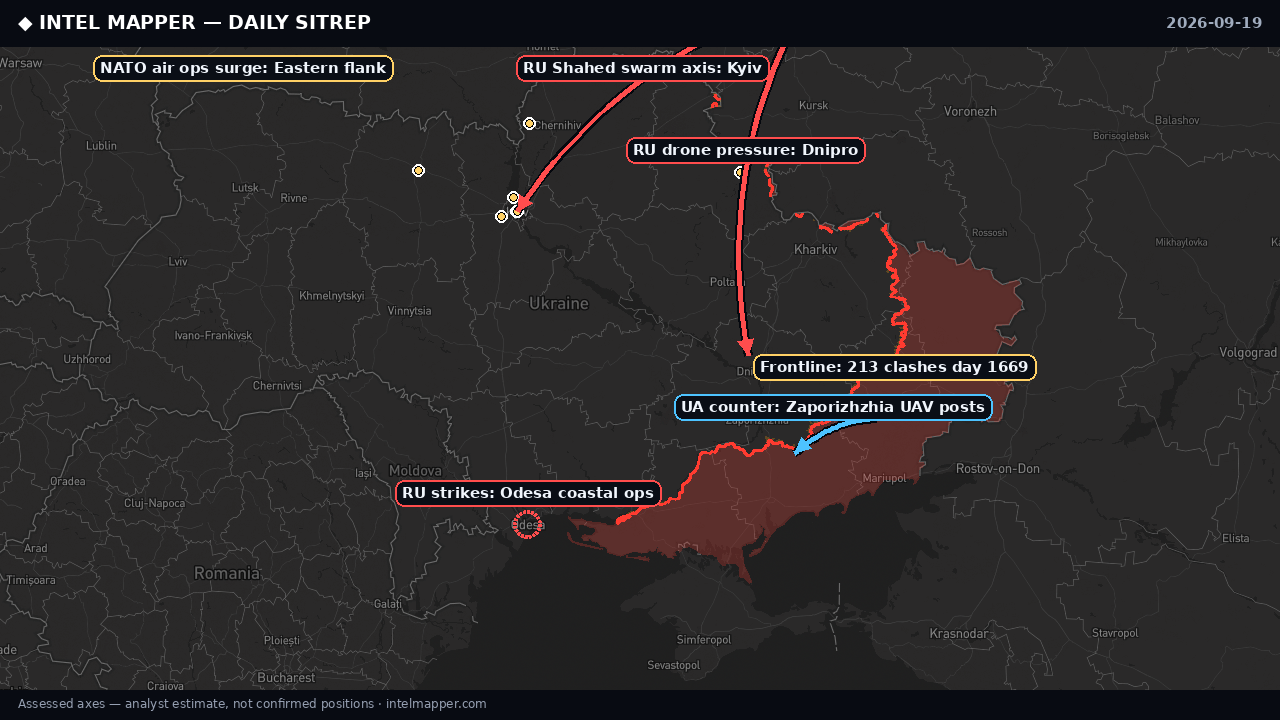
- Russia launched hypersonic Zircon cruise missiles and multiple Shahed drones at Ukrainian targets; Ukraine shot down several threats and approved expanded long-range strike operations.
- U.S. approved $2.6 billion military aid package for Ukraine focused on air defense as NATO conducts surge reconnaissance along eastern borders.
- Turkey announced near-completion of Mecca Alliance military infrastructure and offered maritime security proposals to both Ukraine and Russia.
- Russia expanding underground Shahed drone manufacturing capacity at Alabuga economic zone, indicating preparation for sustained aerial campaign.
- Polish-Ukrainian anti-ballistic coalition framework established; British PM warns Putin may declare victory while retaining conquered Ukrainian territory.
Middle East 30 tracked events
Houthi forces continued sustained strikes against Saudi Arabian infrastructure on 19 September, targeting Aramco facilities at Riyadh airport and King Fahd International Airport fuel storage via ballistic missiles and unmanned systems. Multiple sources confirm direct impacts on airport infrastructure. These attacks represent an ongoing pattern of Houthi escalation against Saudi civilian and economic targets, part of a broader campaign that has persisted for approximately a decade. The strikes demonstrate the group's capability to conduct coordinated multi-platform operations against defended facilities.
Iranian leadership signaled potential strategic shifts in response to U.S. and Israeli actions. Security Council Secretary Mohsen Rezaei warned that continued pressure could force Iran to reconsider its position on the Nuclear Non-Proliferation Treaty, though he emphasized no final decision has been made. Separately, Iran announced a recent ship-to-ship missile test near a U.S. aircraft carrier in the Gulf of Oman and reported ballistic missile strikes on Al-Jahrah Air Base in Kuwait. These moves reflect Tehran's escalatory messaging while Iran simultaneously channels ceasefire mediation efforts through Qatar and Pakistan, suggesting diplomatic hedging alongside military posturing.
Turkey expanded institutional frameworks for regional coordination, with Foreign Minister Hakan Fidan announcing near-completion of secretariat and military headquarters establishment under the Mecca Alliance. Fidan reiterated Turkish support for Saudi Arabia against Houthi attacks and issued direct diplomatic warnings to Israel regarding international isolation and regional instability resulting from current policies. Meanwhile, Syria's new authorities arrested a retired Republican Guard commander, indicating ongoing security consolidation. These developments reflect shifting alignments and institutional building among regional actors with competing interests.
- Houthi forces struck an Aramco facility at Riyadh airport in continuation of large-scale attack on Saudi Arabi
- Turkish Foreign Minister Hakan Fidan announces that secretariat establishment and military headquarters creati
- Turkish Foreign Minister Hakan Fidan urges Israel to adopt foreign policy based on peace, respect, and coopera
- Iran's Security Council Secretary Mohsen Rezaei warns that continued U.S. and Israeli actions could force Tehr
- Israeli PM Netanyahu makes rhetorical statement referencing deaths of Hezbollah leader Nasrallah, Hamas leader
- Iran executed an individual convicted of espionage and transmitting Israeli intelligence related to missile ba
Ukraine 30 tracked events
Russian drone and missile operations against Ukraine sustained intensity on 19 September, with multiple jet-powered Shahed-class kamikaze drones detected transiting toward targets across Kyiv, Dnipropetrovsk, Zhytomyr, Sumy, Poltava, and Odesa oblasts. Ukrainian air defense successfully intercepted several threats, including two Geran-5 variants shot down by the SBU. Russia launched hypersonic Zircon cruise missiles at Kyiv, while ballistic missile strikes targeted Zaporizhzhia Oblast. A drone strike on Fastiv killed three civilians. This pattern reflects Russia's continued reliance on distributed drone and missile attacks against Ukrainian population centers and infrastructure.
Ukraine announced operational and procurement responses to sustained Russian strikes. Defence Minister Yevhen Khmara approved expanded long-range operations and confirmed development of indigenous interceptor drones to counter Shahed variants. The U.S. State Department approved a $2.6 billion military aid package emphasizing air defense equipment. Turkey offered maritime security proposals to both Ukraine and Russia addressing port activity targeting. Polish PM Donald Tusk and President Zelensky established an anti-ballistic coalition framework to enhance air defense cooperation. These measures indicate NATO and allied efforts to increase Ukrainian defensive capabilities amid persistent Russian aerial campaigns.
NATO reconnaissance activity surged along the eastern border, with AWACS E-3A and RC-135W Rivet Joint aircraft conducting intensive surveillance operations over Kaliningrad, Poland, Lithuania, and Latvia over a four-day period. British PM Boris Johnson warned that Putin might fabricate historical claims to justify territorial retention and declare victory while exiting the conflict. Lithuanian leadership highlighted NATO vulnerability to potential Russian missile escalation. Russia simultaneously expands drone production capacity, with approximately 42,000 square meters of underground manufacturing facilities under construction at Alabuga special economic zone for Geran-type kamikaze drones, indicating preparations for sustained long-duration operations.
- Boris Johnson warns that Putin could fabricate historical claims to justify territorial control, declare victo
- U.S. State Department approved $2.6 billion military aid package for Ukraine including air defense equipment.
- Russian drone attack on Fastiv district killed three civilians—mother and two children. Private houses damaged
- President Zelensky emphasizes Russia as Ukraine's common enemy and calls for European unity, particularly with
- Turkish Foreign Minister Hakan Fidan announces Turkey has sent a maritime security proposal to both Ukraine an
- Russia launched 4x 3M22 'Zircon' cruise missiles at Kyiv in an ongoing attack. Zircon is a hypersonic anti-shi
What to watch
Monitor for Houthi response capability following sustained Saudi strikes; assess whether Iran formalizes NPT reconsideration or uses statement as negotiating pressure through mediation channels. Watch Ukrainian air defense effectiveness against planned Russian drone waves and whether new interceptor drone deployment achieves operationally significant impact. Track Russian drone production timeline at Alabuga and potential effects on strike frequency. Observe Turkish Mecca Alliance military headquarters activation and operational deployment timelines. Monitor for escalation or de-escalation signals from Iranian leadership regarding nuclear position within next 48 hours.