Syria ammunition depot explosions amid Ukraine drone barrage; Iran claims MQ-1 shootdown
Key developments
- Multiple explosions at Syrian military ammunition depots in Aleppo and Daraa governorates on September 21; cause officially attributed to accident, responsible party unclear.
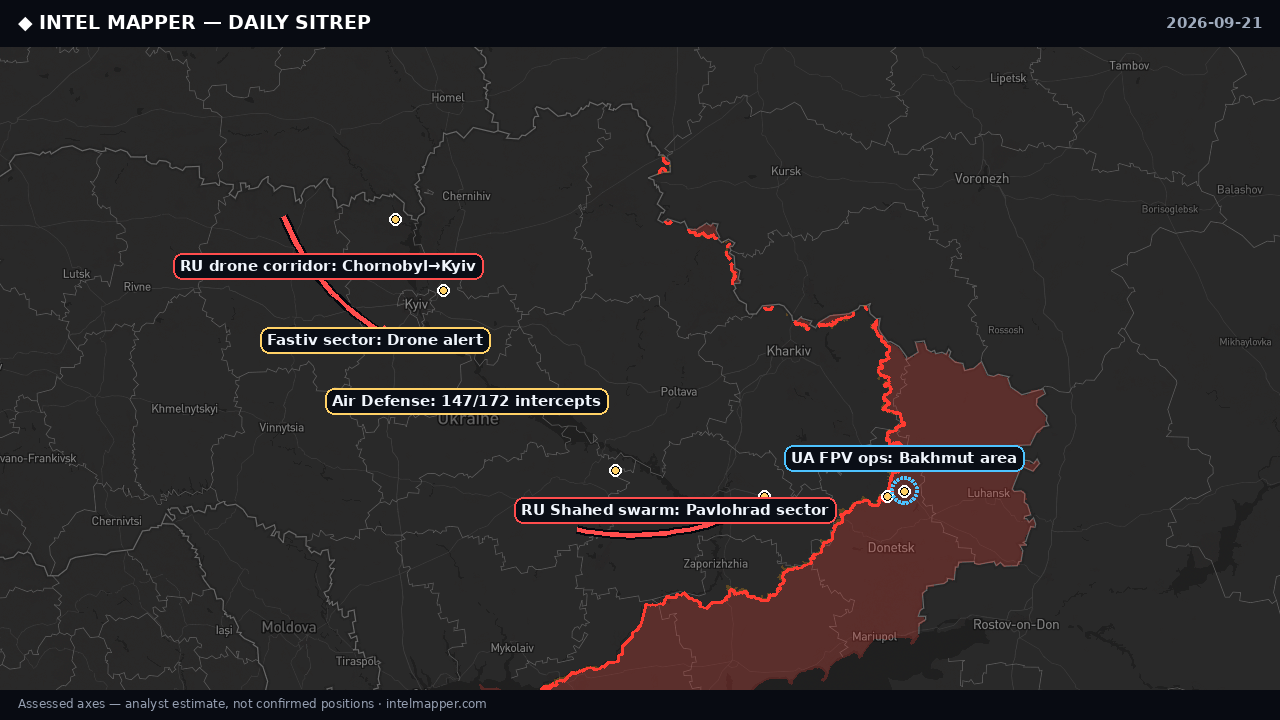
- Ukraine intercepted 147 of 172 Russian attack drones on September 20–21, sustaining 85.5% interception rate despite continued intensive kamikaze drone operations.
- Iranian IRGC claims shootdown of U.S. MQ-1 Predator drone over Hormozgan Province; claim unconfirmed by Western sources.
- Ukrainian General Staff reports 238 frontline engagements and 1,660 Russian personnel losses on day 1,671 of conflict.
- Unidentified object sighted over Tehran airspace; identity and origin pending investigation.
- Saudi-backed Yemeni forces conducted drone strikes against Houthi positions; operational details unconfirmed.
- Multiple Shahed-type kamikaze drone transits detected across central and eastern Ukraine with continuous air alert status.
Middle East 8 tracked events
Syria experienced a significant incident on September 21 centered on an ammunition depot in the Al-Eis area of southern Aleppo Countryside. Multiple explosions were reported throughout the day, with Syrian Civil Defense confirming teams remained mobilized due to ongoing detonations at a military weapons facility. The Damascus government attributed the initial blast to an accident, though the cause remains officially under investigation. At least one civilian sustained shrapnel injuries, with two others experiencing temporary respiratory distress and another injured in a traffic accident while evacuating the area. The Aleppo-Damascus highway was temporarily closed as emergency response continued.
A secondary explosion was reported in Al-Harak town in eastern Daraa Countryside on the same day, though details remain sparse and the origin and responsible party are unconfirmed. The clustering of major detonations in Syrian military facilities within a 24-hour window raises questions about either widespread infrastructure vulnerabilities, coordination of incidents, or possible external targeting, though no party has claimed responsibility for either incident. Syrian authorities' characterization of the primary blast as accidental suggests either genuine malfunction or a deliberate messaging position.
Separately, Iran's Islamic Revolutionary Guard Corps claimed it shot down a U.S. MQ-1 Predator drone over Hormozgan Province on September 21. The claim remains unconfirmed by Western sources, and neither the U.S. operational context nor confirmation of the incident has been independently verified. Additionally, an unidentified object was reportedly sighted over Tehran airspace, with identity and origin unclear pending investigation. In Yemen, Saudi-backed government forces conducted drone strikes against Houthi positions, though operation details and casualty figures await confirmation.
- Syrian Civil Defense confirms teams remain mobilized in Al-Eis village due to ongoing explosions at military w
- Large explosion at an ammunition depot in Aleppo. Damascus government attributes the blast to an accident; ori
- Ammunition depot explosion near Al-Eis, southern Aleppo. One civilian injured by shrapnel, two others suffered
- Iran's Islamic Revolutionary Guard Corps (IRGC) claimed it shot down a U.S. MQ-1 Predator drone over Hormozgan
- Unidentified object sighted over Tehran airspace. Identity and origin remain unclear pending further investiga
- Saudi Arabia-backed Yemeni government forces conducted drone strikes targeting Houthi positions. Operation det
Ukraine 8 tracked events
Ukrainian air defenses sustained intensive defensive operations on September 20–21, intercepting 147 of 172 Russian attack drones launched from multiple Russian regions and occupied territories. The interception rate of 85.5 percent reflects consistent Ukrainian air defense effectiveness, though 14 impacts were recorded and losses of critical infrastructure remain unquantified. The attack employed multiple drone platforms including Shahed, Geran, Parody, and Banderol variants, indicating continued Russian reliance on attrition-focused drone campaigns to degrade Ukrainian civilian and military infrastructure.
On the 1,671st day of the war, Ukrainian General Staff reported 238 discrete combat engagements across the front, with Russian forces conducting 91 airstrikes using 295 guided bombs. Russian kamikaze drone operations continued at scale with 10,237 launches, supported by 2,903 shelling incidents. Reported Russian personnel losses stood at 1,660 with five tanks destroyed, though these figures represent daily snapshots subject to verification lag. Ukrainian counteroperations included FPV quadcopter strikes against Russian forces, with one documented strike on motorcycle-mounted soldiers near Bakhmut, Donetsk Oblast.
Airspace alerts across multiple Ukrainian regions—Kyiv Oblast, Dnipropetrovsk Oblast, and surrounding areas—tracked individual Shahed-type kamikaze drone transits throughout the 24-hour period. Detected flight corridors included routes from Chornobyl area toward Borodyana, from Boryspil toward Brovary, from Irpin toward Yasnohorodka, and from northern positions toward Pavlohrad. These patterns indicate sustained Russian targeting operations across civilian population centers and critical infrastructure nodes, with air defense systems maintaining continuous alert status.
- Ukrainian air defenses intercepted 147 of 172 Russian attack drones (Shahed, Geran, Parody, Banderoль types) l
- Ukrainian General Staff reports 1,671st day of war: 238 combat engagements, 91 airstrikes (295 guided bombs),
- One Russian Shahed-type reactive (jet-powered) kamikaze drone detected in transit toward Fastiv sector, Kyiv O
- Ukrainian FPV quadcopter drone attacked Russian motorcycle-mounted soldiers; one soldier wounded. Drone did no
- Multiple Russian Shahed-type reactive (jet-powered) kamikaze drones detected in transit across Kyiv Oblast: 1×
- Russian Shahed-type reactive (jet-powered) kamikaze drone detected in transit over Kremenchuk District, Dnipro
What to watch
Monitor developments in Syrian ammunition depot incidents for emerging attribution claims or evidence of external involvement. Track Iranian claims regarding the MQ-1 shootdown for U.S. confirmation or denial, and observe unidentified object over Tehran for identification updates. In Ukraine, continue assessment of Russian drone attrition rates and Ukrainian interception sustainability. Watch for escalation or de-escalation signals in Yemen operations and any statements from Damascus regarding cause of explosions. Assess whether Syrian incidents represent infrastructure vulnerability, coordination, or external targeting campaign.