Escalating regional tensions: Turkey reinforces Saudi air defense as Houthi strikes persist; Ukraine targets Russian energy infrastructure
Key developments
- Turkey preparing significant air defense and electronic warfare deployment to Saudi Arabia amid escalating Houthi attacks and maritime threats in the region
- Iran claims responsibility for 12 tanker attacks in Strait of Hormuz (September 29-October 5); declares military readiness for potential U.S. and Israeli conflict
- Syrian-Saudi high-level talks in Riyadh focused on reconstruction, investment, and bilateral relations amid regional normalization efforts
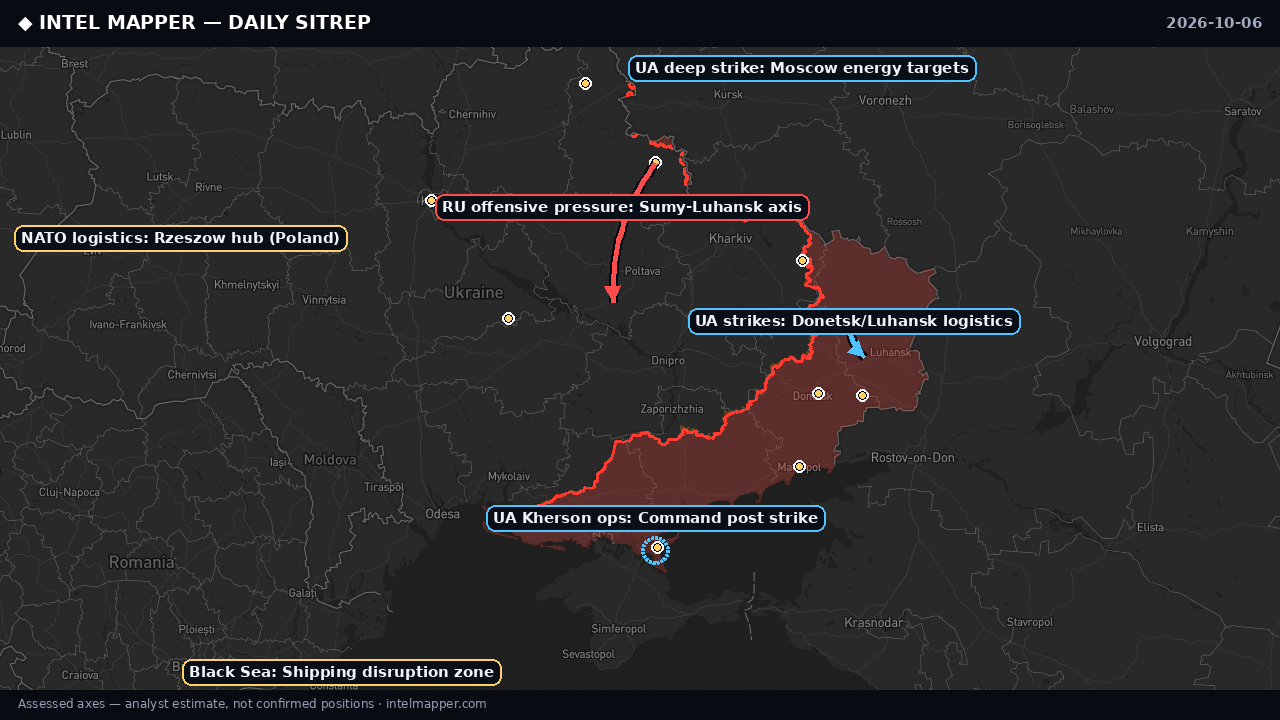
- Ukraine intercepted 114 drones overnight and conducted precision strikes on Russian telecommunications, energy infrastructure (Volodarskaya oil depot), and military logistics
- Israeli operations intensified across Gaza, Lebanon, and Syria; Hezbollah rejected withdrawal negotiations while declaring Israel cannot remain in southern Lebanon
- Black Sea civilian vessel attacks continue; Swedish NATO contingent deploying Patriot systems to Poland logistics hub supporting Ukraine
- Yemeni territorial control remains contested with Houthis gaining approximately 229 square kilometers while government forces advance selectively
Middle East 30 tracked events
Turkey is preparing to deploy additional air defense systems, electronic warfare equipment, aircraft, and technical personnel to Saudi Arabia in response to intensifying Houthi attacks, according to multiple sources. This deployment signals deepening Saudi-Turkish military cooperation against maritime and aerial threats emanating from Yemen. Concurrently, a Panama-flagged oil tanker was struck by an unidentified projectile in the Strait of Hormuz, resulting in 12 crew injuries and evacuation by Omani forces. These incidents underscore persistent maritime vulnerabilities in critical shipping lanes, with Iranian sources reportedly claiming responsibility for 12 tanker attacks in the Hormuz corridor between September 29 and October 5.
Syrian-Saudi diplomatic engagement advanced on October 6, with Syrian President Ahmad al-Shara meeting Saudi Crown Prince Mohammed bin Salman in Riyadh to discuss bilateral relations, reconstruction planning, and investment coordination. This high-level engagement reflects normalization efforts and shared regional concerns. Militarily, Yemen's conflict continued with mixed territorial dynamics: Houthi forces expanded control by approximately 188 square kilometers in Ta'izz Governorate and 41 square kilometers in Sa'dah, while government forces gained about 14 square kilometers in Ta'izz. Houthi military spokesman Yahya Saree claimed forces blocked Saudi advances toward Bab al-Mandab and conducted strikes resulting in casualties among Saudi-backed troops.
Israeli military operations intensified across Gaza, Lebanon, and Syria. The Israeli Defense Ministry raised alert levels in Gaza amid intelligence of potential Hamas attacks, with Defense Minister Israel Katz threatening disproportionate retaliation if Israeli forces face harm. Palestinian Islamic Jihad reported Israeli strikes on its headquarters in Syria and Lebanon, claiming over 2,000 operatives killed in Gaza and 80+ in Lebanon. Israeli forces also conducted mortar strikes in eastern Quneitra Governorate, Syria. In parallel, Hezbollah Secretary General Naim Qassem declared that Israel cannot remain in southern Lebanon and rejected withdrawal negotiations, reflecting hardened positions amid ongoing tensions. Human rights documentation recorded at least 69 deaths caused by Israeli forces in southern Syria between December 2024 and October 2026.
Iran declared military readiness for potential conflict with the United States and Israel, issuing an extensive list of potential targets through the Islamic Revolutionary Guard Corps and state media. This rhetorical escalation accompanies regional tension, though the statement appears designed primarily for domestic and regional messaging. Separately, Syria's interior security forces arrested ISIS military commander Khaled Rayed Beironi, accused of planning and overseeing terrorist operations including IED attacks in Homs province. Syrian anti-narcotics authorities also intercepted a major drug smuggling operation originating from Lebanon, seizing 62 kilograms of hashish and 210,000 captagon pills, indicating ongoing transnational criminal activity despite security improvements.
- Turkey prepares to deploy additional air defense systems, electronic warfare equipment, technical personnel, p
- Syrian President Ahmad al-Shara discusses bilateral relations and regional developments with Saudi Crown Princ
- Palestinian Islamic Jihad leader Ziad al-Nakhala reports Israeli strikes on PIJ headquarters in Syria and Leba
- Israeli Defense Minister Israel Katz ordered IDF alert level raised in Gaza amid intelligence of potential Ham
- Israeli forces arrested a Palestinian civilian whose home was set ablaze by Israeli settlers.
- Syrian presidential media office reports bilateral Syrian-Saudi talks focused on strengthening relations, reco
Ukraine 22 tracked events
Ukrainian forces sustained significant air defense pressure on October 5-6, with air defense systems intercepting or suppressing 114 enemy drones (Shahed, Gerber, Banderol types) launched from Russian territory and occupied regions. Seventeen impact locations were recorded across multiple regions, causing casualties and infrastructure damage. Concurrently, Ukraine conducted multiple precision strikes targeting Russian military and energy assets, including a successful drone strike on a telecommunications hub in Makiivka, Donetsk, and attacks on Russian troop concentrations in Luhansk and an army command post in Kherson Oblast. These operations demonstrate sustained Ukrainian deep-strike capability against Russian rear-area targets.
Ukrainian drone operations targeted Russian energy infrastructure and military logistics. Drones struck the Volodarskaya oil depot in Moscow Oblast, reportedly igniting at least two fuel tanks at this strategically significant distribution hub supplying Moscow. Ukrainian 3rd Army Corps destroyed a Russian military truck carrying Buk M3 air defense missiles, while the 413th Separate Reconnaissance Regiment struck the Snizhne Machine-Building Plant in occupied Donetsk, which manufactures aviation engine components for Russian aircraft. An innovative Ukrainian UGV deployment successfully rammed and destroyed a Russian drone near Kupiansk, demonstrating adaptive unmanned tactics.
Black Sea maritime operations saw contested claims and civilian vessel damage. A fire erupted on the AFRAMAX tanker Rio off Sochi, with Ukrainian-aligned sources claiming responsibility and Russian sources reporting an onboard incident. Additionally, two commercial vessels were struck in Bulgarian Black Sea waters, with the Togo-flagged Alfa Watan sinking approximately 70 nautical miles offshore (crew missing) and the Able catching fire with 18 crew rescued. EU Commission President von der Leyen condemned these attacks on civilian vessels and called for international consequences. Meanwhile, Sweden confirmed deployment of Patriot air defense systems and approximately 100 troops to Rzeszow logistics hub in Poland beginning December 1 to protect NATO supply operations supporting Ukraine, which process approximately 18,000 tons monthly.
- Large fire erupted on a tanker vessel off Sochi port with extensive black smoke visible across the city. Ukrai
- AFRAMAX tanker Rio (IMO 9273844, Liberian flag) carrying crude oil from Novorossiysk to India caught fire off
- Ukraine installed protective netting on the Northern Bridge in Kyiv to defend against potential Russian drone
- Russia attacked two civilian vessels in Bulgarian Black Sea waters using naval and aerial drones. One vessel s
- Ukrainian unmanned ground vehicle rammed and destroyed a Russian drone in combat operations. Ukrainian drone o
- Sweden deploys Patriot air defense system and ~100 troops to Rzeszow logistics hub in Poland (Dec 1 onward) to
What to watch
Over the next 24-48 hours, monitor for: (1) escalation of Turkish-Saudi military coordination against Houthi capabilities and potential Iranian responses; (2) further Israeli operations in Gaza or against Hezbollah positions given heightened alert status; (3) continued Russian drone campaigns against Ukrainian infrastructure versus sustained Ukrainian deep-strike operations; (4) any diplomatic developments from the Syrian-Saudi discussions regarding reconstruction timelines or investment commitments; (5) maritime incidents in the Hormuz Strait or Black Sea reflecting ongoing economic coercion campaigns; (6) Iranian rhetorical escalation potentially translating into kinetic operations or remaining at the messaging level.