Gulf tanker strikes and Yemen fighting; Russian drone waves and assaults across Ukraine
Key developments
- A second supertanker reportedly struck a naval mine in the Strait of Hormuz, and UKMTO reported further attacks on tankers off Saudi Arabia and Yemen.
- CENTCOM reports ongoing enforcement of a naval blockade of Iranian ports, with 138 commercial vessels redirected as of 17 October.
- The Wall Street Journal reports IRGC officers directing Houthi operations toward the Bab al-Mandeb coast, a claim not yet independently confirmed.
- Sisi pledged Egyptian measures to defend Saudi Arabia and sought an emergency parliamentary session to authorize possible military action.
- Ukrainian air monitoring tracked numerous Shahed-type and Geran-3 drones and Banderol cruise missiles, with ballistic missile threats warned.
- Ukrainian General Staff reported sustained Russian assaults on the Kupiansk, Kostiantynivka and Orikhiv axes without indicated breakthroughs.
- The reported US proposal for Europe to resume Russian gas purchases in a peace framework drew German opposition.
Middle East 30 tracked events
Maritime security was the most immediate concern in the Middle East theatre on 17 October. The IRGC Navy said a second supertanker carrying about 2 million barrels of crude struck a naval mine and caught fire in the Strait of Hormuz, and that the vessel had radar and tracking switched off while on what it called an unauthorized route. Separately, UKMTO reported a tanker struck by an unknown projectile about 68 nautical miles northeast of Al Jubayl, Saudi Arabia, and an LNG tanker came under fire from a small boat with seven occupants about 140 nautical miles southeast of Al Mukalla, Yemen. Attribution in the latter two incidents remains unresolved. CENTCOM reported that the destroyer USS Rafael Peralta was enforcing the naval blockade of Iranian ports, with 138 commercial vessels redirected as of 17 October. Air raid alerts were issued in Riyadh and Khamis Mushait according to local sources and Saudi Civil Defense, though no impacts were documented in the material available.
Yemen was the second focal point. The Wall Street Journal reported that IRGC officers are directing Houthi ground operations aimed at seizing the Bab al-Mandeb coast, with Tehran reportedly supplying intelligence, weapons, training and targeting support for strikes on Saudi Arabia. Yemeni Foreign Minister Zube described Iran as a party to the war rather than a mediator. The UAE reportedly agreed to resume payments to anti-Houthi forces, with Saudi Arabia providing air cover, a development that single-source reporting frames as a narrowing of the Saudi-Emirati rift. US Defense Secretary Hegseth claimed the Houthis had not attacked US ships during Operation Epic Fury and attributed this to US capability, also citing a 50-day Operation Rough Rider in Yemen. In Iraq, the Popular Mobilization Forces attributed a blast at its eastern Baghdad unit headquarters to faulty equipment in a warehouse, although earlier footage showed ammunition depot explosions. Drone strikes in Erbil were reported with targets and attackers unconfirmed.
Political rhetoric was intense and frequently ran ahead of verifiable detail. Netanyahu said Iran seeks his elimination and that of other senior officials, pledged 'everything necessary,' and framed the coming election around who would act against Iran's nuclear programme. Defence Minister Katz said regional relations would move toward overt normalization after Iran's defeat, outlined a war plan that includes targeted killings and deportations, and cited large-scale destruction in southern Lebanon; these figures rest on a single source and have not been independently verified. US Vice President Vance put US personnel losses at about 20 and questioned whether the war's benefits justified the cost. Egyptian President Sisi pledged measures to defend Saudi Arabia if requested and sought an emergency parliamentary session to authorize possible military action. Taken together, the day's activity suggests that maritime and proxy dimensions are expanding faster than diplomatic channels.
- Iranian President Pezeshkian says Muslims must unite and is ready to join the Mecca Agreement process, to end
- UAE reportedly agrees to resume payments to anti-Houthi forces in Yemen, with Saudi Arabia providing air cover
- PMF says a blast at its eastern Baghdad unit HQ came from a warehouse with faulty equipment; earlier footage s
- WSJ reports IRGC officers directing Houthi ground operations to seize Yemen's Bab al-Mandeb coast, and Tehran
- A second supertanker carrying about 2 million barrels of crude hit a naval mine and caught fire, per IRGC Navy
- Trump, citing his earlier 'excursion' to Iran, claims the US 'beat the shit out of' Iran, asserting military s
Ukraine 30 tracked events
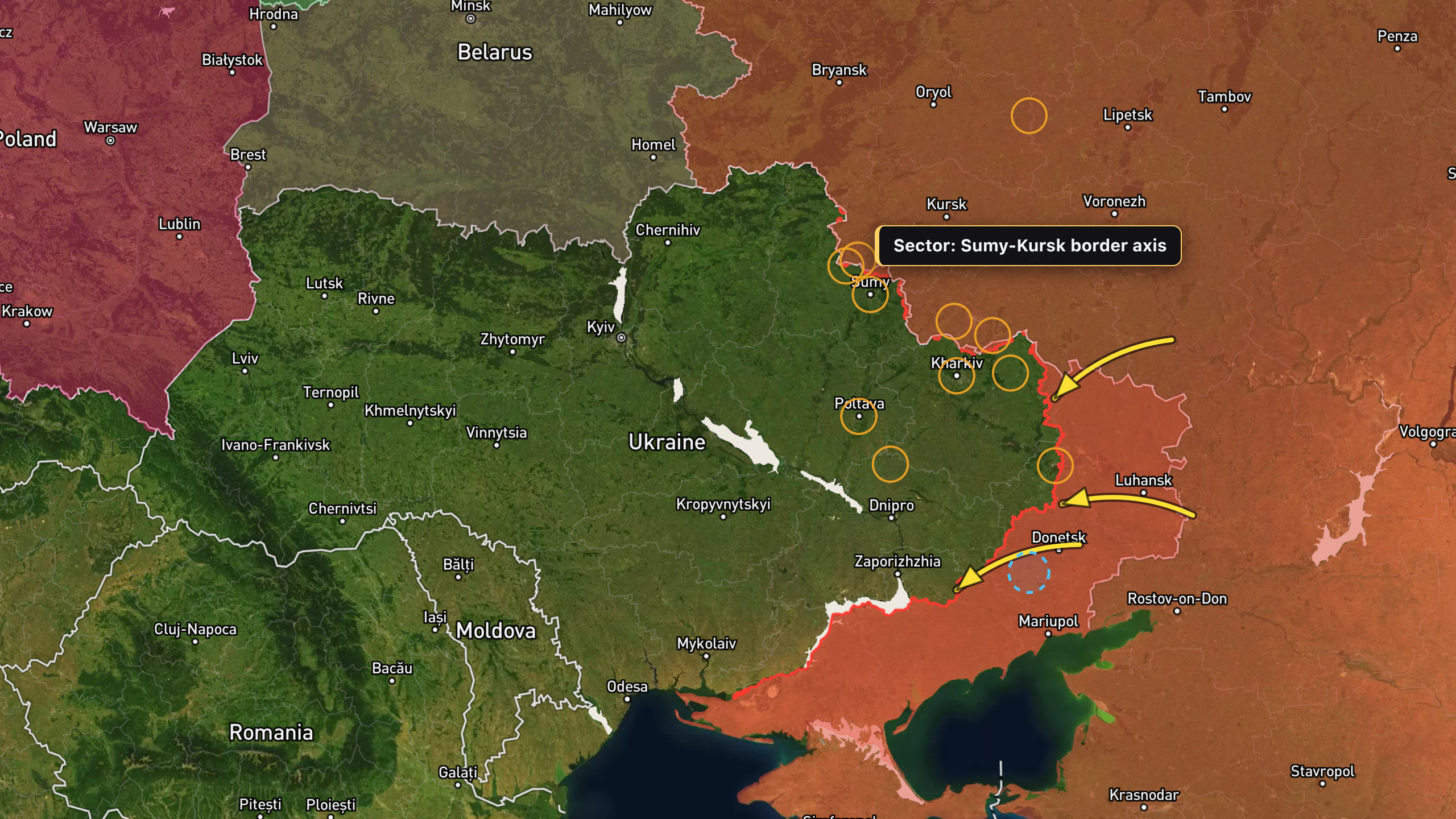
Russian long-range strike activity on 17 October was dominated by drones and cruise missiles. Ukrainian air monitoring tracked multiple Shahed-type and jet-powered Geran-3 drones transiting the Kyiv, Cherkasy, Zhytomyr, Ternopil, Vinnytsia, Konotop and Brovary areas, alongside Banderol mini cruise missiles heading toward Poltava, Dnipro and Kamyanske. The Ukrainian Air Force warned of the possible use of Russian ballistic missiles, and a probable Iskander launch from Voronezh Oblast was flagged. Zelensky said Russia was conducting massive attacks on energy infrastructure. In Romania, NATO forces reportedly shot down two drones that entered Romanian airspace, though their origin and owner were not specified. Zelensky also said Starlink terminals stop working in Ukraine above 161 km/h but function above 180 km/h in the EU, which he characterized as a planned operation that hampers interceptor drones against jet-powered Shaheds and frontline use.
Ground activity, as reported by the Ukrainian General Staff as of 22:00, reflects sustained pressure along several axes. On the Kupiansk axis, Russian forces made ten assault attempts toward Novoosynove and Radkivka. Ukrainian forces reportedly repelled 15 assaults near Kostiantynivka and toward several nearby settlements. In the Orikhiv direction, seven assault attempts were recorded toward Chervona Krynytsia and adjacent villages. Near Bilopillia in Sumy Oblast, one assault, one airstrike using six guided bombs and 48 shellings, including one multiple-launch rocket system attack, were reported. Separately, Ukrainian missiles reportedly struck coordinates shared by a Russian lieutenant, killing 68 Russian soldiers including a colonel in the Vuhledar area; this claim rests on a single source, and a WSJ report describes a wider Russian informant network. Satellite imagery showing Russia refilling armoured storage bases, including the 22nd Tank Storage Base with new T-90 tanks, has raised concern near NATO borders, though the imagery alone does not indicate intent.
Diplomatic friction was the main non-kinetic development. Russian envoy Kirill Dmitriev claimed that Ukrainian hostility to a Russia-US deal had damaged Ukraine-US relations, citing Trump's reaction. A single-link report described a reported Trump-Putin rapprochement while the US-Russia rift with Zelensky deepened, with limited detail available. The administration reportedly proposed that Europe resume Russian gas purchases as part of a peace deal, with Kushner and Witkoff discussing restarting pipelines via Ukraine and Nord Stream; Germany reportedly opposes the plan. Zelensky said the lifting of sanctions against Russia would continue and described the diesel arrangement as only the first step, which suggests Kyiv views the sanctions track as contested. Taken together, these developments indicate that peace-related negotiations are advancing through economic linkages that Ukraine and several European governments view with caution, while military pressure continues unabated.
- NATO forces shot down two drones that entered Romanian airspace, per a WarMonitor3 report. Drone origin and ow
- Zelensky says Starlink terminals shut down above 161 km/h in Ukraine but work above 180 km/h in the EU, callin
- Zelensky says Russia is launching massive energy infrastructure attacks while the US ignores the Lindsey Graha
- Russian envoy Kirill Dmitriev says Ukrainian hostility to a Russia-US deal has worsened Ukraine-US relations;
- Ukrainian Air Force warns of threat of Russian ballistic missile use; no specific target or launch site report
- Reported Trump-Putin rapprochement as US-Russia rift with Zelensky deepens, bearing on Ukraine peace efforts.
What to watch
Over the next 24 to 48 hours, attention is likely to focus on maritime incidents in the Strait of Hormuz, the Gulf of Aden and off the Saudi coast, particularly whether further mine or projectile strikes occur and whether attribution becomes clearer. Reported Saudi-Emirati coordination on Yemen and any formal Houthi response to IRGC involvement reports could signal a shift in the Yemeni front. Egypt's parliamentary process on possible action in defence of Saudi Arabia is also worth monitoring. In Ukraine, watch for further ballistic or Iskander launches, the scale of energy strikes, and whether the Romanian airspace incident prompts further NATO statements. Diplomatic signals on the gas-linked peace proposal and any Trump-Putin contact may clarify the negotiating trajectory, though single-source reports should be treated cautiously until corroborated.