North Korea reportedly deploys large loudspeakers at DMZ border with South Korea
What happened
A post on X from the account @ConflictTR, written in Turkish, reports that North Korean leader Kim Jong Un ordered the deployment of large loudspeakers along the border with South Korea. According to the post, the speakers will play military marches and propaganda broadcasts at a volume South Korean soldiers can hear. The event is dated 22 October 2026, with the post logged at 06:36 UTC. The location given is the Korean Demilitarized Zone on the North Korea-South Korea border, a region-level placement rather than a specific installation. The wording uses the future tense, so it is unclear from this single post whether broadcasts had begun at the time of publication. The source reports no casualties, damage, or South Korean response.
Context and assessment
The Korean DMZ has been a focal point of tension since the 1953 armistice. Loudspeaker broadcasts were a recurring irritant along the line for decades before both sides halted them in 2018. Reviving them would signal a shift in how Pyongyang uses the border as a political and psychological stage, and it would pressure Seoul to respond. The deployment fits a wider pattern in the related events. Roughly nineteen minutes after this report, North Korean state media reported that Pyongyang had ordered border troops to retaliate if South Korean threats to its border security escalate, suggesting the loudspeaker move is being framed as part of a defensive posture rather than an isolated propaganda act. The previous evening, major internet disruptions hit government websites and KCNA, with the cause unknown and a cyberattack among the possibilities being examined. Taken together, these items may indicate a period of heightened border signaling, though the data does not establish any link between the outage and the border issue. Operationally, loudspeakers are a low-cost, non-lethal tool, so their use would more plausibly be a messaging escalation than a precursor to kinetic action. Any change in border posture would still merit close monitoring.
Sources and confidence
The report comes from a single channel, the X account @ConflictTR, which is the only listed source. No wire service, government statement, or South Korean military confirmation appears in the data, so cross-confirmation is absent. The confidence score of 6.1 reflects this single-source status and the Turkish-language post. The deployment type is easy to verify, but it has not been verified here. The related Pyongyang statement is a separate item and does not independently confirm that speakers were installed. Confidence would rise with corroboration from Yonhap, South Korean Joint Chiefs of Staff statements, or dated imagery of the installations. It would fall if South Korean or wire outlets report no deployment or broadcast.
Location
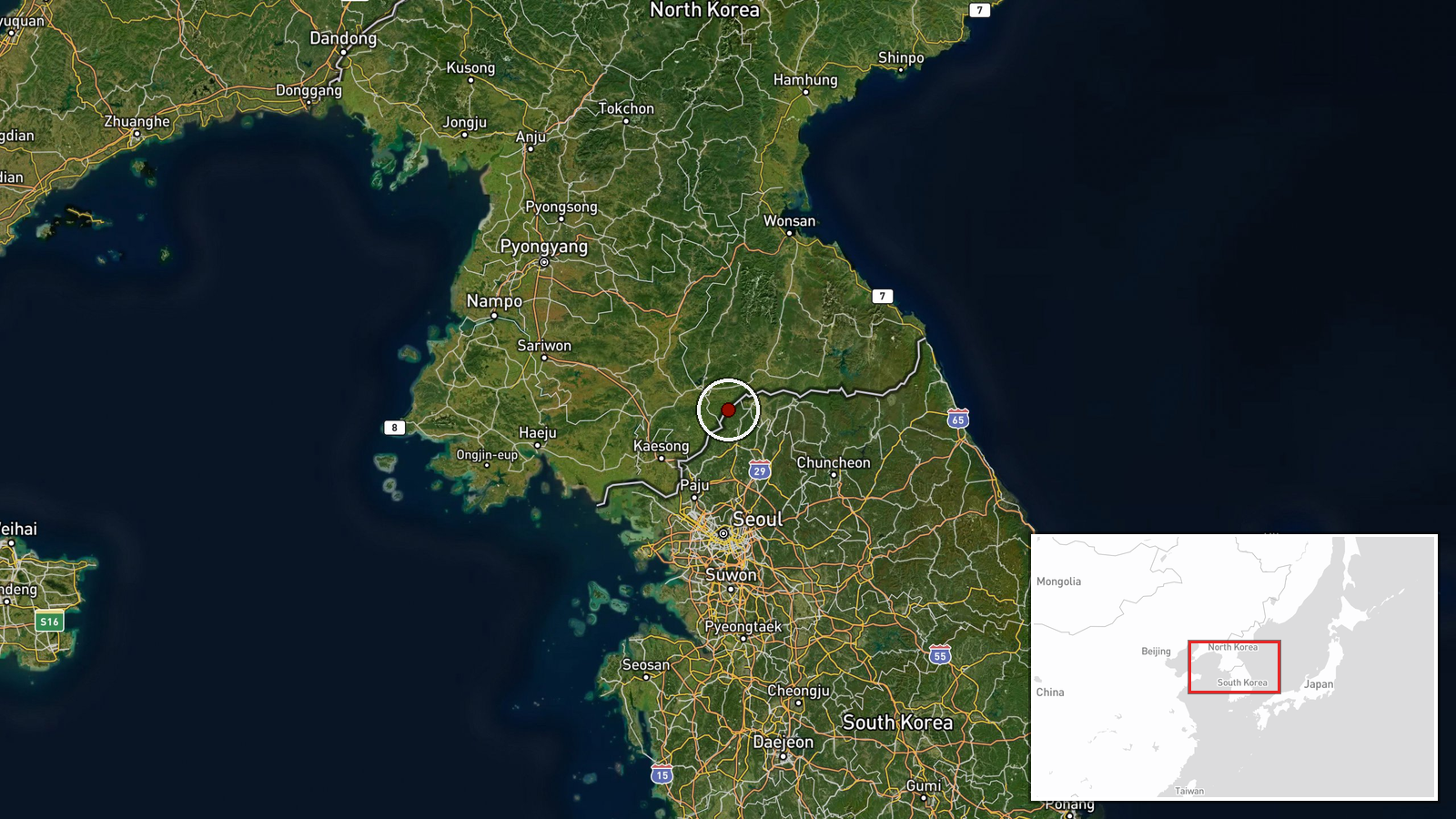
The coordinates (38.2336866, 127.0087307) were assigned at region level, so the point marks the broader DMZ area rather than a surveyed site. Location confidence is rated high because the DMZ is a well-defined zone. The setting is the heavily fortified Korean DMZ, a strip about four kilometers wide running across the peninsula near the 38th parallel, with the Military Demarcation Line at its center. The data does not specify exact speaker positions.
Related events nearby
- North Korean state media reports Pyongyang ordered border troops to retaliate if South Korean threats against 2026-10-22 06:55 UTC · Statement · Pyongyang, North Korea
- Major internet disruptions hit North Korea, affecting government websites and KCNA state media. Cause unknown;2026-10-21 21:39 UTC · Report · Pyongyang, North Korea
▶ View this event on the live map

Intel Mapper aggregates open-source reports from monitored Telegram and X channels, geolocates them, cross-checks duplicates across sources and assigns a confidence score. Entries are updated as new confirmations arrive. Read how we verify events.