Caretaker governor orders action on drug-linked crime in Northern Bahr el Ghazal
What happened
Radio Tamazuj reports that the caretaker governor of Northern Bahr el Ghazal State, Charles Madut Akol, convened a meeting with five caretaker commissioners and two municipal council mayors to discuss the security situation across the state's five counties. Speaking to the media on Saturday, caretaker information minister Dominic Kang Deng said the discussions focused on ongoing criminal activity in the counties, particularly activity linked to drugs, though the excerpt available is cut off before the full description. The governor reportedly ordered security organs to prevent criminal activity ahead of the elections scheduled for December 2026. The report is dated 19 October 2026 and places the meeting in Aweil, the state capital. The available text names no specific incidents, casualties, or perpetrators, so this item describes an administrative response to insecurity rather than a reported violent event.
Context and assessment
Northern Bahr el Ghazal is one of South Sudan's northwestern states, and Aweil, its capital, serves as the administrative hub for the region. That makes a meeting of this kind a useful indicator of how state authorities are framing insecurity. The item is notable less for any single incident than for its framing: a caretaker administration, meaning one operating without a fully installed elected government, is publicly tying criminal activity to drug-related crime and directing security organs to prevent it before the December 2026 elections. Caretaker arrangements may carry uneven authority over local security forces, so officials could be signalling both a crackdown and an effort to show control ahead of a contested vote. No related events are logged on the platform for this location or period, so there is no documented pattern to compare against, and the item cannot be linked to recent violence in neighbouring counties on the present data. Operationally, the statement may indicate that the state government regards drug-linked crime as a governance problem worth public attention. Announcements of this kind do not by themselves show that enforcement has begun or that criminal networks have been disrupted. Observers would normally look for follow-up reporting on arrests, deployments, or incidents in the five counties before reading the meeting as a sign of change.
Sources and confidence
Only one channel, Radio Tamazuj, carried the report, and the platform records a source count of one. No independent outlet in the event data corroborates the meeting, the quoted remarks, or the election-related instruction. The confidence score of 6.0 reflects a single-source report with named attribution and a dated, quoted statement, but not independent confirmation. Confidence would rise if other South Sudanese or regional outlets, or official government communications, reported the meeting and its directives. It would fall if the governor's office or information ministry disputed the account, or if the quoted wording could not be matched to a statement or recording.
Location
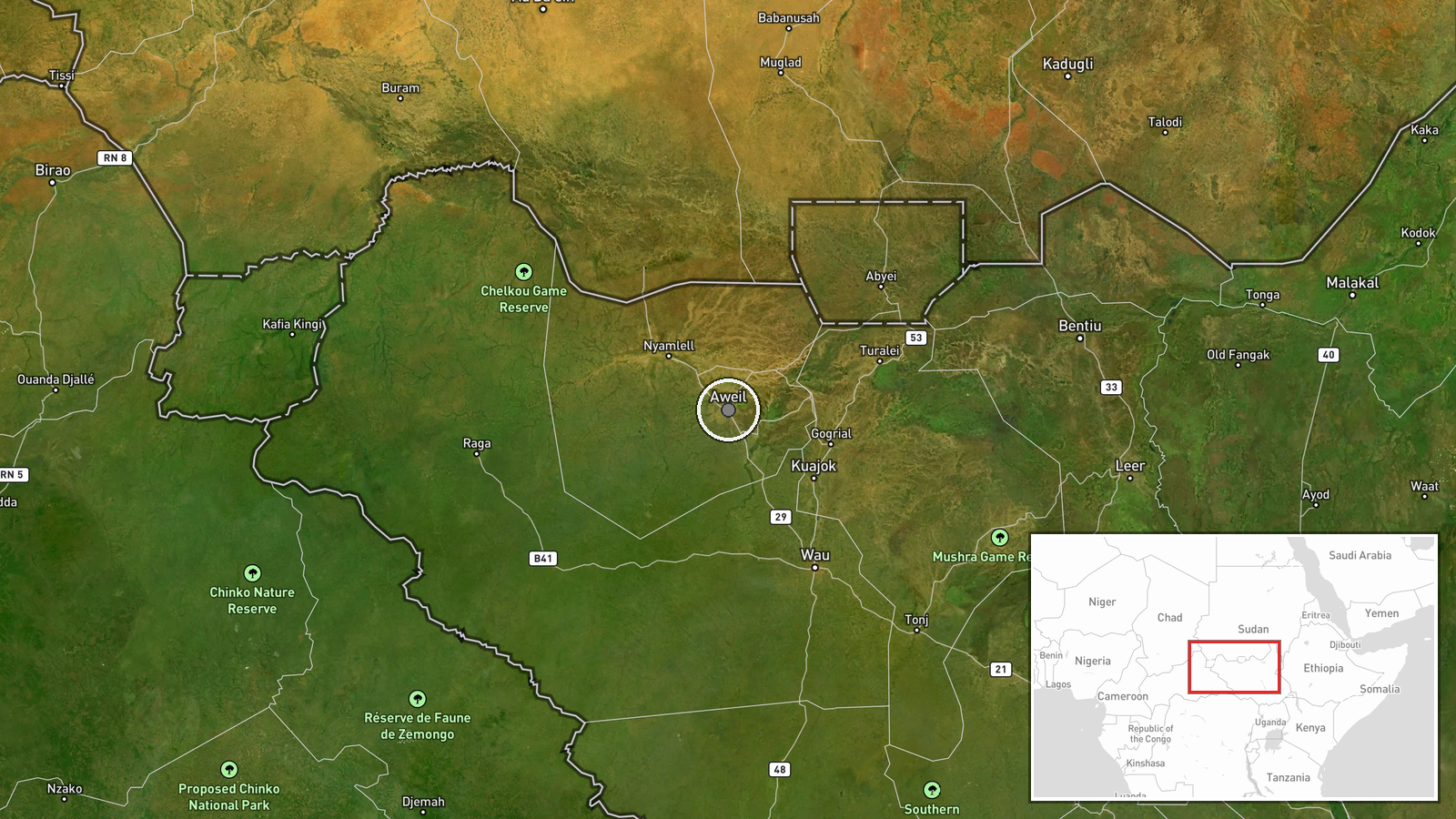
Coordinates place the event at Aweil, the state capital of Northern Bahr el Ghazal, at region-level precision. The marker reflects the town rather than a specific government building, and the exact venue of the meeting is not stated. Aweil sits in the northwest of South Sudan within the Bahr el Ghazal region, a largely flat savanna landscape, with the Sudanese border lying to the north.
Related events nearby
- Drone strike hit the northern side of the Sudan-South Sudan border Ostrich Market, Abyei, killing over 50 and 2026-10-19 14:12 UTC · UAS Strike · Ostrich Market (Souq al-Naam), Abyei, Sudan-South
▶ View this event on the live map

Intel Mapper aggregates open-source reports from monitored Telegram and X channels, geolocates them, cross-checks duplicates across sources and assigns a confidence score. Entries are updated as new confirmations arrive. Read how we verify events.