DNA analysis reportedly identifies family missing in Raqqa for nine years
What happened
A report circulated on Telegram by the channel @AJSyriaNow states that DNA analysis has identified a family that had been missing in Raqqa for nine years. The Arabic-language post describes the case as the first of its kind in Syria and directs readers to a longer article hosted on the Syria Now website. The wording is the post's own headline framing rather than a quoted official finding. The report does not name the family members, identify who carried out the testing, or explain how the family was located or what happened to them. The post is timestamped 21 October 2026 at 15:42 UTC, and the coordinates correspond to Raqqa city at settlement level. No casualty figures, perpetrators or official statements appear in the material available to this desk, so the claim rests on a single channel summary.
Context and assessment
Raqqa is one of the most significant places in Syria's recent conflict. It served as the de facto capital of the Islamic State's self-declared caliphate from 2014 until its capture by US-backed Syrian Democratic Forces in 2017, and many residents, along with families of people detained or killed by various parties, were left without information about their relatives. Enforced disappearance has been widespread across the Syrian conflict, so a documented identification of a long-missing family would matter to relatives and to transitional justice efforts. The item also sits alongside other recent reports from northeast Syria. On 21 October, a legacy regime-era landmine reportedly injured two military engineers during clearance work near Ain Issa in Raqqa Governorate. The day before, Hasakah governorate media reported a planned convoy of about 645 families leaving Al-Tuwaina camp for Ras al-Ain. Operationally, the DNA report is not a kinetic event and does not indicate new fighting. Taken together, the mine incident and the displacement movement point to continuing post-conflict hazards and population movement in the region, which may shape how humanitarian and documentation work proceeds there.
Sources and confidence
The report comes from one Telegram channel, @AJSyriaNow, and no other outlet, official body or family member has been identified as confirming it. The confidence score of 7.6 reflects a clearly attributed source, a linked article and a specific location, offset by the absence of any independent corroboration and by the lack of named individuals or a named forensic laboratory. Confidence would rise with reporting from established news agencies, statements from Syrian authorities or the families involved, or details of the testing institution and methodology. It would fall if the linked article fails to support the summary or if the channel later issues a correction.
Location
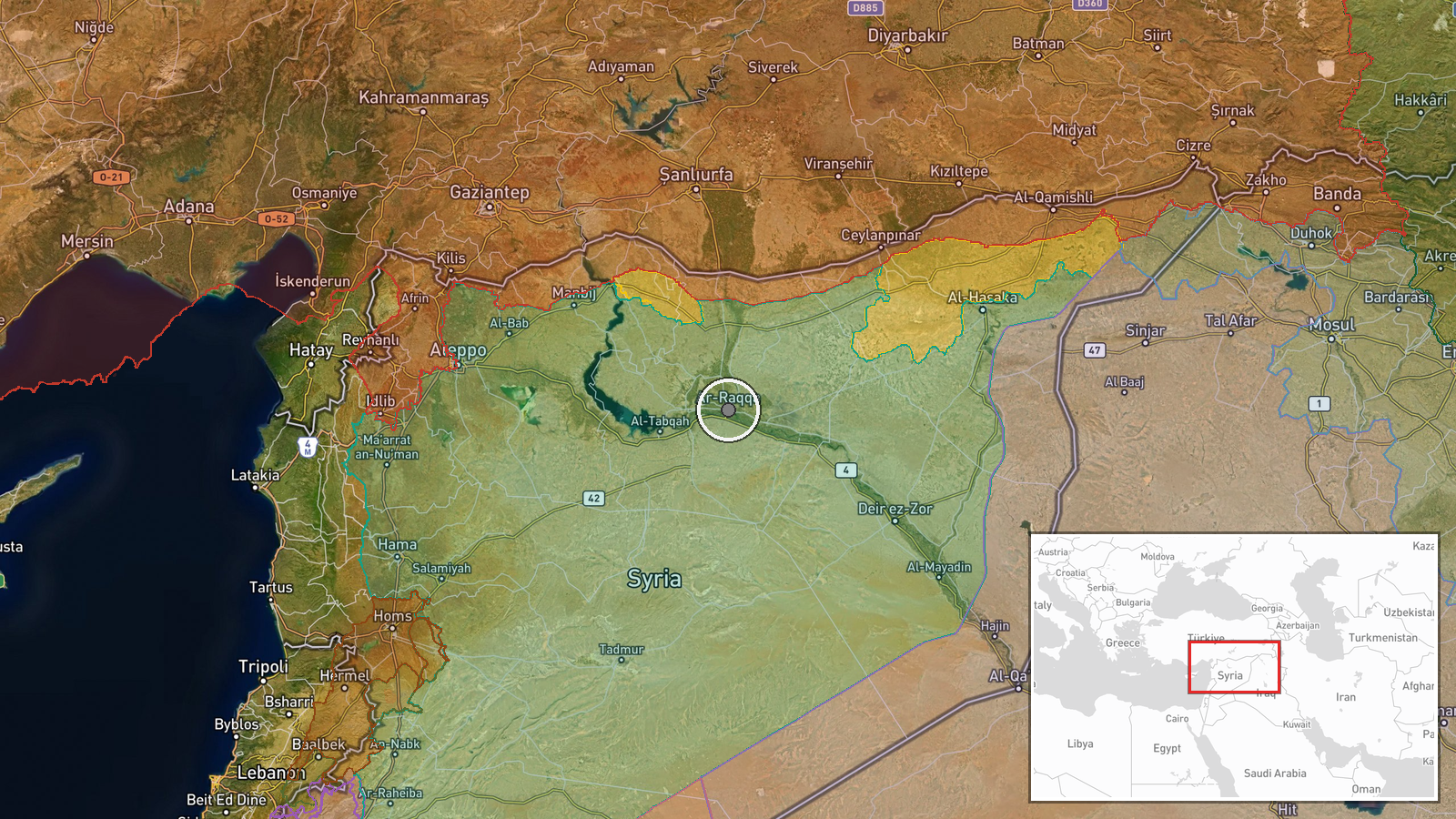
The coordinates place the event at settlement level in Raqqa city, a rather than an exact facility, so the marker reflects the city centre rather than any specific site linked to the family. Raqqa lies on the north bank of the Euphrates River in northern Syria, in the Jazira region. The surrounding terrain is largely flat agricultural land and the river is the main nearby natural feature. Ain Issa, where the mine incident was reported, lies roughly 50 kilometres to the north-west.
Related events nearby
- Two Syrian military engineers were injured, one seriously, by a legacy regime-era landmine while clearing mine2026-10-21 10:13 UTC · Artillery · Ain Issa, Raqqa Governorate, Syria
- Hasakah governorate media says a convoy of about 645 families will leave Al-Tuwaina camp tomorrow for Ras al-A2026-10-20 19:24 UTC · Displacement · Ras al-Ain, Hasakah, Syria
▶ View this event on the live map

Intel Mapper aggregates open-source reports from monitored Telegram and X channels, geolocates them, cross-checks duplicates across sources and assigns a confidence score. Entries are updated as new confirmations arrive. Read how we verify events.