Syrian security forces arrest man accused of mutilating a fighter's body in Hama
What happened
Syria's Internal Security Forces reportedly arrested a man named as Abd al-Bar Yusuf Saad for mutilating the body of Mohammed Subaiha, whom the statement describes as a martyr who died in battles to liberate the Hama fronts from the former regime. The report comes from one Telegram channel, @AJSyriaNow, which relayed the Arabic-language statement. The original text links the arrest to a ceremony honouring the martyr's father, identified as Hamoudi, and says the suspect carried out the act against the body. The post gives no date for the arrest or the alleged mutilation, no charges, and no arrest location beyond the Hama area. The item was published on 26 October 2026 at 14:36 UTC.
Context and assessment
Hama, in west-central Syria, saw sustained fighting between government forces and opposition groups during the civil war, so its front lines remain part of local memory and grievance. The significance here lies less in the battlefield than in the state's framing: a security body publicly tying an arrest to the honouring of a fallen fighter, which suggests an effort to present accountability for abuses against combatants as a public priority. Related reports the same day show the authorities pursuing several threads at once. In Homs, the Interior Ministry announced arrests of former regime-linked figures, including a cousin of Bashar al-Assad. In Kafr Halab, residents celebrated the arrest of a man accused of spying for the ousted government and causing deaths. In Halfaya, Hama countryside, a child was reportedly killed by a legacy landmine, a reminder that old risks persist alongside political change. Operationally, the pattern may indicate that security services are using high-profile arrests to signal accountability, and that local communities are active participants in those narratives. The case may also have been chosen for publicity. Because it rests on a single relayed claim, it should be read as an announced arrest rather than a confirmed account of the alleged act.
Sources and confidence
Only one channel, the Telegram account @AJSyriaNow, carries this report, and the source count is one, so no independent confirmation appears in the data. The confidence score of 7.6 reflects a specific named suspect, a dated post, and a claim attributed to an official security body, offset by single-channel sourcing, no primary statement linked in the data, and no stated arrest location. Confidence would rise with a published Internal Security Forces statement, a Syrian state news agency item, or independent local reporting that names the arrest site or court action. It would fall if the arrest cannot be traced to an official source or if the post proves to be a repost of older material.
Location
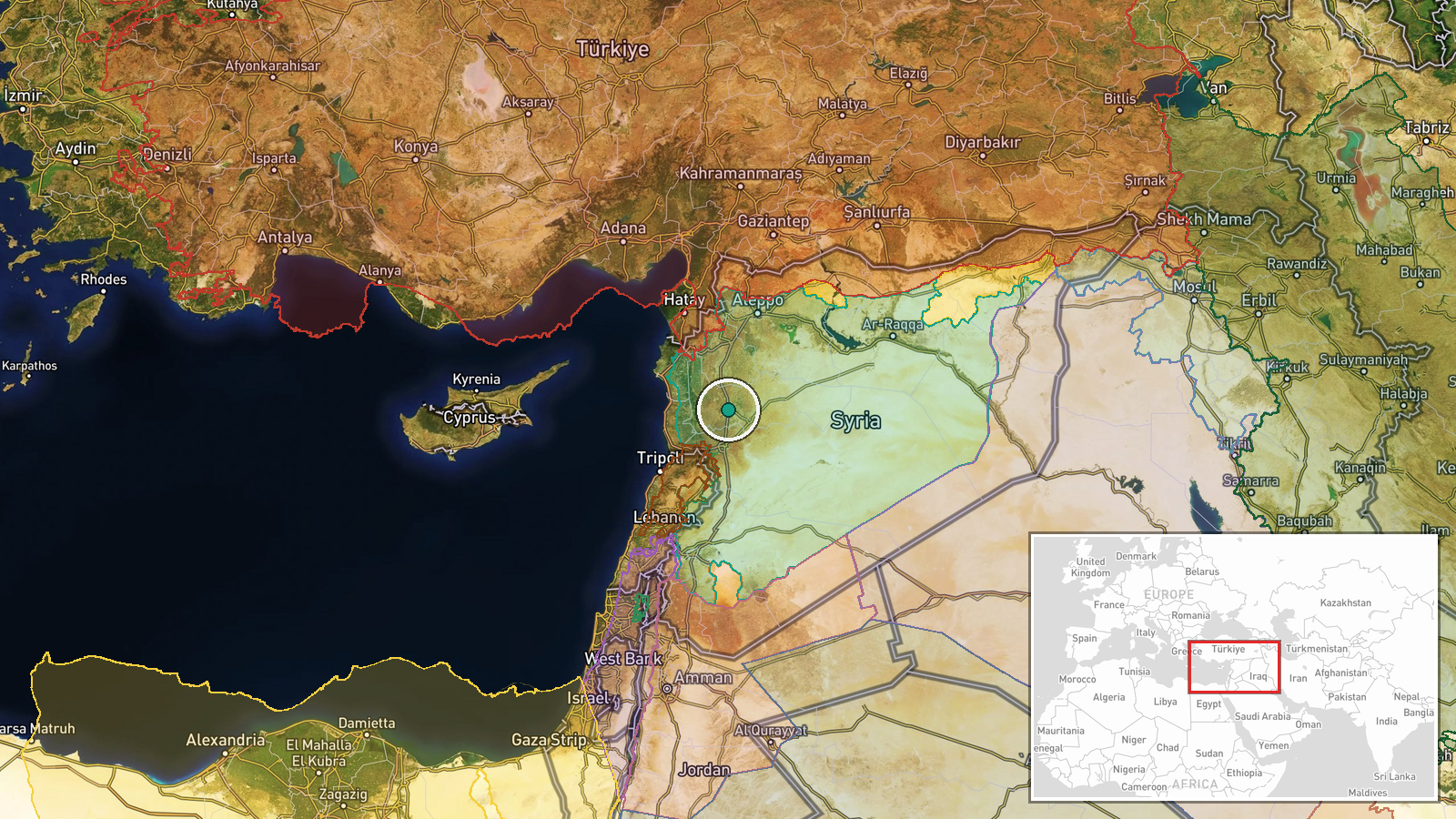
The coordinates place the event at Hama city, the provincial capital, but geo_precision is listed as region and location confidence as low, so the pin likely marks the governorate broadly rather than the arrest site. Hama lies on the Orontes River and is known for its historic waterwheels. The surrounding area is an agricultural plain, and the northern Hama countryside, where several front lines ran during the conflict, lies nearby.
Related events nearby
- A child was killed and his mother and uncle wounded when a landmine left over from the former regime exploded 2026-10-26 09:00 UTC · Explosion · Halfaya, Hama Governorate, Syria
- Interior Ministry spokesman Nour al-Din al-Baba announces arrests in Homs of former regime-linked figures, inc2026-10-26 12:39 UTC · Police Operation · Homs, Syria
- Kafr Halab residents celebrated the arrest of Rajeh Bakkour, accused of spying for the ousted Assad regime and2026-10-26 09:21 UTC · Police Operation · Kafr Halab, Aleppo Governorate, Syria
- Residents of Aleppo protested against Israeli army violations in southern Syria, with protest slogans directed2026-10-26 07:09 UTC · Statement · Aleppo, Aleppo Governorate, Syria
- Car explosion on the Damascus-Homs highway in al-Qastal, Rif Dimashq, causing casualties; initial footage rele2026-10-26 13:29 UTC · Explosion · Al-Qastal area, Damascus-Homs International Highwa
▶ View this event on the live map

Intel Mapper aggregates open-source reports from monitored Telegram and X channels, geolocates them, cross-checks duplicates across sources and assigns a confidence score. Entries are updated as new confirmations arrive. Read how we verify events.