Syrian authorities sweep Daraa sites hit by Jordanian strikes for unexploded ordnance
What happened
A Telegram channel tracked as @AJSyriaNow reports that Syria's Ministry of Emergency and Disaster Management has deployed war-remnant and mine-clearance teams to sweep sites in the Daraa countryside that were struck by Jordanian airstrikes, searching for unexploded ordnance. The post was dated 27 October 2026 at 22:14 UTC. The Arabic original says the teams are clearing war remnants and mines and checking the sites for explosive objects that did not detonate. The post does not give the number of sites or teams, the dates of the strikes being cleared, or any casualty or damage figures. It is a single-channel report, and no other outlet in the dataset carries it. Related reporting from the same day concerns a Jordanian strike on Al-Tuff, in which a child was reportedly killed, and a Jordanian government statement describing the operation in southern Syria.
Context and assessment
Daraa governorate sits in southern Syria along the Jordanian border, and its towns, including Al-Tuff and Nasib, have been central to the country's southern front since the 2011 uprising began there. Strikes in this area carry weight because the Nasib crossing is a major trade route between Syria and Jordan, so damage or contamination near it has economic and humanitarian consequences beyond the immediate impact. The related events point to a pattern. On 26 October, a relative of a victim of Jordanian airstrikes on Nasib questioned the justification for the targeting. On 27 October, a Jordanian government spokesman, Mohammed al-Momani, said the operation was launched after patience ran out over militant movements and threats. A notebook belonging to a child reportedly killed in Al-Tuff was recovered from rubble the same day. Operationally, the clearance deployment suggests that some struck sites contain residual ordnance or unexploded material, which would be consistent with munitions that failed to detonate or with structures not yet surveyed after damage. The Syrian government's role as the responding body is notable because it points to a post-strike recovery effort in an area where authority is contested by several actors. Whether the clearance is limited or part of a broader survey cannot be determined from this report alone.
Sources and confidence
Only one channel, Telegram @AJSyriaNow, reports this clearance deployment, so cross-confirmation is absent. The score of 7.8 reflects a credible single-source post that attributes the work to a named government ministry and quotes an Arabic-language primary text, but it is not independent verification. The score is held back by the single source and by the lack of detail on specific sites, dates, or teams. Confidence would rise with statements from the Syrian ministry, wire or agency coverage naming the sites, or geolocated photographs tied to particular villages. It would fall if the ministry denies the deployment or if the channel's earlier reporting proves inaccurate.
Location
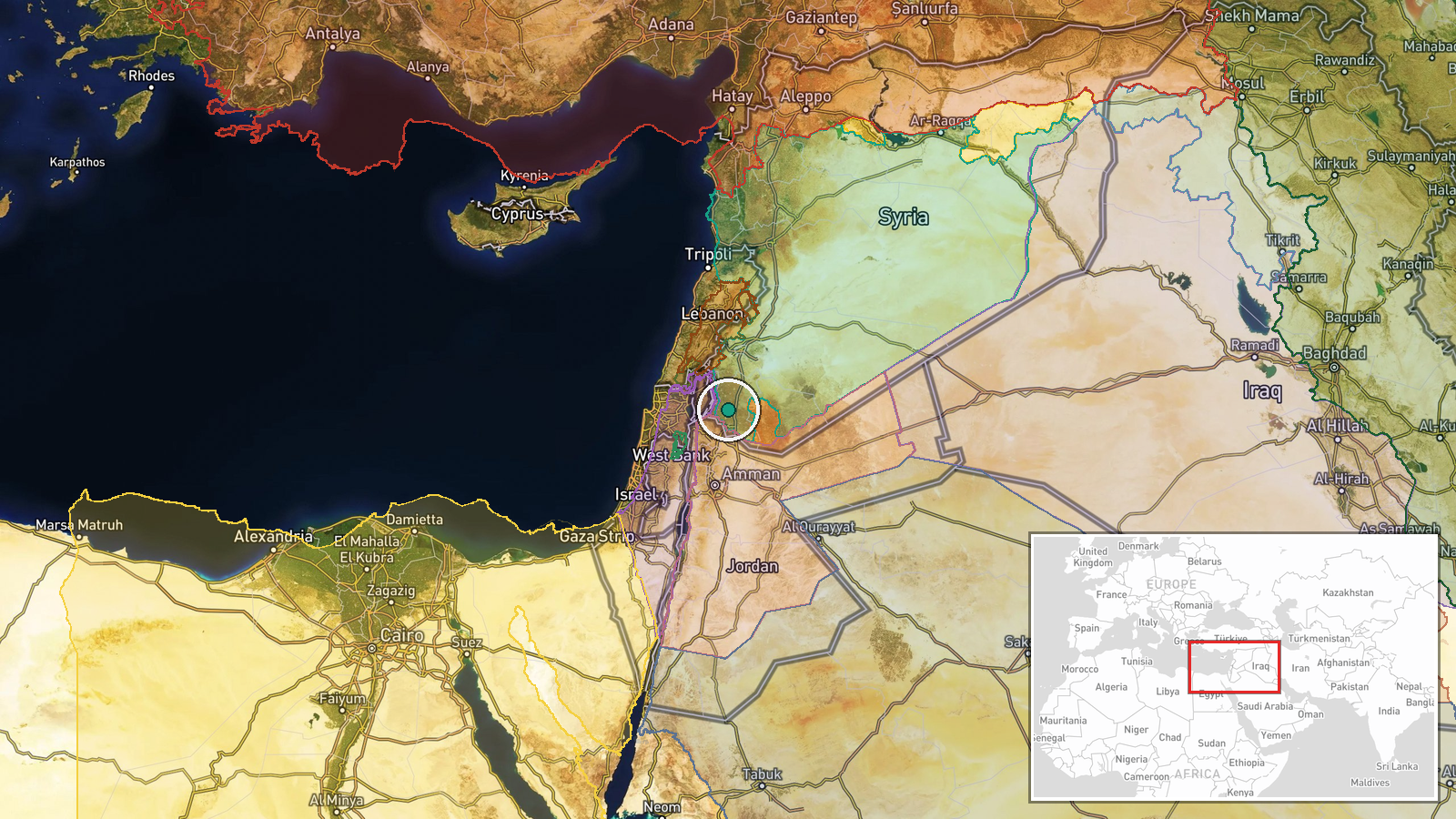
The location is region-level. The coordinates 32.8257, 36.1038 mark a general point in the Daraa countryside rather than a specific village, and the source names no settlement for the cleared sites, so location confidence is low. Daraa governorate lies in southern Syria, bordering Jordan to the south and east, with the Yarmouk basin and the Golan Heights region nearby to the west. Places named in related reporting, such as Al-Tuff and Nasib, are in the same governorate but are not confirmed as the clearance sites.
Related events nearby
- Notebook of child Osama al-Salim, killed in Jordanian strike on Al-Tuff, found in rubble; it recorded a plea f2026-10-27 15:27 UTC · Airstrike · Daraa countryside, Daraa, Syria
- Israeli occupation force patrol of 7 vehicles penetrating the center of al-Mu'allaqa village in southern Qunei2026-10-27 19:22 UTC · Convoy · Al-Mu'allaqa village, southern Quneitra countrysid
- Israeli forces abducted a person during an incursion into al-Huriya village in the Quneitra countryside.2026-10-27 11:37 UTC · Security · Al-Huriya village, Quneitra Governorate, Syria
- Jordanian government spokesman Mohammed al-Momani says the operation in southern Syria was launched after pati2026-10-27 08:30 UTC · Report · Al-Sanamayn Military Hospital, Daraa Governorate,
- Son of a victim of Jordanian airstrikes on Nasib describes the events and questions the justification for the 2026-10-26 22:34 UTC · Report · Nasib, Daraa Governorate, Syria
▶ View this event on the live map

Intel Mapper aggregates open-source reports from monitored Telegram and X channels, geolocates them, cross-checks duplicates across sources and assigns a confidence score. Entries are updated as new confirmations arrive. Read how we verify events.