Syrian authorities report seizure of 200,000 captagon pills in Homs, reportedly smuggled from Lebanon
What happened
Syria's Anti-Narcotics Department announced that it seized 200,000 captagon pills in Homs, which it said had arrived from Lebanon. The department described the seizure as the result of a targeted operation and a well-planned ambush. The report was posted on Telegram by the channel identified as @AJSyriaNow and appears to be a brief official-style statement. It gives no details on arrests, suspects, vehicles, smuggling routes, or the exact place of the seizure within Homs. The original Arabic wording links the pills to Lebanon as a point of origin, and that origin is the department's claim rather than an independently verified route. The event is dated 28 October 2026 at 12:15 UTC, and no other outlet has reported it so far.
Context and assessment
Homs is a central hub on the main highway corridor linking Damascus, Homs and Aleppo, and it sits within reach of the western frontier region with Lebanon, which has long been a route for captagon smuggling. Captagon, an amphetamine-type stimulant, became a major illicit economy in Syria and along its borders during the war, and interdictions of large shipments have been a recurring feature of the post-2024 security landscape. The related events in the same window point to a busy security agenda on the Syrian-Lebanese frontier. The Lebanese Army freed two Syrian nationals who had been kidnapped and held for ransom after being lured from Syrian territory, which shows that cross-border criminal activity was active at the same time. Separately, formerTurkistan Islamic Party members now serving in the Syrian Army were reported conducting drone and thermal-equipped drills in Idlib, reflecting a broader reorganization of security forces. An Iraqi prime minister's visit to Damascus on 28 October, with pledges of expanded security cooperation, may also signal regional coordination on border and narcotics issues. None of these events is directly tied to the seizure in the reporting available, so any link should be treated as a hypothesis. If accurate, an ambush-based interdiction could suggest intelligence-led work on a transit route, though this cannot be confirmed from a single statement.
Sources and confidence
The report comes from one Telegram channel, @AJSyriaNow, and no independent outlet, official government site, or wire service has repeated it in the data. The confidence score of 7.6 reflects a specific quantity, a named origin and a city, but it is held down by the single-source status and the lack of photos, video, or follow-up details. Confidence would rise with confirmation from the Syrian government's official channels, the state news agency, or photographs of the seized pills, or with reports of arrests or Lebanese counterpart statements. It would fall if the quantity or location changed in later reporting, if the original post could not be found, or if the seizure was attributed to a different date or place.
Location
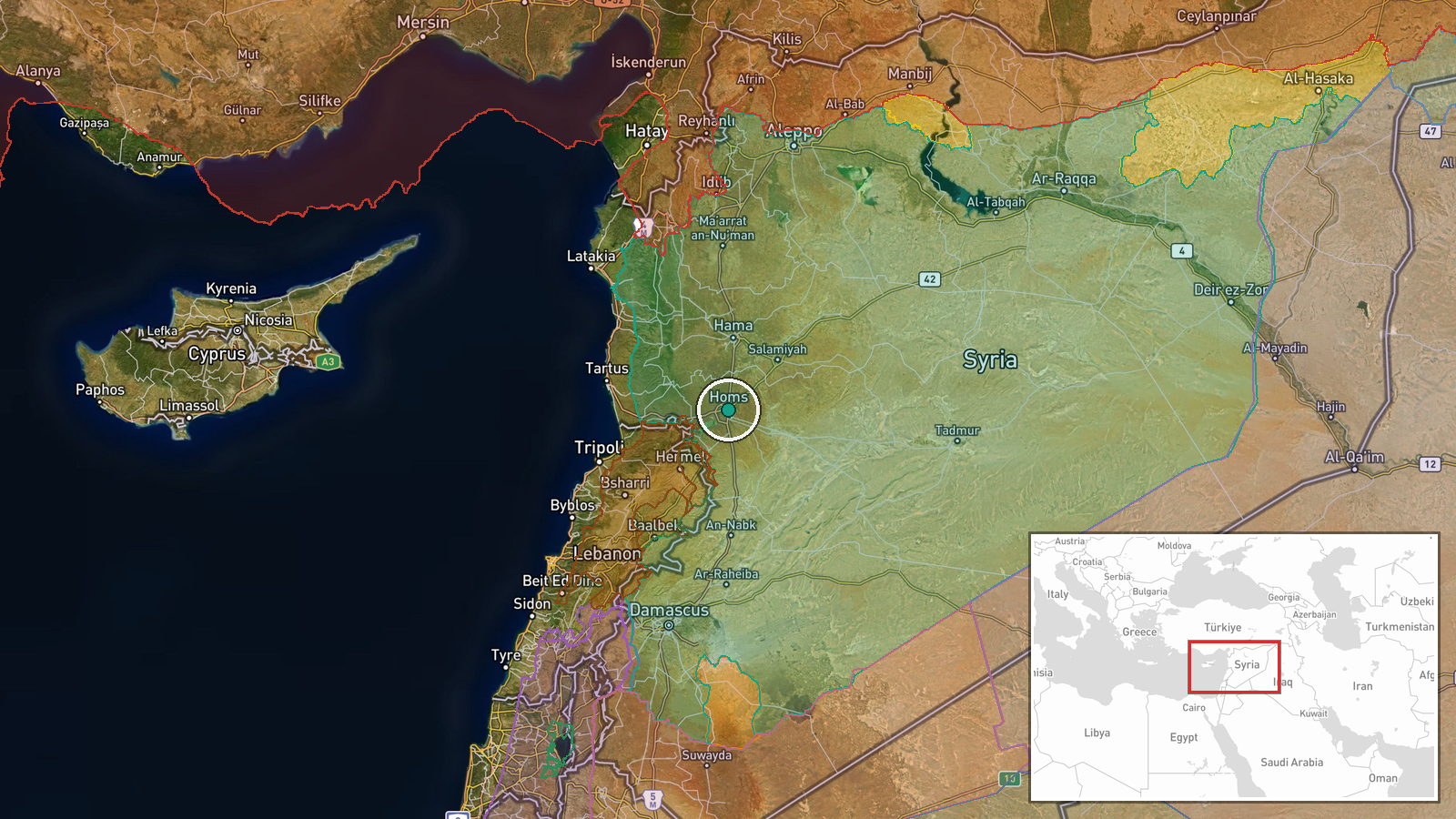
The location is recorded at settlement precision, with coordinates placed at the center of Homs city rather than at a specific checkpoint, warehouse, or roadside site, and no location confidence value was assigned. Homs is Syria's third-largest city and the capital of Homs Governorate in west-central Syria. The city lies on the Orontes River and is crossed by the M5 highway, a major north-south road. Its position makes it a common transit point between the coast, the interior and the Lebanese border.
Related events nearby
- Lebanese Army freed two Syrian nationals kidnapped about two weeks earlier, lured from Syrian territory and he2026-10-27 15:32 UTC · Security · Lebanon (location not reported)
- Former TIP members, now part of the Syrian Army, conducted drone and thermal-equipped military drills in Idlib2026-10-27 16:00 UTC · Military Exercise · Idlib, Syria
- In a Dijla TV interview, al-Sharaa recounts going alone to Iraq in 2003 to confront the American occupation, w2026-10-27 22:27 UTC · Statement · Damascus, Syria
- In a Dijla TV interview, President al-Sharaa said he has never harmed an unarmed civilian and cites principles2026-10-27 20:26 UTC · Statement · Damascus, Syria
- Iraqi PM Ali al-Zaidi, in Damascus, pledged economic and social partnership with Syria and expanded security c2026-10-28 11:24 UTC · Diplomacy · People's Palace, Damascus, Syria
▶ View this event on the live map

Intel Mapper aggregates open-source reports from monitored Telegram and X channels, geolocates them, cross-checks duplicates across sources and assigns a confidence score. Entries are updated as new confirmations arrive. Read how we verify events.