Lebanese army reportedly arrests 99 Syrians for illegal entry and movement in Hermel
What happened
Lebanese army wording, as relayed by a Telegram channel (@AJSyriaNow), reports that troops arrested 99 Syrian nationals for entering Lebanon illegally and moving around inside the country without valid legal papers. The post is dated 2 November 2026 at 17:07 UTC and places the arrests in Hermel, in Lebanon's Baalbek-Hermel Governorate, close to the Syrian border. The original Arabic attributes the statement to the Lebanese army and uses the phrasing 'illegal entry' and 'without legal papers'. The report does not state how many of those detained were later referred for deportation or prosecution, whether any arrests occurred at a specific crossing, or whether the figure has been confirmed by an official Lebanese channel.
Context and assessment
Hermel and the northern Bekaa are part of the Lebanon-Syria frontier, where irregular crossings and smuggling routes have long drawn Lebanese security attention. Arrests of this size are typically framed by security services as enforcement against illegal entry, so the report fits a recurring pattern rather than a new kind of incident. The related events help explain why the border is active on the agenda this week. On 1 November, remnants of a missile of unidentified origin reportedly fell in al-Qusayr in Syria's Homs countryside, a short distance across the frontier. The same day, Qatar's defense minister met Syria's defense minister to discuss bilateral defense cooperation. On 2 November, a Lebanese delegation led by Deputy Prime Minister Tarek Mitri held talks in Damascus covering border control and security cooperation, and Syria's foreign minister said Damascus was weighing participation in a proposed 'Mecca Alliance' security pact. Taken together, these items point to active diplomacy on border management. Operationally, visible enforcement against unregistered movement could be part of that effort, though this is an inference and the arrest report does not say so. The Hama item, a portrait of Hafez al-Assad inside a military unit, has no stated link to this event and should be treated cautiously.
Sources and confidence
The report rests on a single Telegram channel, @AJSyriaNow, which republished Lebanese army wording in Arabic. No second outlet, official Lebanese army account, or wire service in the dataset confirms the arrest count or location. The confidence score of 7.6 reflects a plausible primary statement with a specific date and quoted official language, offset by single-source status and the absence of corroboration. Confidence would rise if the Lebanese army or national news agencies published the same figure, or if local outlets named the arrest location. It would fall if the number is revised, if the arrests prove to come from earlier operations, or if the channel is found to be recycling older material.
Location
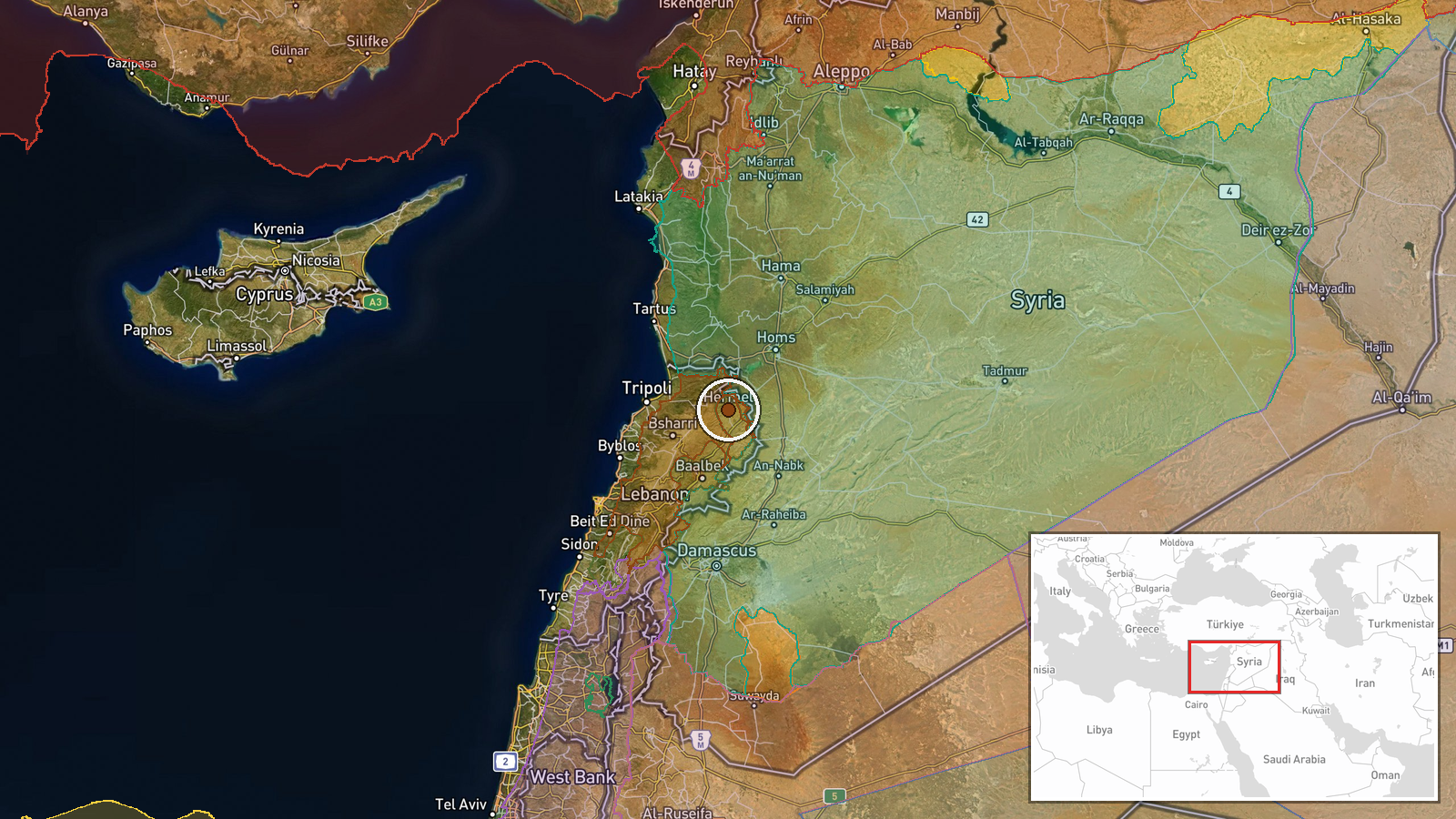
The point is placed at settlement level for Hermel town in Baalbek-Hermel Governorate, which suggests a reported arrest area rather than a specific facility or crossing. Hermel lies in the northern Bekaa Valley near the Syrian frontier, where mountain ranges shape the terrain on both sides of the border. The Assi (Orontes) river valley and several minor crossings in the surrounding area are notable nearby features. The Syrian town of al-Qusayr sits just across the frontier in Homs Governorate.
Related events nearby
- Security camera footage shows the moment remnants of an unidentified-origin missile fell in al-Qusayr, Homs co2026-11-01 20:01 UTC · Ballistic Missile · Al-Qusayr, Homs Governorate, Syria
- Citizen camera shows the name of former president Hafez al-Assad painted on a wall inside a military unit in H2026-11-02 17:02 UTC · Report · Hama, Hama Governorate, Syria
- Syrian FM Asaad al-Shaibani received a Lebanese delegation led by Deputy PM Tarek Mitri; talks covered border 2026-11-02 12:29 UTC · Diplomacy · Damascus, Syria
- Syrian Foreign Minister Shaibani says Damascus is discussing joining the proposed 'Mecca Alliance' security pa2026-11-02 08:19 UTC · Statement · Damascus, Syria
- Qatari Deputy PM and Defense Minister Saud bin Abdulrahman Al Thani met Syrian Defense Minister Maj. Gen. Murh2026-11-01 19:50 UTC · Diplomacy · Damascus, Syria
▶ View this event on the live map

Intel Mapper aggregates open-source reports from monitored Telegram and X channels, geolocates them, cross-checks duplicates across sources and assigns a confidence score. Entries are updated as new confirmations arrive. Read how we verify events.