US reportedly deployed Typhon missiles in the Philippines, Army Pacific chief says
What happened
A single Telegram channel, @ClashReport, reports that US Army Pacific commander General Ronald Clark has said Washington has deployed Typhon missile systems in the Philippines, capable of striking coastal China, alongside HIMARS rocket systems and other long-range weapons. The post is dated 18 October 2026 at 20:17 UTC. According to the excerpt, Clark argued that the US must show it can deploy and operate these weapons at scale so that China reconsiders potential military action, particularly over Taiwan. The same passage says military cooperation with Asian allies is expanding, with record joint exercises and increased US deployments, despite concerns about Trump's commitment to the region. The excerpt breaks off mid-sentence before Clark's remarks on the US Army are complete. The report gives no specific site, unit, or deployment date. It describes a posture and a stated intent rather than a discrete strike or incident.
Context and assessment
Typhon is a truck-mounted launcher that the US Army has used to fire long-range anti-ship and land-attack missiles, and its appearance in the Philippines is significant because the archipelago sits along the first island chain that bounds China's maritime access. Northern Luzon and the Bashi Channel lie within reach of systems of this class, which is why Taiwan contingency planning often focuses on the Luzon Strait. Washington and Manila have expanded rotational access under the 2014 Enhanced Defense Cooperation Agreement, and recurring exercises such as Balikatan have grown in scale over recent years. The provided excerpt describes record joint exercises and increased US deployments, which fits that longer trend, but no related events were supplied to confirm a specific sequence. Operationally, a stated need to demonstrate deployment and operation at scale suggests that the emphasis may be on proving logistics, mobility, and interoperability with HIMARS as much as on any fixed basing. Such a message may also be aimed at signaling deterrence to Beijing and reassuring regional allies. Beijing has consistently opposed US missile deployments in the region, so a confirmed deployment would likely draw a diplomatic or military response. Without official confirmation of locations and numbers, however, the operational meaning should be treated as provisional.
Sources and confidence
The event rests on one Telegram channel, @ClashReport, which reproduced what appears to be an excerpt from a wider article or statement attributed to General Clark. No second outlet, official US Army Pacific release, or Philippine government statement appears in the data to corroborate the deployment claim. The score of 7.1 reflects a named senior official as the claimed source, a plausible match with known US posture in the region, and a clearly sourced quotation, offset by the single-channel basis, the truncated text, and the absence of any site detail. Confidence would rise with an official transcript or press release from US Army Pacific, a Philippine government acknowledgement, or independent imagery of the systems. It would fall if the full text contradicts the excerpt or if the quote cannot be traced to a named publication.
Location
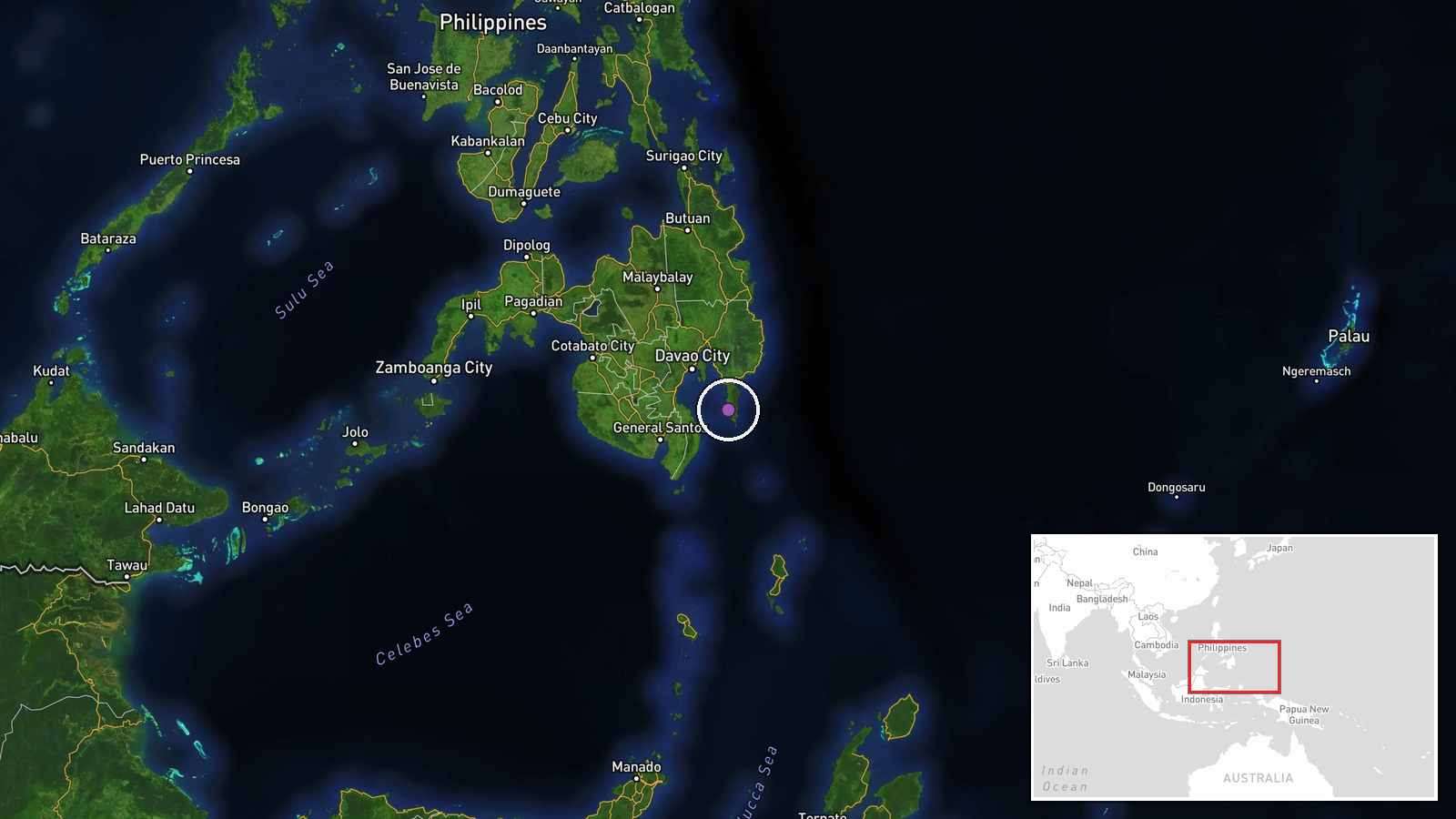
The coordinates, about 6.52 N and 126.09 E, fall in the southern Philippines, in the Mindanao region, near the Celebes Sea and Philippine Sea approaches. The location is a region-level approximation and does not identify a base, port, or site, and no specific place was reported. The area is coastal and island-dotted, which is consistent with the reported coastal reach of the systems but does not confirm where any launcher was positioned.
▶ View this event on the live map

Intel Mapper aggregates open-source reports from monitored Telegram and X channels, geolocates them, cross-checks duplicates across sources and assigns a confidence score. Entries are updated as new confirmations arrive. Read how we verify events.