Trump announces U.S. airstrikes on Iranian targets near Strait of Hormuz
What happened
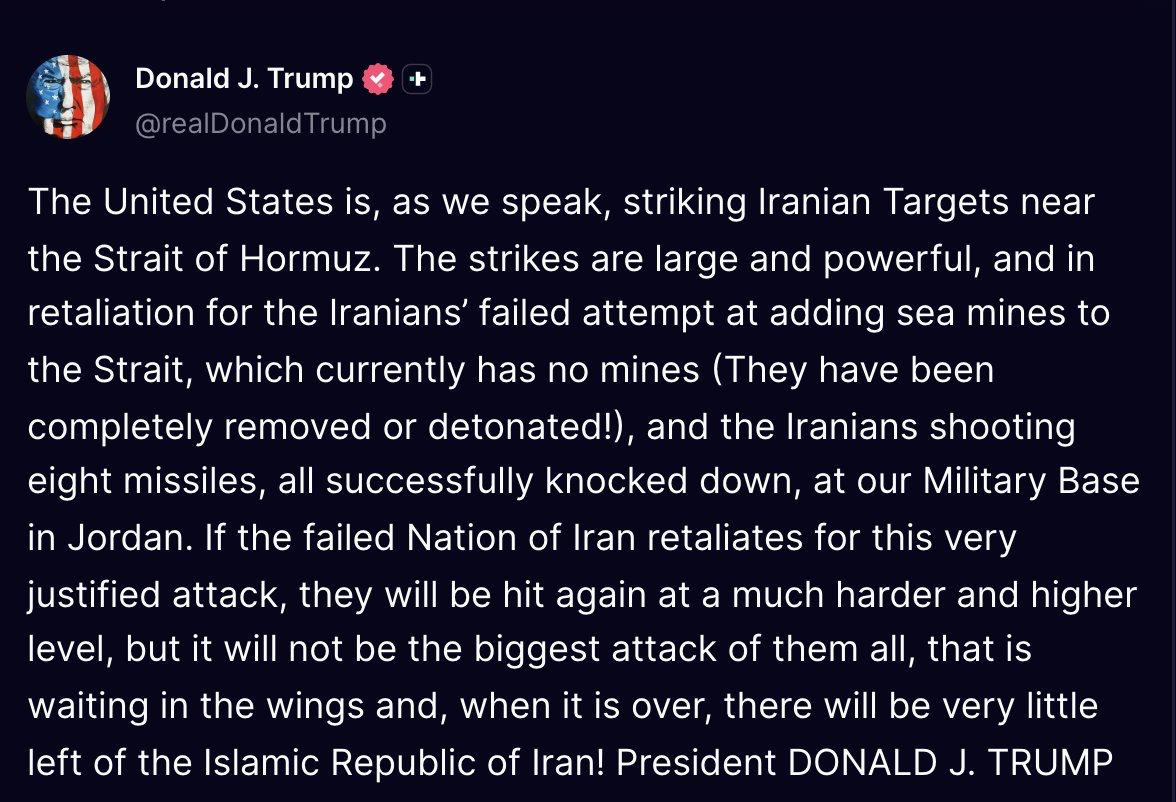
U.S. President Donald Trump announced that airstrikes against Iranian military targets near the Strait of Hormuz were underway as of his statement on September 1. Trump characterized the strikes as retaliation for Iranian sea mines and what he described as eight missile attacks on a Jordanian military base. The announcement came amid escalating military exchanges in the Persian Gulf region and included a threat of further strikes should Iran respond to the U.S. action.
Context and assessment
The Strait of Hormuz remains one of the world's most strategically vital waterways, with roughly one-fifth of global oil trade passing through it. Iran's control of its southern coastline has long made the strait a focal point for U.S.–Iran tensions. This announcement follows Iranian statements earlier the same day warning against interference with Gulf shipping and threatening military response to blockade threats. A separate reported strike on Bandar Abbas port facility in southern Iran occurred around the same timeframe, suggesting sustained U.S. military operations in the region. The escalating rhetoric from both sides—including Trump's threat of severe further strikes—indicates a significant deterioration in military posture.
Sources and confidence
Two sources reported Trump's statement: Telegram channel @ClashReport and X account @ConflictTR. Both are social media intelligence channels with partial overlap on regional coverage. The confidence score of 7.0 reflects the limited source count and reliance on social channels rather than official U.S. government statements or news wire services, which would provide stronger corroboration.
Location
The Strait of Hormuz, located between Iran and Oman in the Persian Gulf, was specified as the general operational area. Coordinates place the reference in the central strait region. A related contemporaneous event cited Bandar Abbas port in Hormozgan province, Iran's main southern Gulf port, as a specific strike location, suggesting operations concentrated along Iran's southern coastline.
Related events nearby
- U.S. President Trump declares USS George Washington carrier strike group is 'loaded to the gills with ammuniti2026-09-01 18:20 UTC · Statement · Strait of Hormuz, Persian Gulf
- Trump escalates rhetoric toward Iran, threatening total annihilation ('wiped out as a country') if Iran repeat2026-09-01 18:15 UTC · Statement · Strait of Hormuz, Persian Gulf
- U.S. President Trump escalates rhetoric against Iran, claiming the U.S. has not yet launched its 'biggest stri2026-09-01 17:51 UTC · Statement · Strait of Hormuz, Persian Gulf
- Iran's Parliamentary Speaker Ghalibaf threatens military response to any blockade of Iranian Gulf oil exports,2026-09-01 15:45 UTC · Statement · Strait of Hormuz, Persian Gulf
- Iran's Parliamentary Speaker Ghalibaf warns the U.S. against violating agreements over Strait of Hormuz passag2026-09-01 14:25 UTC · Statement · Strait of Hormuz, Persian Gulf
▶ View this event on the live map
Intel Mapper aggregates open-source reports from monitored Telegram and X channels, geolocates them, cross-checks duplicates across sources and assigns a confidence score. Entries are updated as new confirmations arrive. Read how we verify events.