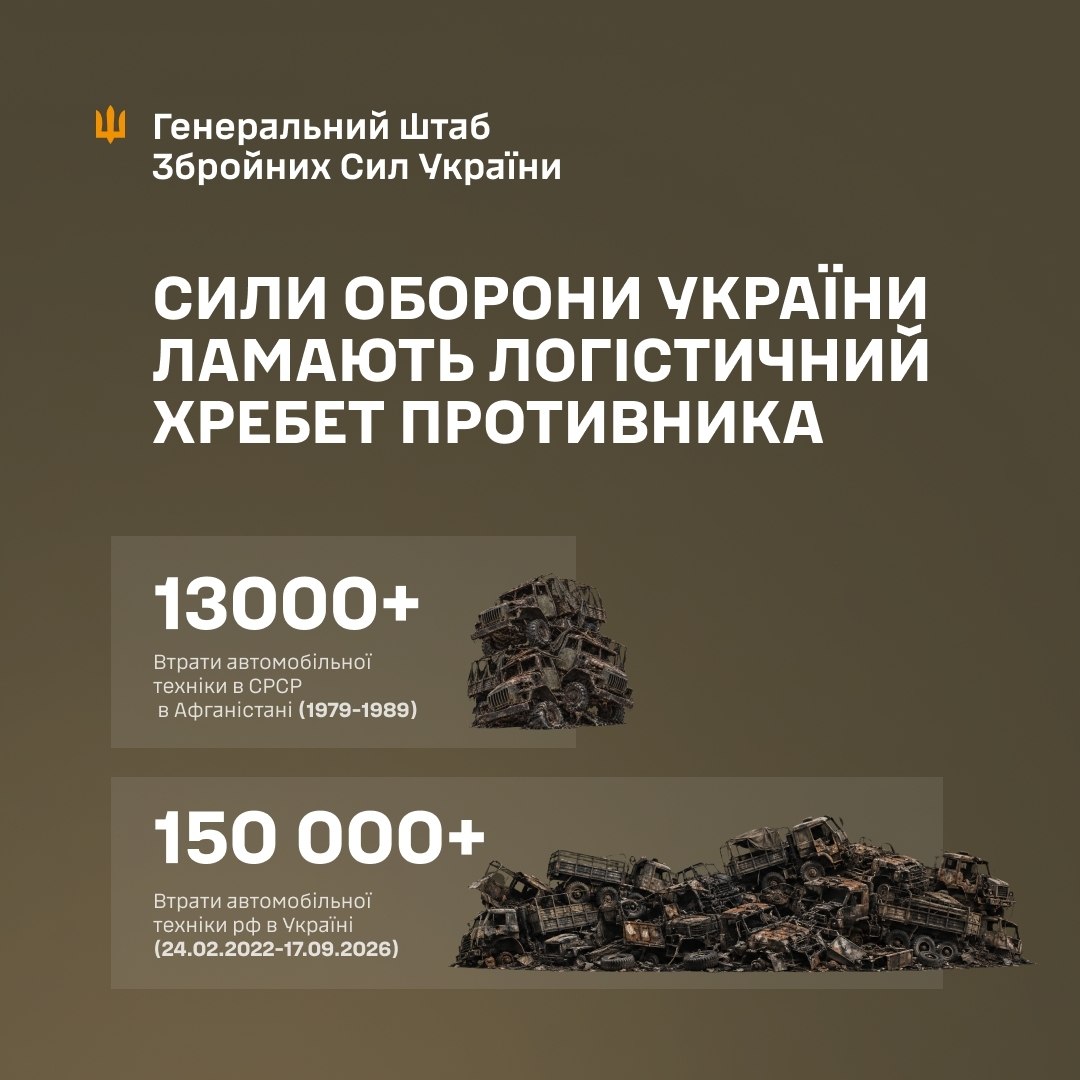
Ukrainian General Staff claims destruction of over 150,000 Russian vehicles since invasion
What happened
The Ukrainian General Staff announced on 17 September that Ukrainian forces have destroyed more than 150,000 Russian military vehicles and fuel tankers since the start of the full-scale invasion in February 2022. The statement, issued via Telegram, compared this figure to Soviet losses during the decade-long war in Afghanistan, when approximately 13,000 vehicles were lost. Ukrainian officials characterised each destroyed truck and fuel tanker as disrupting enemy ammunition resupply, immobilising armoured units, and preventing offensive operations.
Context and assessment
Vehicle attrition represents a core measure of military logistics degradation. Russia's reliance on motorised transport to sustain far-flung frontlines across Ukraine makes cumulative losses significant for operational sustainability. The comparison to Afghanistan—where logistical strain contributed to Soviet strategic exhaustion—underscores Ukrainian messaging about war of attrition. This announcement follows a reported coordinated Russian missile and drone strike on 16–17 September targeting Ukrainian infrastructure, suggesting cyclical patterns of Ukrainian casualty claims accompanying Russian kinetic operations. Verification of such aggregated figures is difficult without independent confirmation, though vehicle losses across multiple fronts are documented through open-source imagery.
Sources and confidence
The claim originates solely from the official Telegram channel of the Ukrainian General Staff (@GeneralStaffZSU). No independent corroboration or cross-confirmation from third-party monitors is noted. The confidence score of 8.0 reflects that the source is an official state institution with institutional credibility, though the claim is unverified by external analysts. Independent satellite or damage assessment data would strengthen confidence; contradictory claims from Russian sources or recognised third-party monitors would lower it.
Location
Kyiv, Ukraine—the statement's point of origin. The claimed destruction spans the entire Ukrainian theatre of operations across multiple frontlines since February 2022, covering an area from Donbas to Russian-occupied territories in eastern and southern Ukraine, though no specific geographic concentration is implied in the announcement.
Related events nearby
- Ukrainian President Zelenskyy claims North Korea has deployed 30,000–50,000 soldiers to Russia to support the 2026-09-17 11:37 UTC · Statement · Kyiv, Ukraine
- Ukrainian President Zelensky states China's political non-alignment is detrimental to Ukraine's war effort. Ze2026-09-17 09:28 UTC · Statement · Kyiv, Ukraine
- Russia launched coordinated massive missile and drone attack on Ukraine night of Sept 16–17. 157 Shahed drones2026-09-17 04:15 UTC · Ballistic Missile · Kyiv, Ukraine
- Ukrainian air defense repelled incoming Russian Shahed kamikaze drone attacks over Kyiv and Kyiv Oblast. Multi2026-09-17 02:33 UTC · Siren · Kyiv, Ukraine
- Russian ballistic missile attack on Kyiv region near 03:00 local time. Ongoing precision strike campaign targe2026-09-16 19:10 UTC · UAS Strike · Kyiv, Kyiv City, Ukraine
▶ View this event on the live map
Intel Mapper aggregates open-source reports from monitored Telegram and X channels, geolocates them, cross-checks duplicates across sources and assigns a confidence score. Entries are updated as new confirmations arrive. Read how we verify events.