Iran reportedly ships jet fuel and LPG to Myanmar despite US naval blockade
What happened
A report dated 19 October 2026 says Iran has been able to export some liquefied petroleum gas and jet fuel since July, despite a United States naval blockade that has halted its crude exports. According to the account, the cargoes are hidden among a growing volume of ship-to-ship transfers carried out by other Gulf producers off Oman. Four people in maritime security who track Gulf oil movements are cited as the basis for the claim. The summary states that a jet fuel tanker reached Burma in September, which is the destination most directly tied to the report. The original text attributes the reporting to Reuters, while the event record lists a single Telegram channel, DVB News, as its only source. The location is recorded as the Gulf of Oman, the broader area where the transfers are said to take place.
Context and assessment
The significance of this report lies less in the volume of fuel than in what it suggests about how sanctions and interdiction efforts are being bypassed. A naval blockade of crude exports is designed to cut off Iran's main source of hard currency, and any petroleum product that reaches a buyer undermines that aim. Ship-to-ship transfers in the Gulf of Oman have long been used to blend, relabel and disguise the origin of cargoes, and the report suggests that Iranian product is being folded into a larger stream of legitimate Gulf trade. Myanmar is a plausible end market because its military government has faced sanctions, fuel shortages and difficulty buying from conventional suppliers, while jet fuel has direct relevance to air operations. The September arrival of a jet fuel tanker in Burma, if confirmed, would give the claim a concrete endpoint. The event record contains no related events, so the wider pattern cannot be checked against other reporting here. Operationally, the account may indicate that enforcement at sea depends heavily on identifying specific cargoes in mixed transfers, which is difficult without detailed shipping data.
Sources and confidence
The event rests on one recorded channel, a Telegram account associated with DVB News, which carries a source count of one. The original text names Reuters and cites four anonymous maritime security sources, so the underlying reporting may be a rewrite or repost rather than an independent second channel. No separate confirmation from shipping data providers, the blockade's enforcing authorities or Myanmar officials appears in the record. The confidence score of 5.9 reflects a single unverified channel combined with a low location confidence rating. Confidence would rise if a Reuters report or shipping intelligence firm confirmed the cargoes and vessel identities. It would fall if the named tanker cannot be traced or the September arrival in Burma is not corroborated.
Location
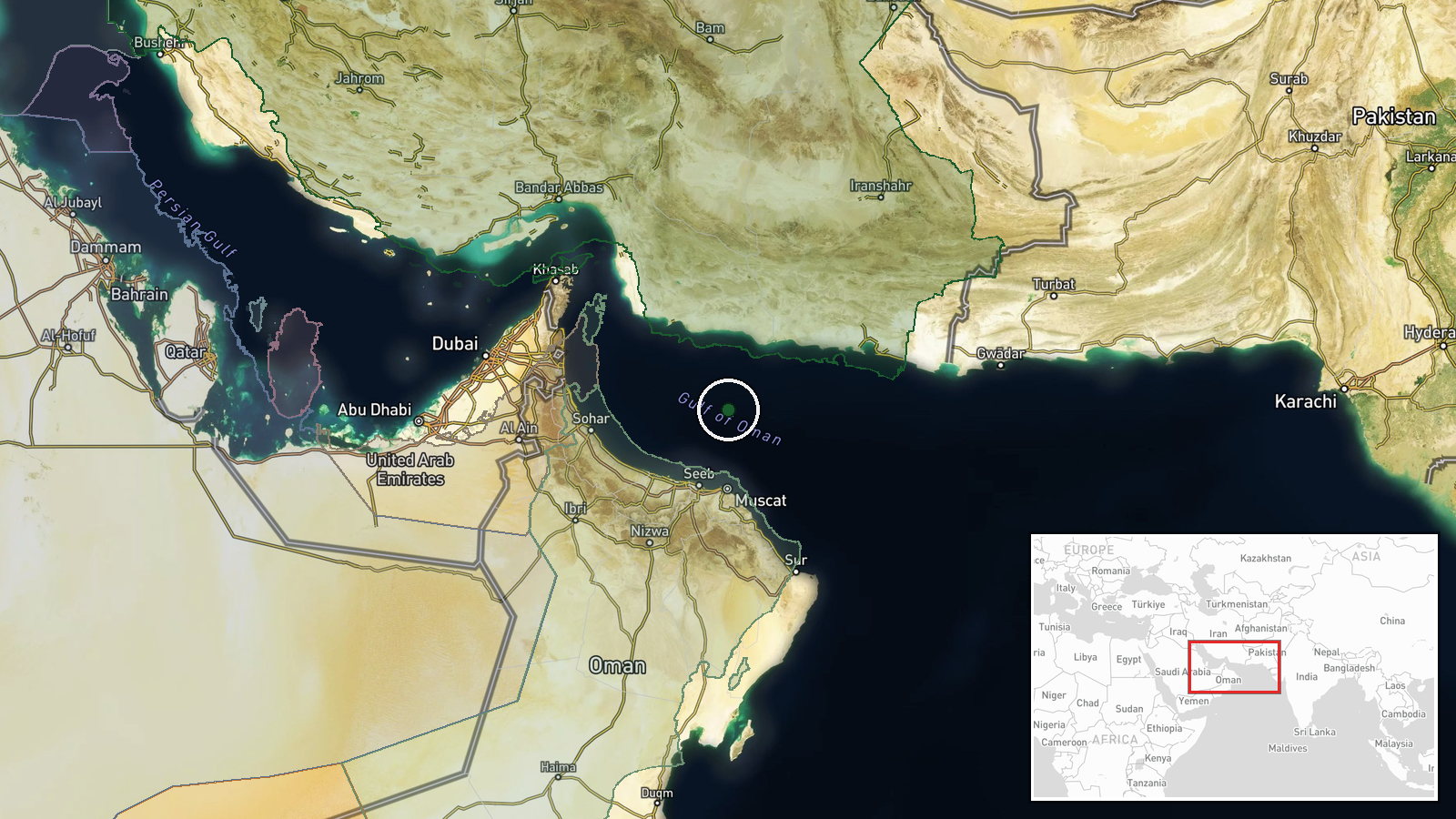
The location is recorded at region precision, placing the event at coordinates of 24.6 north and 58.6 east, in the Gulf of Oman rather than at a named port or anchorage. The point is an approximation of an open water area off Oman's northeastern coast, where ship-to-ship transfers are commonly reported. This setting sits near the approaches to the Strait of Hormuz, a narrow chokepoint through which much of the Gulf's oil passes. Because the transfers are said to occur in deep, crowded anchorage zones, the precise position of any specific cargo transfer cannot be determined from the data provided.
▶ View this event on the live map

Intel Mapper aggregates open-source reports from monitored Telegram and X channels, geolocates them, cross-checks duplicates across sources and assigns a confidence score. Entries are updated as new confirmations arrive. Read how we verify events.