Single Telegram channel reports impact on a house in Bryansk, Russia
What happened
A single Telegram channel, @supernova_plus, reports an impact on a house in Bryansk, the regional capital of Bryansk Oblast in western Russia. The post is timestamped 16 October 2026 at 21:13 UTC. The source text is fragmentary: a short Russian-language line that reads roughly as 'Bryansk ... hit on a house', followed by a disconnected phrase and a word fragment that do not form a complete account. The report does not identify the attacker, the weapon, or the number of casualties, and no damage assessment or official statement accompanies it. Because the wording is brief and incomplete, the event should be read as a claim of impact rather than a verified description of damage.
Context and assessment
Bryansk Oblast borders Ukraine and has seen repeated cross-border drone, artillery, and missile incidents since 2022, which makes reports from the region part of a longer pattern rather than an isolated development. A related event in the data describes Ukrainian Defense Forces striking a Russian electronic warfare station near Novozybkov on 15 and 16 October 2026, with the record geolocated to Ozarionnyi in the same oblast. That report falls within the same two-day window, suggesting sustained activity in the area, but the data does not establish a link between the strike on the electronic warfare site and the reported impact in Bryansk city. Operationally, a hit on a residential building in a large city could reflect targeting of military or logistics sites in or near the urban area, or it could result from intercepted or misdirected munitions falling on civilian property. Air defense engagements over cities commonly produce debris impacts of this kind. The available information cannot distinguish these possibilities, so any interpretation of intent should remain provisional until further reporting is available.
Sources and confidence
The event rests on one Telegram channel, @supernova_plus, with no cross-confirmation from another outlet, official source, or geolocated imagery in the dataset. The confidence score of 6.3 reflects this single-source status together with the fragmentary wording of the original text, which omits the attacker, the target, and any outcome. The related event comes from a separate report whose summary is truncated, so it provides context but does not corroborate the Bryansk claim. Confidence would rise with independent reporting from other channels, verified imagery of damage at a specific address, or a statement from Russian regional authorities. It would fall if the original post were deleted, revised to contradict the claim, or found to recycle older footage.
Location
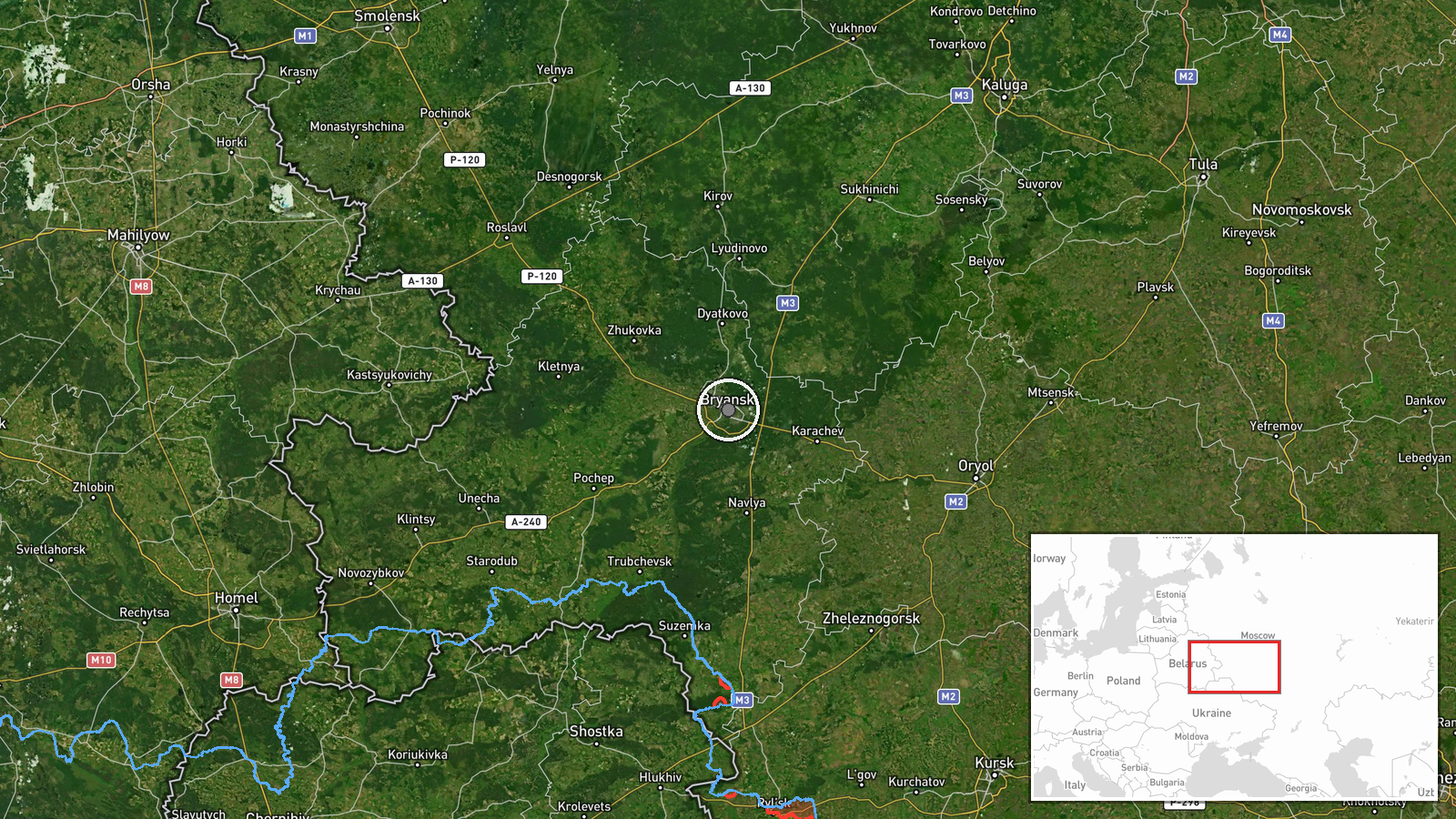
The event is placed at settlement level, using a point for the center of Bryansk city at approximately 53.2521 N, 34.3717 E. No street address or building footprint is given, and the location confidence field is empty, so the pin should be read as the city rather than the specific house. Bryansk sits on the Desna River in a largely forested landscape, and the wider oblast includes extensive woodland and lowland terrain. The city lies within a relatively short distance of the Ukrainian border, which is why it is often mentioned in reports of cross-border activity.
Related events nearby
- Ukrainian Defense Forces struck a Russian electronic warfare station near Novozybkov, Bryansk Oblast, on Octob2026-10-16 14:29 UTC · Combat · Ozarionnyi, Bryansk Oblast, Russia
▶ View this event on the live map

Intel Mapper aggregates open-source reports from monitored Telegram and X channels, geolocates them, cross-checks duplicates across sources and assigns a confidence score. Entries are updated as new confirmations arrive. Read how we verify events.