15 Russian Shahed drones tracked toward Nizhyn in northeastern Ukraine
What happened
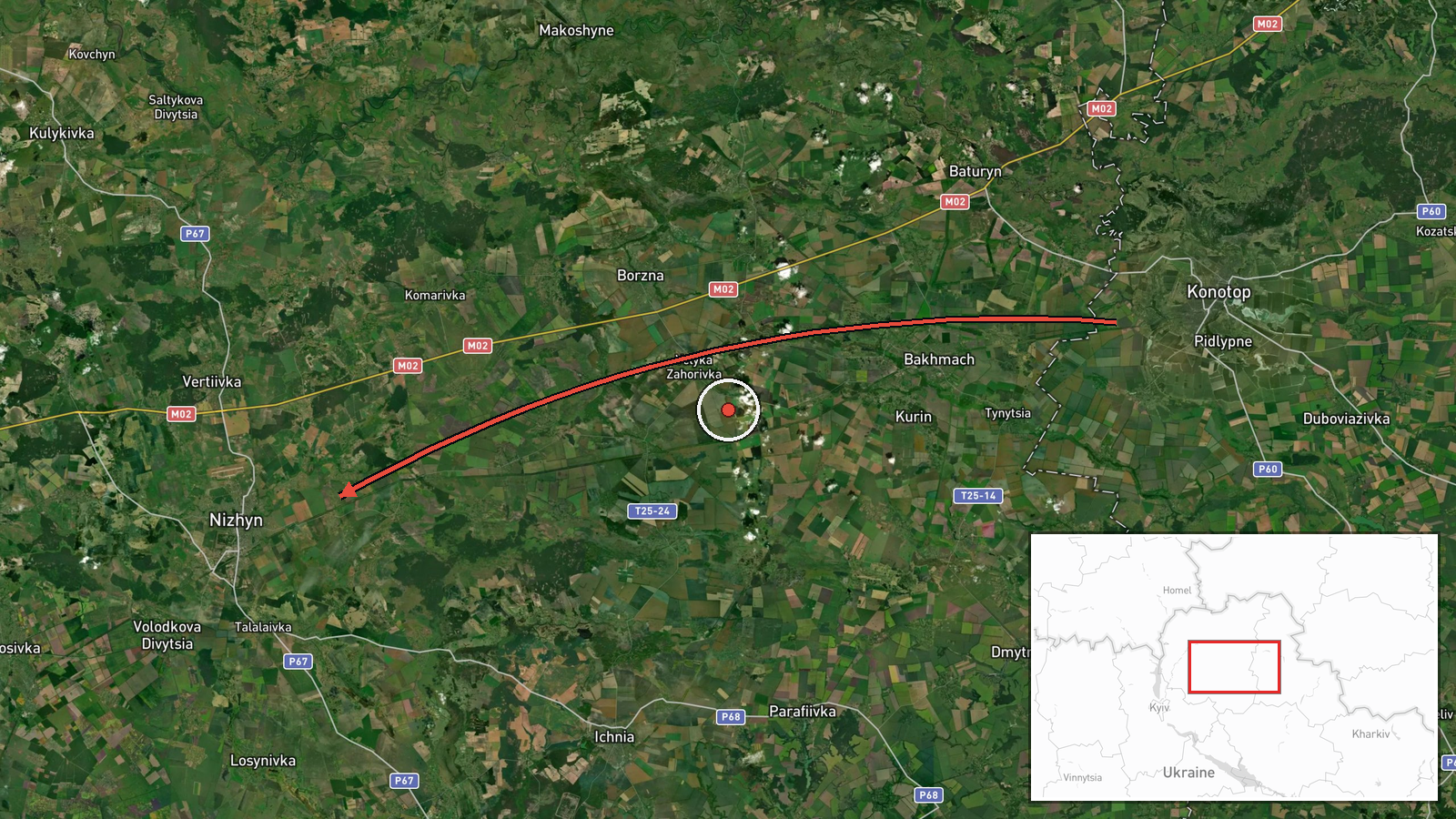
Ukrainian air monitoring reportedly detected 15 Russian Shahed-type attack drones transiting through Konotop airspace on a trajectory toward Nizhyn in Chernihiv Oblast on the morning of October 5. The report, logged at 02:12 UTC, comes from the Telegram channel @war_monitor, which tracks Ukrainian air defense observations. No strike impact or defensive outcome was reported in the monitoring data.
Context and assessment
Nizhyn, a city of roughly 70,000 in northeastern Ukraine, lies along a known corridor for Russian drone strikes targeting settlements and infrastructure in central and northern Ukraine. This detection follows a pattern of sustained Russian unmanned aircraft operations: two Banderol cruise missiles were tracked toward the same area less than 19 hours earlier on October 4, and concurrent Shahed formations were observed transiting Shostka district and approaching Kyiv Oblast overnight. Recurring strikes on this axis suggest either sustained targeting of military or civilian infrastructure near Nizhyn, or use of the corridor as a transit route to more distant objectives in Kyiv or beyond. The escalation in drone sorties over two days may indicate an intensified campaign phase.
Sources and confidence
Single source: Telegram channel @war_monitor, which aggregates Ukrainian official air monitoring reports. No cross-confirmation from other channels or official Ukrainian defense ministry statements is documented here. Confidence score of 6.0 reflects reliable source reputation but single-source reporting and absence of strike confirmation. Score would rise with corroboration from Kyiv or Chernihiv regional administration or air force statements.
Location
Nizhyn is a city in Chernihiv Oblast, northeastern Ukraine, approximately 90 km north of Kyiv. The detection point near Konotop, a key transit node 50 km southwest of Nizhyn, lies on a direct flight corridor often used by Russian strike drones approaching targets in the Kyiv region and beyond. Precision is settlement-level based on Ukrainian air monitoring protocols.
Related events nearby
- Ukrainian air monitoring: 2 Russian Banderol mini cruise missiles passing Konotop, heading toward Nizhyn.2026-10-04 07:02 UTC · Cruise Missile · Nizhyn, Ukraine
- Ukrainian air monitoring: 7 Russian Shahed-type drones passing Shostka district, heading toward Chernihiv Obla2026-10-04 22:49 UTC · Drone Transit · Chernihiv Oblast, Ukraine
- Ukrainian air defense monitoring reports massed Russian Shahed-136 reactive drones transiting toward Kyiv and 2026-10-04 07:48 UTC · Siren · Kyiv Oblast, Ukraine
- Ukrainian air monitoring: 1 Russian jet-powered Shahed (Geran-3) drone over Baryshivka.2026-10-04 08:37 UTC · Drone Transit · Baryshivka, Ukraine
- Ukrainian air monitoring: 1 Russian jet-powered Shahed (Geran-3) drone over Brovary district.2026-10-04 09:07 UTC · Drone Transit · Brovary district, Ukraine
▶ View this event on the live map
Intel Mapper aggregates open-source reports from monitored Telegram and X channels, geolocates them, cross-checks duplicates across sources and assigns a confidence score. Entries are updated as new confirmations arrive. Read how we verify events.