Trump announces energy ceasefire agreement between Russia and Ukraine
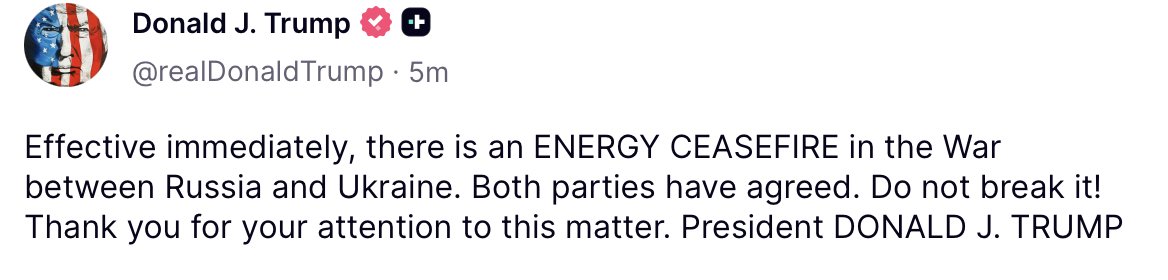
What happened
U.S. President Donald Trump announced on October 11 that Russia and Ukraine have agreed to a ceasefire specifically targeting energy infrastructure. Speaking from Washington, D.C., Trump stated both parties have consented to halt attacks on power plants, refineries, and related facilities. The announcement follows Trump's recent phone call with Russian President Putin, according to earlier statements from the Trump administration.
Context and assessment
Energy infrastructure has been a focal point of the conflict, with both Ukrainian and Russian forces targeting power generation and distribution networks to degrade the opponent's war-fighting capacity and civilian resilience. The announcement follows a pattern of Trump administration statements over three days pressuring Ukraine to cease strikes on Russian oil refineries, including threats to curtail U.S. intelligence sharing. These moves suggest the administration is attempting to broker localized humanitarian agreements as part of broader ceasefire negotiations. However, the practical enforceability and verification of such a sectoral ceasefire—given the decentralized nature of energy targeting and the difficulty of real-time monitoring—remains unclear.
Sources and confidence
Reported by X accounts @WarMonitor3 and @ConflictTR on October 11. Coverage derives from Trump's direct public statements. Confidence of 6.7 reflects reliance on social media reporting of a political announcement rather than independent military or humanitarian verification. Confirmation from Ukrainian officials or Russian statements would significantly raise confidence; details on verification mechanisms would strengthen assessment.
Location
Washington, D.C., United States. Trump's announcement was made from the U.S. capital, where the presidency is based. The agreement itself concerns energy infrastructure across Ukraine and Russia, spanning multiple contested and non-contested regions along the front line and rear areas.
Related events nearby
- Trump claims Russia wants a peace deal with Ukraine while Zelenskiy opposes it. Trump states Putin expressed w2026-10-11 07:29 UTC · Statement · Washington, D.C., USA
- Trump envoy Keith Witkoff threatened to cut off U.S. intelligence sharing with Ukraine if it continues strikin2026-10-10 18:05 UTC · Statement · Washington, D.C., United States
- Trump states Ukraine needs new leadership, claiming Zelenski refuses to negotiate. Remarks reflect U.S. pressu2026-10-10 16:56 UTC · Statement · Washington, D.C., United States
- Trump reiterates warning to Ukraine against striking Russian oil refineries, threatening loss of U.S. intellig2026-10-10 16:31 UTC · Statement · Washington, D.C., United States
▶ View this event on the live map

Intel Mapper aggregates open-source reports from monitored Telegram and X channels, geolocates them, cross-checks duplicates across sources and assigns a confidence score. Entries are updated as new confirmations arrive. Read how we verify events.