Single-source report says Ukrainian drones have kept Moscow airspace restricted six days
What happened
A post on X from the account @WarMonitor3 states that Ukrainian drone attacks have forced airspace restrictions over Moscow for six days in a row, disrupting commercial air travel and the wider economy. The post was published on 16 October 2026 at about 08:52 UTC, and it is the only source logged for this event. Its wording is informal and offers no official confirmation. It does not name specific airports, flight numbers, or the number of affected departures. A second sentence in the same post claims that Ukrainian forces have secretly launched a campaign to cripple Russian aviation. The report presents this as a covert effort but gives no supporting detail. The event is classed as an airspace closure, with Russia listed as the actor, and the location is recorded at the city of Moscow.
Context and assessment
Moscow is Russia's political and economic center and the country's main hub for international and domestic air traffic, so airspace restrictions there would affect a large share of civil aviation. Several related events were logged the same day. A UAS strike entry at 00:04 UTC reports that Ukrainian drones attacked Moscow and hit industrial and warehouse facilities, though impact details remain unconfirmed. On 15 October, Putin gave conflicting public statements about Ukrainian strikes on Russian refineries, first saying they caused no significant damage and then saying Russia would retaliate against Ukrainian energy infrastructure. The mobilization statement and the Assad asylum statement are thematically unrelated, but they show the broader volume of Moscow-focused reporting that day. Taken together, a pattern of drone activity near Moscow and a stated focus on energy targets suggests a sustained effort to pressure infrastructure and logistics. Airspace restrictions could be a defensive response by Russian air defense to repeated drone activity rather than a direct target of the attacks. The covert aviation campaign claim cannot be verified from the data available here.
Sources and confidence
Only one channel, X account @WarMonitor3, has reported this event, and no second source is logged for cross-confirmation. The confidence score of 5.4 reflects that single-source basis, the lack of specific details such as airport names or closure notices, and the unverified claim about covert intent. Confidence would rise with independent confirmation from Russian aviation authorities, airline notices, flight tracking data showing sustained closures, or wire-service reporting. It would fall if the account is found to repeat unsourced claims, or if flight data shows no restrictions matching the stated six-day period.
Location
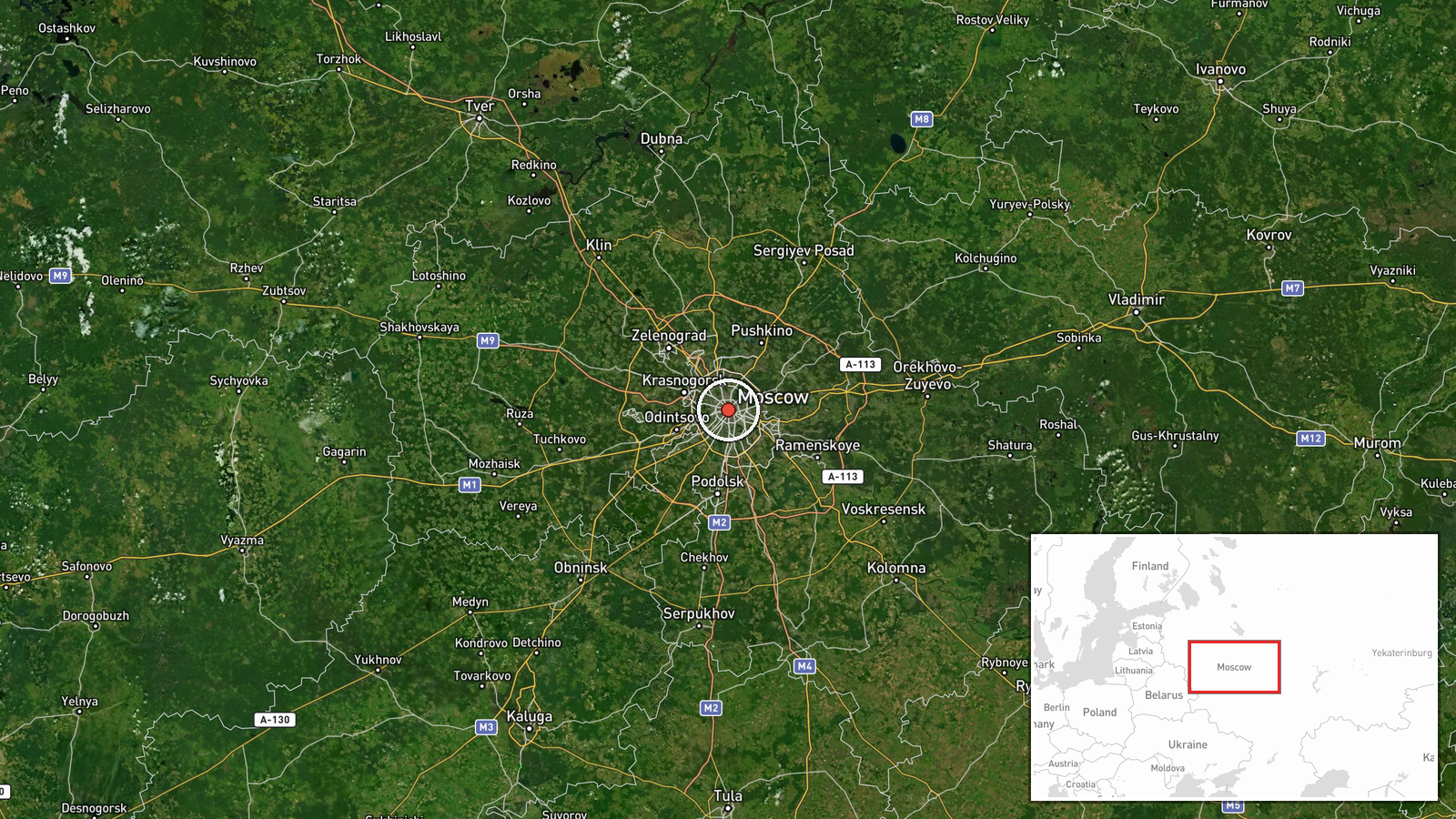
The coordinates correspond to central Moscow and are recorded at settlement precision, so the point marks the city rather than a specific airport or facility. Any airspace closure would likely extend over several airports around the city rather than a single site. Moscow lies on the Moskva River in western Russia, and its major airports sit on the periphery, with the city ringed by the Moscow Ring Road. No separate location confidence score was assigned.
Related events nearby
- Russia and India have begun the joint military exercise 'Indra-2026', according to a conflict-monitoring post.2026-10-16 09:35 UTC · Military Exercise · Russia
- Reports say Russia's new mobilization may forcibly draft indebted men, the unemployed, and male students faili2026-10-16 07:42 UTC · Statement · Moscow, Russia
- Ukrainian drones reportedly attacked Moscow, with reports of industrial and warehouse facilities hit. Impact d2026-10-16 00:04 UTC · UAS Strike · Moscow, Russia
- Putin states Russia will retaliate against Ukrainian strikes on Russian refineries. Statement reiterates Russi2026-10-15 16:36 UTC · Statement · Moscow, Russia
- Putin claims Ukrainian strikes on Russian refineries have caused no significant damage, contradicting earlier 2026-10-15 15:58 UTC · Statement · Moscow, Russia
▶ View this event on the live map

Intel Mapper aggregates open-source reports from monitored Telegram and X channels, geolocates them, cross-checks duplicates across sources and assigns a confidence score. Entries are updated as new confirmations arrive. Read how we verify events.