Japan scrambles fighter jets on three consecutive days over possible airspace violations
What happened
Japan's Air Self-Defense Force reportedly scrambled fighter aircraft on October 16, 17 and 18 in response to possible airspace violations over the Sea of Japan, the Sea of Okhotsk and the East China Sea. The account comes from the official Joint Staff Office post on X. It says fighters from the Central Air Defense Force, among other units, were launched, and it describes the incidents as possible violations rather than confirmed ones. The post does not identify the aircraft or the countries involved. It also states that its accompanying photograph is a reference image rather than footage of the incidents, and it carries the hashtags for scramble and F-2 fighter operations. The notice was published on October 19 UTC and covers three separate days across three maritime areas.
Context and assessment
Japan regularly scrambles fighters when radar tracks approach or enter national airspace or when unidentified aircraft are detected near its territory, so routine responses of this kind are common and do not by themselves signal a crisis. The three named areas are significant. The Sea of Japan and the Sea of Okhotsk lie adjacent to the Russian Far East, where Russian military aviation operates, while the East China Sea sits near Chinese air activity and the disputed Senkaku or Diaoyu islands, which Japan administers. Russian and Chinese military aircraft have both been reported in the broader region in recent years, including in joint patrols, and Japan has often publicized such scrambles. The Intel Mapper feed contains no related events for this report, so this item cannot be placed within a documented sequence in this dataset. Operationally, activity reported in several distant sectors over three days could reflect multiple separate aircraft tracks, a wider regional deployment, or a coordinated patrol. The statement offers no evidence for any of these readings, and the term possible violation means the tracks were not confirmed as intrusions.
Sources and confidence
The report rests on a single channel, the official Joint Staff Office account on X, and no independent outlet or wire service is recorded in the data. The source's official status supports its reliability, but the post is brief and lacks detail, which limits verification. The confidence score of 6.1 reflects that single-source position and the hedged wording of possible violations. Confidence would rise with a matching Ministry of Defense press release, Japanese news reports citing officials, or confirmation from Russian or Chinese authorities. It would fall if the Joint Staff Office issued a correction or if later reporting showed the scrambles were unrelated to airspace concerns.
Location
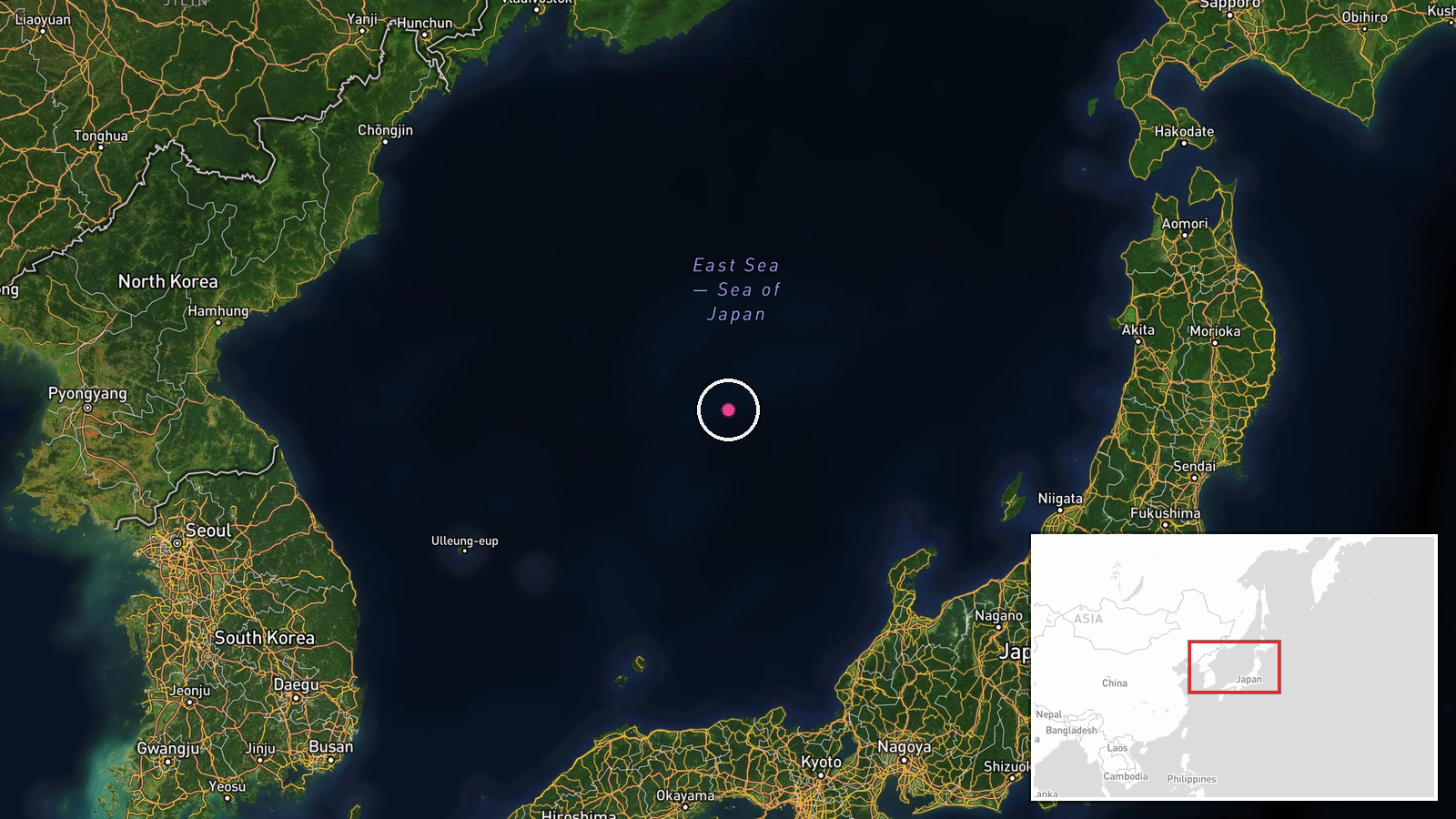
Location precision is region level and location confidence is low. The coordinates, roughly 39 degrees north and 134.5 degrees east, are an approximate central point in the Sea of Japan, off the western coast of Honshu, rather than a specific incident position. The statement names three broad maritime areas, so no single point of interception is known. The Sea of Japan is a semi-enclosed body bordered by Japan, Russia, North Korea and South Korea, and it connects to the Sea of Okhotsk to the north through straits. The East China Sea lies much farther southwest and is not represented by the pin.
▶ View this event on the live map

Intel Mapper aggregates open-source reports from monitored Telegram and X channels, geolocates them, cross-checks duplicates across sources and assigns a confidence score. Entries are updated as new confirmations arrive. Read how we verify events.