Lebanese military court seeks arrest of two Hezbollah figures over seized explosives truck
What happened
A report posted on X by the account @Osint613 states that Lebanon's government commissioner to the military court has issued arrest warrants for two senior Hezbollah figures, known as 'Sajed' and 'Dhu al-Fiqar', over an explosives truck seized in Lebanon. According to the report's wording, the truck drivers told investigators that Sajed handed them the explosives, and that Dhu al-Fiqar was due to receive them in Beirut's Dahiyeh district. The event is dated 20 October 2026 at 11:56 UTC. The report does not give the date or place of the seizure, the quantity of explosives, or whether the warrants have been executed. Both nicknames appear only as reported, and no official Lebanese statement is cited in the data.
Context and assessment
The warrants land in a heated domestic debate over who may hold weapons in Lebanon. On 19 October, Lebanese MP Razi Al-Hajj demanded that the Hezbollah explosives case be referred to the Judicial Council and called for firm implementation of weapons exclusivity to the state. Hours later, Walid Jumblatt argued that Hezbollah has no right to reclaim explosives seized by the army, warned against renewed war, and called for amending the Israel-Lebanon framework agreement. The legal step therefore reads as an attempt by state institutions to assert control over an arms file that is politically sensitive. The same day, an Israeli drone reportedly dropped munitions on a house near Kfar Shouba in Nabatieh, where the munitions reportedly failed to detonate, and explosions were reported in Tebnine. Those strikes, along with Israeli tanks advancing into Tal al-Hawa in Syria's Quneitra governorate on 20 October, suggest a wider and active military picture across the border region. None of these related events is directly linked to the Beirut warrants in the source data, so any connection should be treated as a hypothesis rather than an established relationship.
Sources and confidence
The event rests on a single channel, X account @Osint613, with no cross-confirmation from wire services, Lebanese state media, or the military court itself in the data provided. This is why the confidence score is low at 6.5. The account's history and sourcing method are not described in the data. Confidence would rise if a Lebanese judicial or army statement, or reporting from established Lebanese outlets, confirmed the warrants and named the individuals. It would also rise if the seizure itself were documented with a date and place. Confidence would fall if the nicknames could not be tied to identifiable officials or if the warrants were denied or described differently by officials.
Location
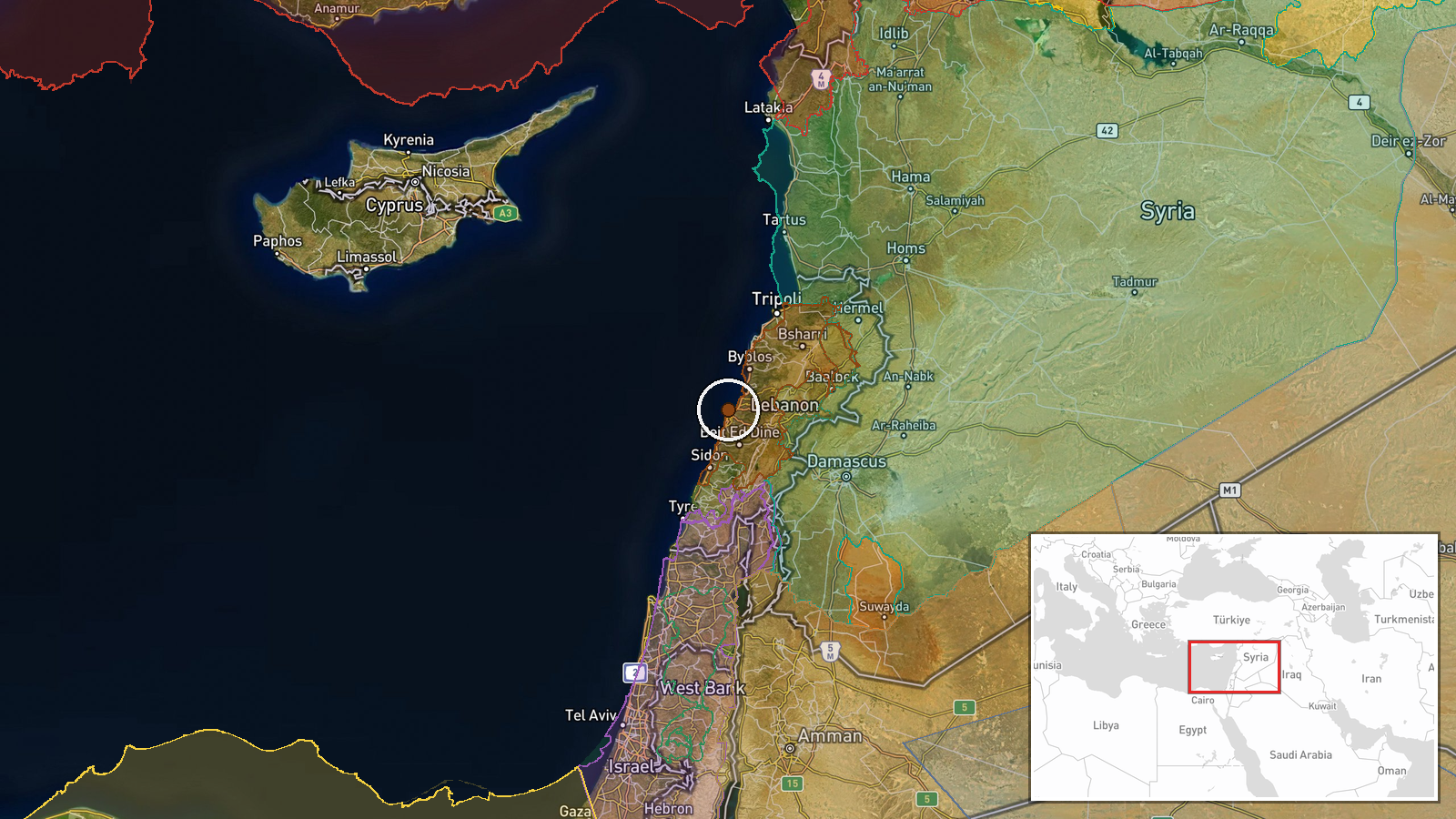
The marker is placed at the settlement level for Beirut, Lebanon, at approximately 33.8938 N, 35.5018 E, and the location confidence field is blank. The report places the intended handover in Dahiyeh, the southern suburbs of Beirut, but the data does not specify where the truck was stopped, so the marker reflects the city rather than a precise site. The city sits on the Mediterranean coast, and Dahiyeh lies to its south and southeast, a densely built area that is a long-standing Hezbollah stronghold.
Related events nearby
- Walid Jumblatt says Hezbollah has no right to reclaim army-seized explosives, warns against wars and calls for2026-10-19 20:14 UTC · Statement · Beirut, Lebanon
- Lebanese MP Razi Al-Hajj demands the Hezbollah explosives case be referred to the Judicial Council and calls f2026-10-19 14:39 UTC · Statement · Beirut, Lebanon
- Eastern Libya's House of Representatives ratified the 2019 Turkey maritime delimitation memorandum with the GN2026-10-20 11:33 UTC · Diplomacy · Tripoli, Libya
- Israeli forces advanced with two tanks into Tal al-Hawa, west of Jubata al-Khashab in northern Quneitra countr2026-10-20 09:52 UTC · Tank · Tal al-Hawa, Jubata al-Khashab, Quneitra Governora
- Explosions reported in Tebnine, southern Lebanon, following reports of Israeli Defense Forces (IDF) strikes. I2026-10-19 16:14 UTC · Airstrike · Tebnine, Lebanon
▶ View this event on the live map

Intel Mapper aggregates open-source reports from monitored Telegram and X channels, geolocates them, cross-checks duplicates across sources and assigns a confidence score. Entries are updated as new confirmations arrive. Read how we verify events.