Iran threatens to strike Israel's Dimona nuclear site again; unverified single-source claim
What happened
Intel Mapper logged a statement on 23 October 2026, at 09:49 UTC, attributed to Iran, that Iran threatens to hit Israel's Dimona nuclear project again. The original post, from the account X (@Osint613), adds a parenthetical claim that the main facility lies very deep under rock and that none of Iran's missiles can get close. The wording is informal and does not name a launch plan, unit, or timeline. The event is geolocated to Tehran, Iran, which marks where the claim originated rather than where any action would occur. No independent outlet is listed as confirming the post, and the data reports no strike, damage, or casualties.
Context and assessment
Dimona, in Israel's Negev Desert, hosts a nuclear research complex that Israel has never fully described publicly, which makes any Iranian reference to it both symbolically and militarily sensitive. The threat sits within a cluster of Tehran-origin statements logged over roughly seven hours on the same day. An IRGC warning at 00:13 UTC accused Washington of inciting ships to transit Hormuz illegally and threatened retaliation against US regional bases. At 01:39 Iran warned that renewed US and Israeli airstrikes would bring retaliation across the Gulf, naming bases, warships, airports and oil pipelines. At 08:02 Supreme Leader-linked media published a photo of the Dimona plant under 'New fronts will be opened' and 'soon' headlines. Later posts from the IRGC Navy commander and the foreign minister focused on US naval posture and missile-defense spending. Taken together, the sequence reads as coordinated messaging rather than a discrete operational signal. Such statements may aim at deterrence, domestic audiences, or pressure on Washington and Jerusalem. The claim about the facility's depth is a technical assertion that cannot be verified from open data and may be intended to reassure or to provoke. Absent launch indicators, movement reports, or official confirmation, the most defensible reading is rhetorical escalation.
Sources and confidence
The post comes from a single account, X (@Osint613), which is the only listed source; the record shows a source count of one and no cross-confirmation. The related Tehran statements carry their own sourcing, but they are statements by officials and state-linked media rather than independent verification of any military event. The confidence score of 5.9 is low, reflecting a single unverified channel, a technical claim about facility depth that cannot be checked from open data, and the absence of corroborating reporting. Confidence would rise if major outlets or official Israeli or Iranian channels reproduced the statement with context, or if imagery or flight data showed related military activity. It would fall further if the account were found to be recycling older material or if the claim were retracted.
Location
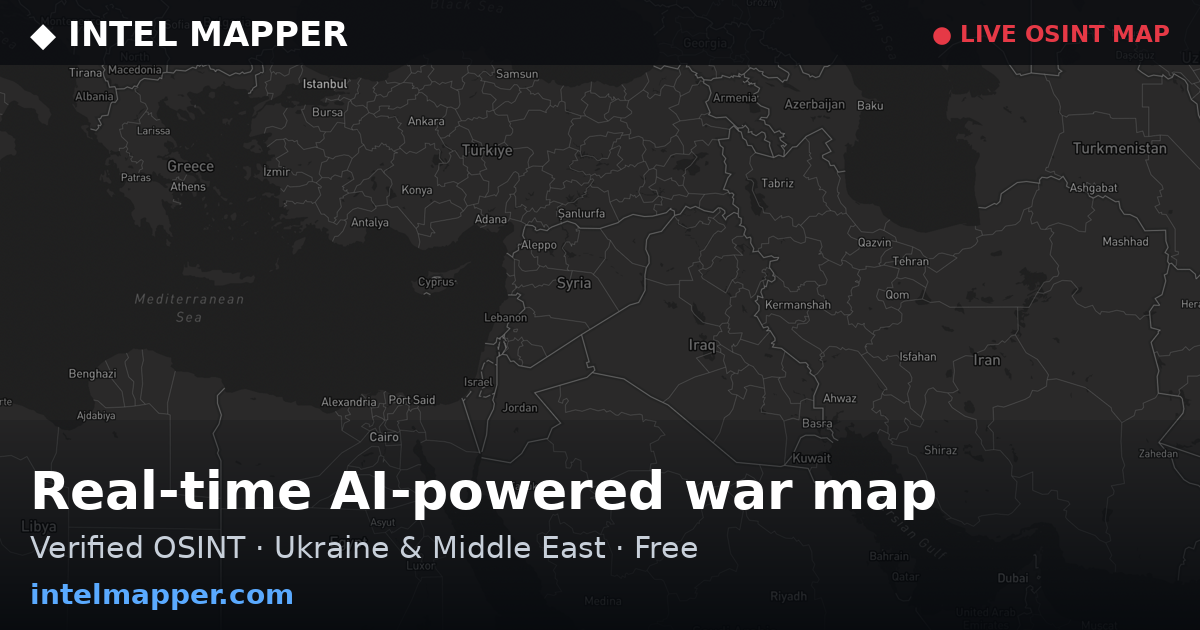
The pin is placed on Tehran at settlement precision, reflecting the event record's listed origin of the statement. No facility-level location is attached to the threat itself. Dimona, the named target, lies in Israel's Negev Desert in the south of the country, a semi-arid region of open plains and dry wadis. The pin therefore marks where the claim was made, not where it concerns. Location confidence is recorded as null, so the precise placement should be treated as approximate.
Related events nearby
- IRGC Navy commander Ali Azmaei claims U.S. forces have moved 600-700 km from the Strait of Hormuz and have no 2026-10-23 08:07 UTC · Statement · Tehran, Iran
- Iran's Supreme Leader-linked media threatened Israel's Dimona nuclear plant, publishing its photo under 'New f2026-10-23 08:02 UTC · Statement · Tehran, Iran
- Iranian FM Araghchi claims the US spent $11B on Israeli missile defense and fired more interceptors than Israe2026-10-23 06:58 UTC · Statement · Tehran, Iran
- Iran warns renewed US and Israeli airstrikes would trigger retaliation across the Gulf, targeting US bases, wa2026-10-23 01:39 UTC · Statement · Tehran, Iran
- IRGC accuses the US of inciting ships to transit Hormuz illegally and warns retaliation could cover US bases i2026-10-23 00:13 UTC · Statement · Tehran, Iran
▶ View this event on the live map

Intel Mapper aggregates open-source reports from monitored Telegram and X channels, geolocates them, cross-checks duplicates across sources and assigns a confidence score. Entries are updated as new confirmations arrive. Read how we verify events.