Israeli forces reportedly demolish homes of suspects in Yehuda Junction attack in Hebron
What happened
A post on X from the account @Osint613, dated 30 October 2026, states that the Israeli Defense Forces blew up the family homes of the militants behind the Yehuda Junction attack in Hebron. The post says the attack took place one week earlier and left two soldiers dead, using the word 'murdered.' The original text is brief and includes no video, photographs, or official statement, so the description of the demolition rests on the account's own claim. The report does not name the individuals, the exact time of the demolition, or the number of homes affected. The post frames the demolition as a response to the attack.
Context and assessment
Hebron is the largest Palestinian city in the southern West Bank and one of the most sensitive urban areas in the territory. Its historic center contains the Tomb of the Patriarchs, and the city is divided into sectors with different security arrangements, which has made it a recurring site of friction between Israeli forces and residents. Demolition of the homes of attackers' relatives is a punitive measure that Israeli authorities have used in past cases. Israel presents it as a deterrent, while rights groups and many international bodies describe it as collective punishment that breaches international humanitarian law. The related events in this feed are mostly Israeli domestic stories, including political claims about elections, a soldier's espionage case, and a vote-buying investigation. None of them directly concerns the West Bank, so they do not establish a link to this event. If the claim is accurate, a demolition about a week after the attack suggests a planned administrative and military process rather than an immediate reaction. Such operations can be intended to signal deterrence to local residents, though this is an inference rather than something the report states.
Sources and confidence
The event rests on one channel, X account @Osint613, with no cross-confirmation from other outlets, official Israeli statements, or Palestinian reporting in the dataset. The confidence score of 6.8 reflects that single-source status, the absence of imagery or named individuals, and the lack of an independently verified timeline for the attack. Confidence would rise with an IDF or police statement, wire coverage, or geolocated photographs or video of the demolition. It would fall if the attack timeline or casualty claim could not be matched to official or media reports.
Location
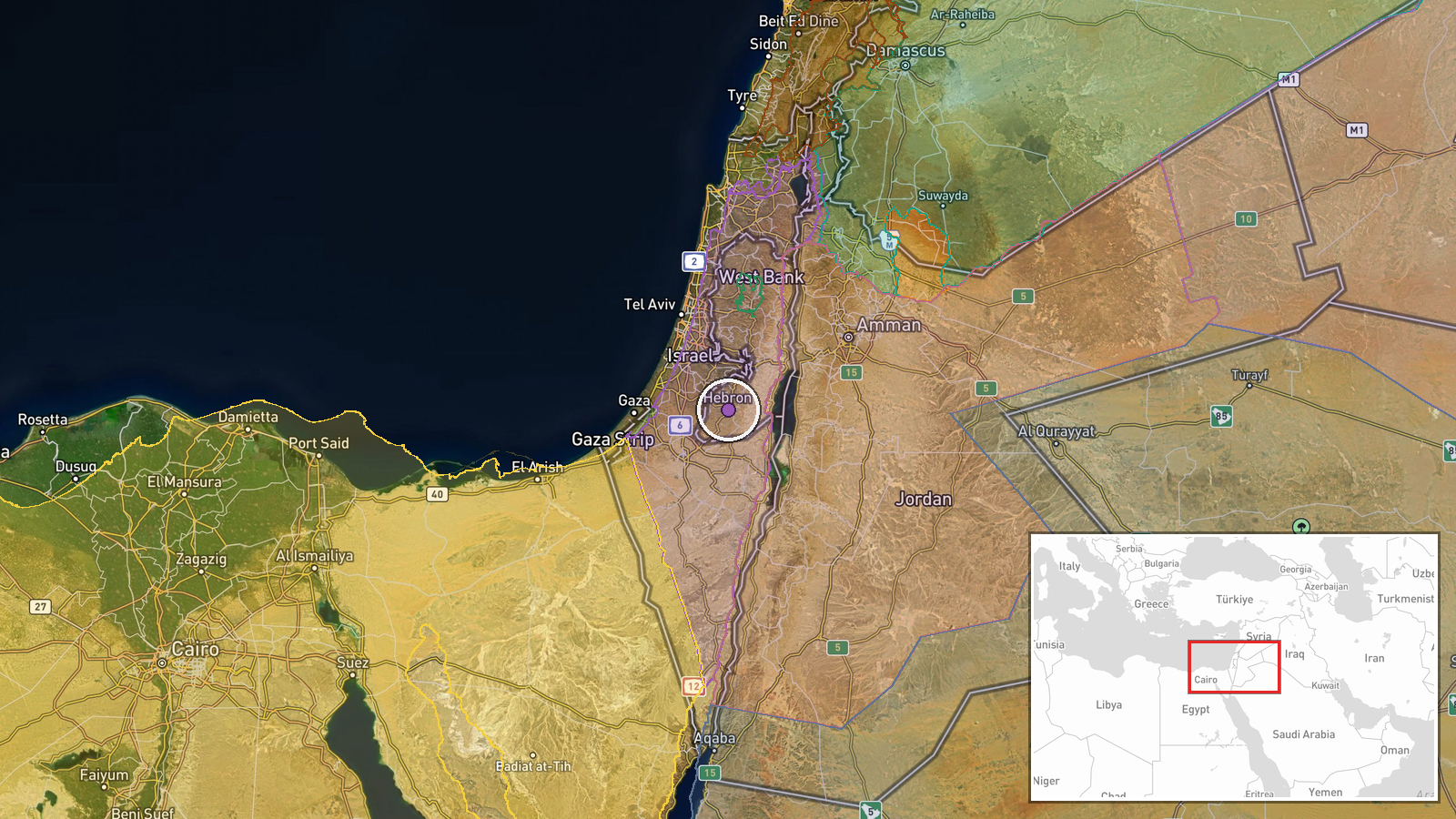
The location is coded at settlement precision, meaning the marker reflects the general center of Hebron rather than a specific house or junction. The exact site of the demolition and the Yehuda Junction attack are not confirmed by the data. Hebron sits in hilly terrain in the southern West Bank, with a dense old city and newer neighborhoods on surrounding slopes. The city is divided into H1 and H2 sectors, with H2 under Israeli security control.
Related events nearby
- Arab Israeli MP Ahmed Tibi claims Netanyahu wants to launch war on Iran with Trump's coordination after US mid2026-10-29 23:16 UTC · Statement · Jerusalem, Israel
- Israeli military soldier to be tried for alleged espionage for Iran; he is accused of leaking photos of US air2026-10-30 06:23 UTC · Report · Jerusalem, Israel
- Shin Bet is investigating whether countries besides Qatar attempted to influence Israel's elections, a counter2026-10-29 19:16 UTC · Report · Jerusalem, Israel
- IDF soldier, arrested last September for allegedly acting for an Iranian entity, indicted on charges of passin2026-10-29 17:15 UTC · Report · Jerusalem, Israel
- Israeli police arrested 7 suspects, including 3 school principals, in an alleged vote-buying scheme tied to Ra2026-10-29 14:51 UTC · Police Operation · Israel
▶ View this event on the live map

Intel Mapper aggregates open-source reports from monitored Telegram and X channels, geolocates them, cross-checks duplicates across sources and assigns a confidence score. Entries are updated as new confirmations arrive. Read how we verify events.