Israel escalates Lebanon ops; U.S.-Russia diplomacy continues amid ongoing Ukraine strikes
Key developments
- Israeli airstrikes on southern Lebanon continue; Lebanese health ministry reports 4,362 cumulative killed since March 2, 2026
- Iranian official reportedly claims anti-ship missile strike on U.S. warship; single-source account lacks independent corroboration
- Seven ambassadors formally present credentials to Syrian President; international normalization proceeding amid Israeli military positioning on Syrian territory
- U.S. diplomatic envoys (Kushner/Witkoff) visit Kyiv after Russian airstrikes on intended landing airports force train travel from Poland
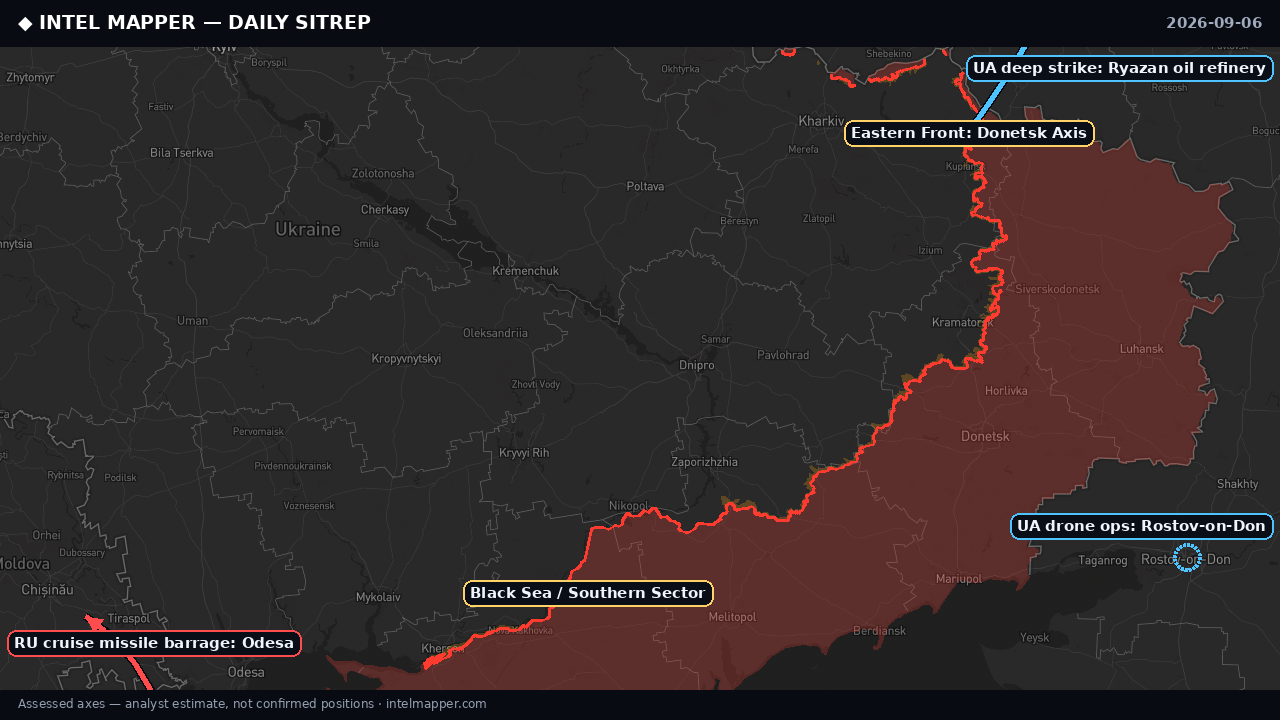
- Ukrainian strikes on Rostov-on-Don Airfield and Ryazan Oil Refinery mark continued deep operations against Russian logistics
- Ukrainian General Staff reports 206 daily combat clashes; Russian forces deploy 5,308 kamikaze drones with sustained offensive pressure
- NATO officials warn alliance unprepared for prolonged Russia conflict due to limited capacity, political divisions, and public support concerns
Middle East 30 tracked events
Israeli military operations in southern Lebanon intensified on 6 September with extensive fighter jet airstrikes on the Nabatieh area, continuing a pattern of sustained aerial campaigns. Lebanese Ministry of Health reports cumulative casualties since March 2 at 4,362 killed and 12,378 wounded, reflecting months of cross-border engagement. Israeli leadership rhetoric has hardened, with PM Netanyahu declaring Iran's regime weak and nearing collapse while vowing to complete an unspecified military mission to transform Middle Eastern geopolitics. This messaging appears coordinated with security establishment claims of assassination attempts against Israeli officials, signaling elevated threat perception. The operational tempo and political discourse suggest preparation for potential wider escalation.
Alleged Iran-U.S. naval tensions dominated rhetoric without independent corroboration. Iran's Security Council Secretary Rezaei reportedly claimed Iranian anti-ship missiles forced a U.S. warship to flee in the Persian Gulf 48 hours prior, and threatened further action against American vessels in the Strait of Hormuz. A single-source report indicates a U.S. Navy missile strike on a communications complex in Kuhestak, southern Iran, with one errant missile reportedly striking a nearby wedding party and killing at least four civilians. Iranian claims and U.S. operational accounts remain uncorroborated by independent sources, though the pattern suggests elevated naval risk. Netanyahu's warning that any Iranian attack will result in devastating consequences indicates continued escalation potential.
Syrian reconstruction and diplomatic normalization proceeded parallel to Israeli military positioning on Syrian territory. Seven ambassadors—from Saudi Arabia, Vatican, EU, Brazil, Greece, Sweden, and Denmark—formally presented credentials to Syrian President Ahmad al-Shara, marking significant international reengagement. Denmark opened its first diplomatic mission since 2012. Syria reported removing 3 million cubic meters of debris and clearing over 130,000 mines, with rehabilitation projects underway on the Naseeb-Damascus highway. Simultaneously, Israeli military personnel established checkpoints and conducted excavation near Daraa and Quneitra, while Turkish forces deployed portable bridge infrastructure in Deir ez-Zor. These parallel processes indicate Syria's fragmented sovereignty, with international stabilization efforts coexisting with foreign military presence.
- Israeli fighter jets conducted extensive airstrikes on Nabatieh area in southern Lebanon since morning. Ongoin
- Israeli National Security Minister Itamar Ben-Gvir claims he has survived approximately ten assassination atte
- Israeli PM Netanyahu declares Iran's regime is weak and nearing collapse, vowing to complete an unspecified mi
- Iran's Security Council Secretary Rezaei threatens U.S. vessels in Strait of Hormuz and Persian Gulf, claiming
- Iran's Security Council Secretary Rezaei claims Iranian anti-ship missile was tested against a U.S. warship 48
- Syrian Emergency and Disaster Management Minister reports removal of 3 million cubic meters of debris and clea
Ukraine 23 tracked events
Ukrainian strike operations on Russian infrastructure intensified while diplomatic engagement proceeded. Ukrainian forces struck Rostov-on-Don Airfield and Ryazan Oil Refinery on the night of 5-6 September, with fires confirmed at both facilities. These deep strikes target Russian military logistics networks. Concurrently, U.S. presidential representatives Steve Witkoff and Jared Kushner visited Kyiv to meet President Zelensky, with discussions focused on achieving a durable peace settlement. Russian forces reportedly targeted airports near Kyiv intended as landing sites for the U.S. delegation, forcing the envoys to arrive by train from Poland instead—an apparent attempt to disrupt diplomatic engagement. Zelensky announced Ukrainian anti-ballistic system development and noted U.S. plans to increase Patriot missile production, framing defensive capability enhancement alongside peace discussions.
Russian offensive operations maintained intensity with 206 reported combat clashes across all Ukrainian sectors on 6 September. Russian forces deployed 5,308 kamikaze drones, conducted 59 airstrikes with 208 guided bombs, and launched 1,957 artillery strikes. Ukrainian air defense engaged 108 attack drones and 12 cruise missiles overnight, with mixed interception results. Multiple Shahed-variant 'Banderol' courier drones transited Ukrainian airspace over Odesa, Dnipro, and Poltava oblasts, indicating sustained drone campaign operations. Russian military personnel conducted FPV drone countermeasures training, suggesting adaptation to Ukrainian close-range drone tactics. Intelligence reports indicate Russian preparation for massive strategic strikes on Ukrainian energy infrastructure, with noted movement of strategic bomber assets.
Diplomatic and NATO-level consultations reflected escalating concern over conflict sustainability. National security advisors from Germany, France, and the United Kingdom arrived in Kyiv for consultations, underscoring European security interest in Ukrainian outcomes. Moscow described Putin's three-hour meeting with U.S. envoys as productive but acknowledged no breakthrough on conflict termination. Russian leadership claimed battlefield advantage and escalated negotiating demands, citing perceived military gains. European defense officials publicly warned NATO remains unprepared for prolonged Russia conflict, citing weak public support, limited military capacity, political divisions, and cyber vulnerability. These assessments suggest growing doubts about Western endurance capacity despite continued military aid and diplomatic engagement.
- Ukrainian President Zelensky announces Ukrainian anti-ballistic system coming soon and notes U.S. will increas
- President Zelensky claims Russian forces prevented U.S. delegation (Kushner/Witkoff) from arriving by air, for
- Ukrainian forces struck Rostov-on-Don Airfield in Russia's Rostov Oblast on the night of September 5-6, 2026.
- Russian forces launched 108 attack drones (Shahed, Geran, Parodiya decoys) and 12 S-8000 Banderol cruise missi
- Ukrainian Defense Forces struck Ryazan Oil Refinery in western Russia on night of September 5-6, 2026. Fire co
- Ukrainian General Staff daily operational report (22:00 06.09.2026): 206 combat clashes across all sectors. Ru
What to watch
Monitor escalation trajectory in Lebanon-Israel theater following Netanyahu's rhetoric on regime change; track any Iranian operational response to alleged U.S. strike. In Ukraine, observe outcomes of diplomatic envoy visit and whether negotiations produce ceasefire frameworks or intensify military commitment. Watch for Russian strategic bomber deployment and timing of promised energy infrastructure strikes. Assess whether Syria's diplomatic normalization stabilizes or complicates Israeli operations on Syrian soil. Track NATO cohesion under stress of European defense official warnings regarding sustained conflict capacity.