Israeli territorial assertions in Syria, escalating Iran-Gulf tensions, Ukraine strikes deep Russian energy infrastructure
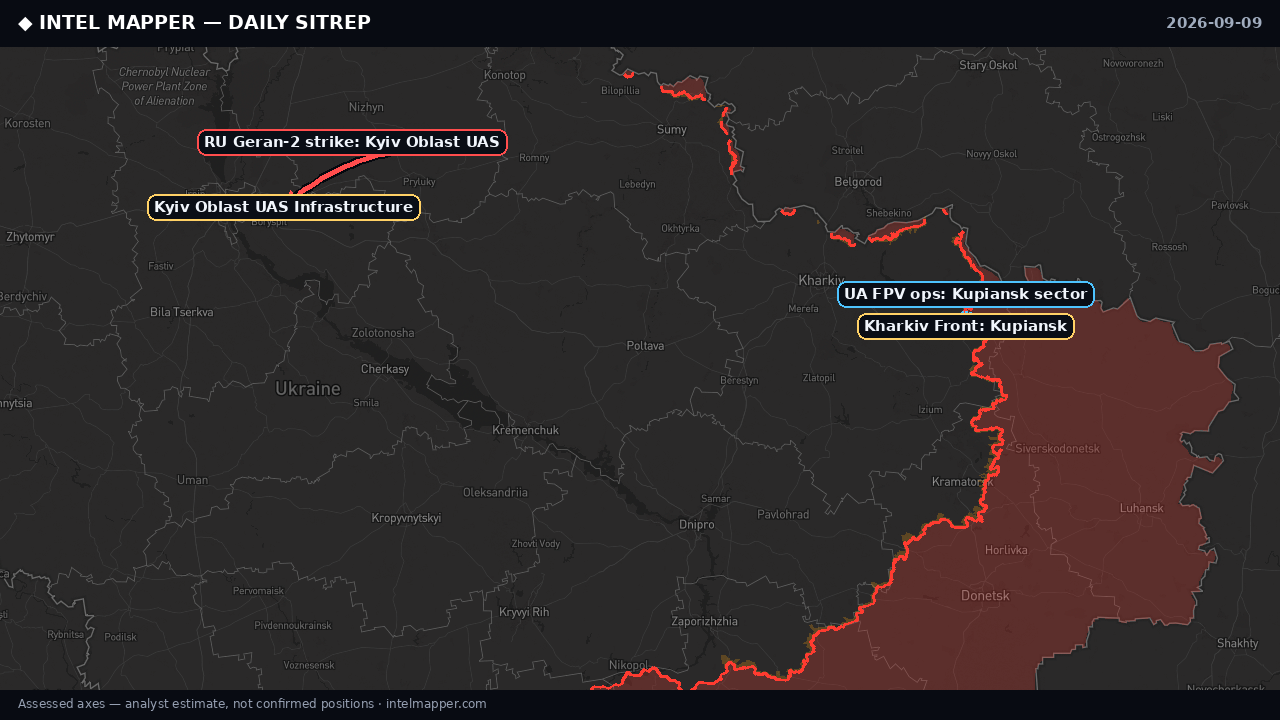
Key developments
- Israeli leadership declared unprecedented military control over Syrian territory from Mount Hermon to the Mediterranean, stating no withdrawal from security zones.
- Iran's Revolutionary Guard threatened a 10-for-2 retaliation ratio against strikes; Israeli Defense Minister countered with threats of additional strikes on Iran.
- Ukrainian drones struck Novy Urengoy Gas Condensate Plant in Arctic Russia (3,000 km from frontline), a major Gazprom facility with 19.5M tons annual capacity.
- Russian Shahed-136 kamikaze drones struck Sumy city center with 2 killed, 14 wounded; multiple drone transits detected across central Ukrainian oblasts.
- Ukraine struck Novoressiysk Naval Base in Krasnodar Krai with confirmed explosions and fires at fuel terminal; two ammunition depots and drone facilities also targeted.
- Syria's Arab League sanctions (excluding former regime officials) lifted; Jordan and Syria initiated bilateral normalization discussions as Assad-era transitions.
- Mysterious explosion at Idlib fortified headquarters reportedly killed 45 military commanders; Syria confirmed 14 personnel killed in separate Sarmada weapons depot blast.
Middle East 30 tracked events
Israeli leadership made unprecedented assertions of military control over Syrian territory, with Prime Minister Netanyahu and Defense Minister Gallant releasing footage from Mount Hermon and declaring territorial dominance extending from the Golan Heights to the Mediterranean. Netanyahu announced primary military objectives centered on this geographic control, while Gallant stated Israel will not withdraw from the security zone. These statements mark a significant escalation in Israeli positioning following the collapse of Assad's government, establishing de facto territorial claims over strategically vital Syrian areas. Separately, the IAEA Board approved lifting Syria's non-compliance finding, signaling potential reintegration into international nuclear oversight frameworks despite ongoing territorial tensions.
Regional escalation rhetoric intensified on multiple fronts. The Iranian Revolutionary Guard Corps issued a 1-to-10 retaliation multiplier threat, stating Iran would respond to two enemy strikes with attacks on twenty targets. Israeli Defense Minister Katz countered with threats of a potential third military strike on Iran. Additionally, a Panama-flagged tanker carrying two million barrels of Iraqi crude was struck by unmanned aerial vehicle in the Persian Gulf, escalating maritime security tensions. An unexplained explosion was reported near Jask in Iran's Hormozgan Province, with origins unclear. These developments reflect a densifying cycle of threat-and-counter-threat rhetoric alongside concrete military incidents.
Syria underwent significant political transition with diplomatic normalization progressing. The Arab League lifted economic, political, and social sanctions on Syria (while maintaining sanctions on former regime officials), which the Syrian Foreign Ministry welcomed. Jordan's Foreign Minister met with Syrian President al-Shara in Damascus to discuss strengthening bilateral relations. However, mysterious explosions continued: unconfirmed reports describe a blast at a fortified headquarters in Idlib killing 45 military commanders on the anniversary of previous deaths, while Syria's Defense Ministry confirmed 14 military personnel killed in a weapons depot explosion near Sarmada. Lebanon witnessed territorial fluctuations in Nabatîyé between Hezbollah and Lebanese forces, with approximately 96 square kilometers of contested control changes reported.
- Netanyahu declares unprecedented Israeli military control from Mount Hermon to Yarmouk and Mediterranean, mark
- Unexplained explosion reported in southern Jask, Hormozgan Province, originating from the sea. Source unclear;
- IRGC spokesperson issues escalatory threat: if enemy strikes 2 Iranian targets, Iran will retaliate with attac
- Panama-flagged tanker carrying 2 million barrels of Iraqi crude oil struck by unmanned aerial vehicle in Iraqi
- Unknown explosion reported near Sarmada, northern Idlib. No casualties, perpetrator, or cause confirmed at tim
- Sudan Army AKINCI drone destroyed a Chinese-made FK-2000 air defense system supplied by the UAE to the RSF. Th
Ukraine 30 tracked events
Ukrainian forces conducted a deep strike into Russia's Arctic energy infrastructure, targeting the Novy Urengoy Gas Condensate Plant in Yamalo-Nenets Autonomous Okrug approximately 3,000 kilometers from the frontline. The facility, a major Gazprom installation with 19.5 million tons annual processing capacity, was struck by Ukrainian long-range drones. This represents a significant extension of Ukrainian strike range and targeting of civilian energy production infrastructure critical to Russian export revenues. The attack underscores Ukraine's evolving capability to project power deep into Russian territory and target economic infrastructure rather than purely military objectives.
Russian drone operations against Ukrainian civilian infrastructure continued at elevated tempo. Shahed-136 kamikaze drones struck Sumy city center, hitting a parking lot near a shopping mall and causing two confirmed deaths, fourteen wounded (including a minor), and four critical injuries. Multiple reactive Shahed-136 drones transited across Ukrainian airspace with tracks detected over Chornobyl, Odesa, Mykolaiv, Kherson, Dnipropetrovsk, and Kyiv oblasts. Russian tactical aviation deployed to forward airfields over Crimea in preparation for air-launched cruise missile strikes. Russian forces also launched Kh-35U cruise missiles toward Mykolaiv and Kherson oblasts. This sustained drone and cruise missile campaign maintains pressure on Ukrainian civilian and military targets across multiple regions.
Ukrainian offensive operations targeted Russian military and strategic assets. Forces struck two ammunition depots (Fashivka, Luhansk and Selidove, Donetsk), radio-electronic reconnaissance installations in Vitino and Olenivka, a drone storage facility in Horlivka, and a Project 12150 Mangust-class patrol boat in Sevastopol. Most significantly, overnight September 8-9, Ukrainian forces struck Novorossiysk Naval Base in Russia's Krasnodar Krai, with confirmed explosions near ship berthing areas and fires at the fuel terminal. The 22nd Mechanized Brigade deployed robotic and unmanned systems for high-risk operations including evacuation and demining, reflecting organizational adaptation to drone warfare.
- Ukraine conducted a UAS strike on Novy Urengoy Gas Condensate Plant (ZPKT), a major Gazprom facility in Russia
- Ukrainian long-range drones struck Novourengoyskoye ZPKT gas condensate refinery in Novy Urengoy, Arctic Russi
- Russian Shahed-136 kamikaze drones struck Sumy city center, hitting a parking lot near a shopping mall. 2 kill
- Ukrainian air defense monitoring detected multiple reactive (jet-powered) Shahed-136 kamikaze drones in transi
- Multiple reactive (jet-powered) Shahed-136 kamikaze drones detected transiting across Ukraine: group toward Sl
- Multiple reactive (jet-powered) Shahed-136 kamikaze drones launched from Donetsk. Ukrainian air defense respon
What to watch
Monitor for Iranian retaliation signals following recent incidents and Israeli threats; assess whether rhetoric translates to kinetic action. Track continuation of Ukrainian deep strikes into Russian energy infrastructure and whether Russia escalates air defense deployments in response. Observe Syrian territorial consolidation under Israeli military presence and implications for regional proxy dynamics. Watch for amplification of Russian drone campaign intensity over Ukraine and air defense attrition rates. Assess diplomatic trajectories regarding Syria's normalization with Arab states versus potential Israeli-led security arrangements in Syrian territory. Monitor Persian Gulf maritime incidents following the tanker strike.