Iran signals dual-track posture amid strait tensions; Russia sustains massive drone campaign against Ukraine
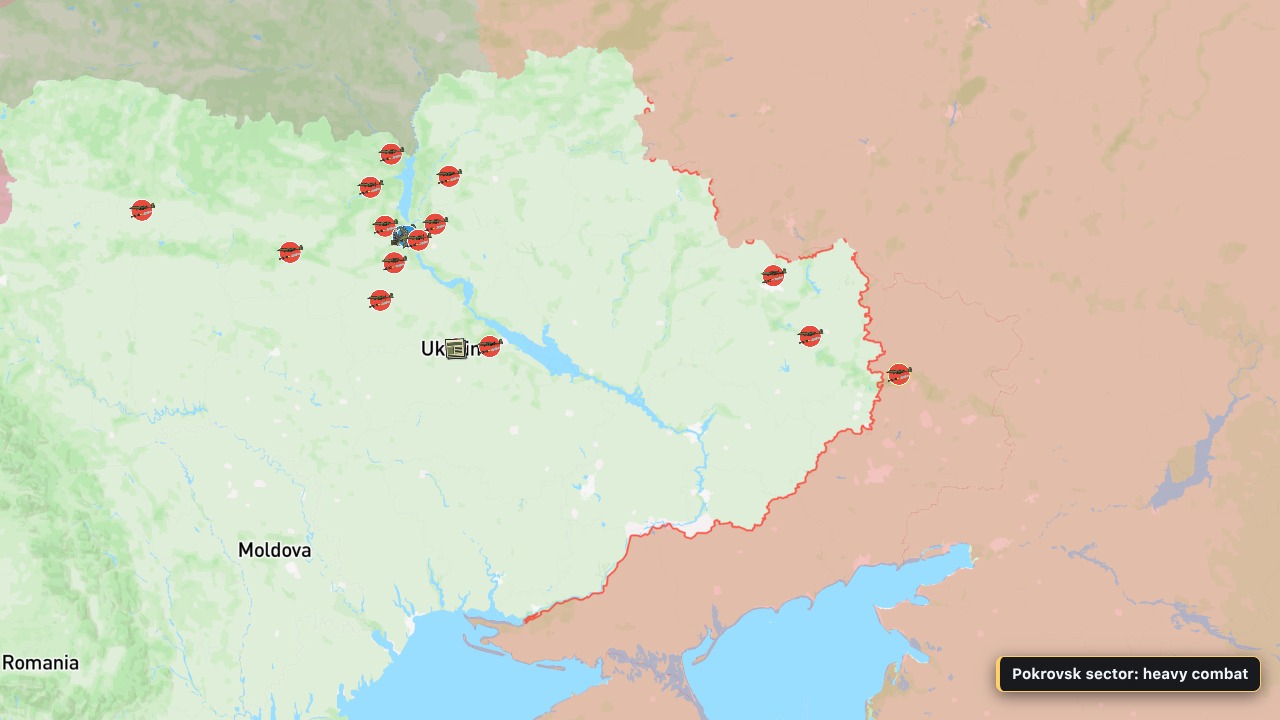
Key developments
- Iran claims seizure of second U.S. surveillance drone in Strait of Hormuz while signaling dual readiness for military escalation and diplomacy; U.S. Treasury estimates 15 million barrels remaining Iranian crude before China deliveries exhaust.
- Israeli Finance Minister proposes extending West Bank settlement policies to Galilee and Negev; Netanyahu meets UAE leadership amid diplomatic frictions with Netherlands and Turkey over settlement expansion and Al-Aqsa access.
- Russia conducted week-long aerial assault on Ukraine with 2,200+ drones and 38 missiles; Shahed variants struck Kyiv industrial targets while Ukrainian forces reported 10,660 Russian casualties and conducted deep strikes on Russian logistics.
- Syrian security forces dismantled ISIS cells across multiple governorates; humanitarian crisis worsens with three-month water outages in Nawa despite modest security gains.
- Ukrainian counteroffensive operations around Lyman reportedly constrain Russian Slovyansk offensive objectives; Russian commanders express medium-term pessimism on territorial gains.
- Polish-Lithuanian joint civilian evacuation planning for Baltic region signals NATO escalation preparedness; U.S. forces at British bases on elevated alert amid Iran-linked investigation.
- Israeli military conducted ground raids into southern Syria (Quneitra, Daraa) while Syria distances itself from Iranian policy over 14-year war legacy.
Middle East 30 tracked events
Iran maintained an assertive dual-track diplomatic and military stance on 27 September. Foreign Minister Abbas Araghchi reiterated readiness for both military escalation and diplomatic engagement, while the IRGC Navy reportedly claimed seizure of a second U.S. REMUS 600 surveillance drone in the Strait of Hormuz via electronic warfare. Army Chief General Hatami framed control of the waterway as a symbol of national dignity, stating Iran will not permit enemy use while facing trade restrictions. These statements occurred as U.S. Treasury Secretary Bessent assessed Iran's remaining crude inventory at approximately 15 million barrels with final China deliveries expected within two weeks. The rhetorical escalation coincided with elevated alert levels at U.S. forces stationed at British bases, though specific threat details remained undisclosed.
On the Israel-Palestine frontier, diplomatic tensions escalated over settlement policies and religious access. Israeli Finance Minister Bezalel Smotrich proposed extending West Bank settlement strategies to the Galilee and Negev regions through demographic expansion via new communities. Prime Minister Netanyahu traveled to the UAE for talks with President Mohamed bin Zayed, suggesting continuity in Israeli-Gulf diplomacy despite regional friction. Turkey condemned Israeli extremist incursions into Al-Aqsa Mosque conducted under military protection, while Israel revoked diplomatic status of Dutch envoys in Ramallah in response to Netherlands sanctions on West Bank and Golan Heights trade. These moves reflect hardening positions on settlement expansion and religious site access.
Syria's internal security improved modestly while humanitarian conditions deteriorated. Security forces dismantled ISIS cells across multiple governorates, seizing explosives and weapons, and arrested a former air defense commander on extortion charges. However, residents in Nawa city reported three months without water access, indicating critical humanitarian gaps. Israeli military conducted ground raids into rural Quneitra and Daraa, firing on empty terrain. Syrian officials distanced themselves from Iranian policy, citing the 14-year war and suffering under the previous Tehran-aligned regime. International engagement included an Italian-funded archaeological assessment of the damaged Ebla site in Idlib, while 263 families participated in voluntary returns from displacement camps.
- UK police arrest suspects within 25 minutes of farmer reporting suspicious vans and masked men near RAF Fairfo
- Iran's Foreign Minister Abbas Araghchi states Iran is fully prepared for military escalation if aggression res
- Israeli Finance Minister Bezalel Smotrich proposes applying West Bank settlement policies to Galilee and Negev
- Iran's IRGC Navy claims seizure of a second U.S. REMUS 600 underwater surveillance drone in the Strait of Horm
- Iranian Army Chief General Hatami issues threat: Iran will not allow enemies to use Strait of Hormuz while Ira
- Residents of Nawa city in Daraa Governorate report severe water scarcity, with no access to water for three mo
Ukraine 29 tracked events
Russia sustained an intense aerial campaign across Ukraine on 27 September, continuing a week-long assault that included over 2,200 attack drones, approximately 1,650 aerial bombs, and 38 missiles including ballistic variants. Multiple Shahed-variant jet-powered UAVs transited toward Kyiv, Rivne, and other objectives at various altitudes between 1.9 and 6 kilometers. A Shahed strike damaged the Azov Optical-Mechanical Plant in Kyiv's Darnytskyi District, with jet-engine debris recovered at the impact site. Ukrainian air monitoring detected coordinated drone operations from multiple vectors and reported imminent ballistic missile launches from Bryansk. The intensity reflects sustained Russian effort to degrade Ukrainian infrastructure through attrition.
Ukrainian forces conducted selective offensive operations despite Russian pressure. The General Staff reported 10,660 Russian casualties (killed and wounded) across active sectors during the reporting week, with intense combat on the Pokrovsk, Kostyantynivsk, and Lyman axes. Ukrainian strikes hit a Russian fuel and lubricants depot in Novoamvrosiivka (Donetsk), a logistics facility in Rovenky (Luhansk), and a drone storage and preparation facility in Donetsk Oblast. A Ukrainian fighter jet successfully struck an unspecified target, with video documentation released. These operations indicate Ukrainian capacity to conduct deep strikes despite Russian air superiority and numerical drone advantages.
Operational stalemate conditions persisted on the ground while escalation pressures mounted. Russian military commanders expressed pessimism about capturing Slovyansk in the medium term due to Ukrainian counteroffensive operations around Lyman threatening Russian flank positions. Poland and Lithuania developed joint civilian evacuation plans for the Baltic region, signaling NATO coordination on civil defense. The Kremlin warned that providing Starlink data for deep strikes inside Russia would be 'very harmful' and 'reckless,' indicating concern over Ukrainian long-range strike capabilities. These developments suggest hardening positions on both sides with limited near-term prospects for territorial change.
- Two Russian Shahed/reactive (jet-propelled) drones detected transiting over Kyiv Oblast: one over Knyazhychi,
- Ukrainian air monitoring detected one Russian jet-powered Shahed-variant (reactive) UAV in transit toward Rivn
- Ukrainian air monitoring reports Russia preparing combined missile attack. Shahed-variant drone threats from n
- Russian military commanders express pessimism about capturing Slovyansk in the medium term due to Ukrainian co
- Ukrainian air monitoring detected two Russian jet-powered Shahed-variant UAVs in transit toward Kyiv Oblast. P
- US forces stationed at British military bases have elevated alert levels. No specific threat details provided
What to watch
Monitor whether Iranian rhetoric translates into escalated maritime operations in the Strait of Hormuz or further drone seizures targeting U.S. assets; track UK investigation outcomes into alleged Iranian plot against RAF Fairford and corresponding U.S. alert posture. Observe whether Israel's settlement expansion rhetoric precedes policy implementation in Galilee-Negev regions and subsequent Palestinian or Arab state responses. In Ukraine, assess whether Russian aerial campaign intensity sustains or moderates; track Ukrainian deep-strike success rates against Russian logistics and whether Kremlin warnings on Starlink escalate to direct countermeasures. Note Syria's evolving distance from Iranian alignment and implications for regional bloc consolidation.