Massed Russian drone assault hits Ukraine as Middle East aviation security crisis unfolds
Key developments
- FlyDubai flight FZ1073 diverted to Tabuk after co-pilot allegedly stabbed captain in cockpit altercation; Israeli security assessed incident as lone actor with no terror group or Iranian direction.
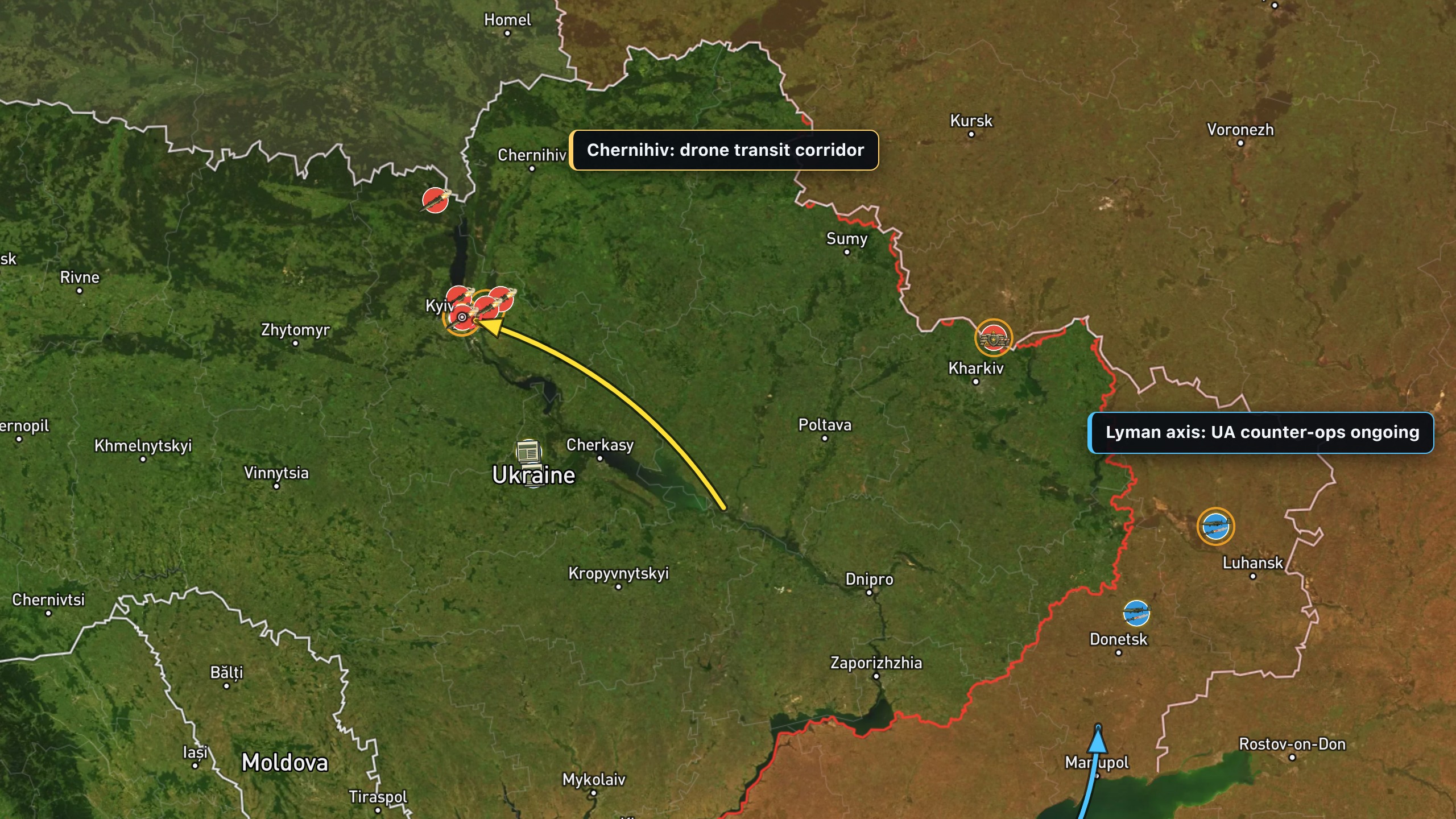
- Russia deployed estimated 188 Shahed drones plus cruise missiles in overnight assault on Ukraine, striking multiple Kyiv districts as Ukrainian General Staff reported 221 combat clashes across all frontlines.
- Ukraine's claimed Operation Vivaldi counteroffensive disrupted Russian breakthrough toward Slovʼyansk-Kramatorsk with reported 5,000+ Russian casualties, though independent verification unavailable.
- Houthi forces conducted drone and missile strikes on Abqaiq Oil Processing Facility and other Saudi infrastructure; Saudi Arabia vowed confrontation with militia.
- Pentagon completed 12-year Operation Inherent Resolve withdrawal from Iraq, transferring security responsibility to Iraqi forces and reshaping military balance in eastern theater.
- Iran's IRGC launched Janfada women paramilitary mobilization with 32 percent female participation in weapons and drone training; senior Iranian officials condemned U.S. regional military presence.
- Kremlin escalated warnings that NATO isolation of Kaliningrad would trigger direct conflict and nuclear response; Putin claimed referendums in occupied territories legitimized Russian annexation.
Middle East 30 tracked events
A FlyDubai flight from Dubai to Tel Aviv experienced a critical cockpit incident on 30 September, diverting to Tabuk Regional Airport in Saudi Arabia after a physical altercation between pilots. According to multiple reports, the co-pilot allegedly stabbed the captain in an attempt to force an emergency descent, with the aircraft declaring hijacking alert (code 7500) while transiting Saudi airspace with 180 passengers. Israeli security authorities investigated the incident as a suspected terrorist act, but preliminary assessment concluded the Omani co-pilot acted alone with no evidence of direction from Iranian sources or terror organizations. A replacement aircraft carrying passengers eventually reached Ben Gurion Airport safely, though Saudi Arabia rejected an Israeli request to permit evacuation via Israeli Air Force transport.
Iran's security apparatus demonstrated visible mobilization on the periphery of regional tensions. The Islamic Revolutionary Guard Corps and Basij launched the Janfada women paramilitary campaign, with approximately 32 percent of participants comprising women trained in rifle marksmanship, FPV drone operation, anti-tank weapons, urban warfare, and first aid. Senior Iranian officials including Security Council Secretary Rezaei condemned U.S. military presence in the region and referenced the ongoing Gaza conflict. Separately, IRGC spokesman Hossein Mohammadi claimed Iranian forces have conducted sustained interdiction operations in the Strait of Hormuz against small vessel transit, asserting the United States has not responded militarily to these actions.
Saudi Arabia confirmed its confrontational posture toward Houthi forces, with Crown Prince Mohammed bin Salman declaring the militia 'chose chaos, destruction, and threats.' Houthi forces conducted drone and missile strikes on Abqaiq Oil Processing Facility and other Saudi infrastructure during the reporting period, with satellite imagery documenting significant smoke plumes. An Aramco facility fire in the Eastern Province also occurred, though cause remained under investigation. Concurrently, the U.S. completed its 12-year Operation Inherent Resolve in Iraq, withdrawing coalition forces from Erbil Air Base and ceding primary security responsibility to Iraqi forces, potentially reshaping military balance in the eastern theater.
- FlyDubai flight FZ1073 (Dubai–Tel Aviv, 180 passengers) experienced violent cockpit altercation after pilot at
- FlyDubai flight FZ1073 cockpit incident clarified as physical confrontation between pilots, not hijacking. Oma
- FlyDubai flight Dubai–Tel Aviv (180 passengers) declared hijacking alert (code 7500) over Saudi airspace after
- FlyDubai FZ1073 (Dubai–Tel Aviv) emergency-landed at Tabuk, Saudi Arabia after co-pilot allegedly stabbed capt
- Video evidence released showing stabbed captain aboard FlyDubai FZ1073 after emergency landing at Tabuk. Cockp
- Israeli authorities investigating FlyDubai FZ1073 cockpit incident as suspected terrorist attack. Preliminary
Ukraine 30 tracked events
Russia executed a sustained aerial bombardment of Ukraine overnight 29–30 September, deploying an estimated 188 Shahed drones (86 of reactive jet-engine configuration), Geran unmanned systems, decoys, and multiple cruise missile variants including Iskander-M, Tsirkon, and Onyx. Ukrainian air defense systems tracked individual drone transits across multiple districts in Kyiv and surrounding oblasts at specified altitudes and distances. Ukrainian General Staff reported confirmed strikes producing fires and destruction across four Kyiv districts (Sviatoshyn, Podil, Holosiyiv, Solomianka) and documented at least one loud explosion in central Kyiv. The General Staff's operational summary for day 1680 of the conflict reported 221 combat clashes across all frontlines, with Russian forces conducting one cruise missile strike, 76 airstrikes delivering 263 guided bombs, and sustained artillery fire.
Ukrainian military leadership briefed on Operation Vivaldi, described as a four-season counteroffensive aimed at disrupting Russian breakthrough operations toward the Slovʼyansk-Kramatorsk axis. Ukrainian command claimed Russian casualties of over 5,000 killed-in-action or wounded-in-action during the operation period, though independent verification remained unavailable. The military held a coordination meeting on the Lyman axis addressing defensive procurement, drone funding allocation, long-range artillery requirements, personnel compensation structures, and logistics optimization. Ukrainian strike operations targeted Russian supply depots in Azov (Zaporizhzhia Oblast), command-observation posts in Lysychansk (Luhansk), and a drone storage facility in Horlivka (Donetsk), though precise damage assessments were not disclosed.
The Kremlin sustained rhetorical escalation against NATO, warning that any attempt to isolate Kaliningrad from mainland Russia would constitute direct conflict triggering nuclear weapon deployment. Russian officials specifically referenced the 'full arsenal' and warned against NATO 'hotheads in Europe' amid escalating Baltic tensions. CIA Director Ratcliffe reportedly warned Russian intelligence chiefs in late August that continued war would collapse Russia's economy, an assessment alleged to have angered President Putin sufficiently to cancel a planned high-level meeting. Putin claimed millions participated in referendums in occupied Donbas and Novorossiya, reasserting Russian annexation claims and framing the conflict as defensive nation-rebuilding.
- Ukrainian General Staff reports massed Russian aerial attack on night of 29–30 September. Russia deployed 188
- Ukrainian military leadership briefs on Operation Vivaldi: 4-season counteroffensive has disrupted Russian bre
- Russia warns NATO that any attempt to isolate its Baltic exclave Kaliningrad could trigger nuclear response an
- CIA Director Ratcliffe warned Russian intelligence chiefs in late August that continued war in Ukraine would c
- Kremlin warns NATO that any attempt to isolate Kaliningrad from mainland Russia would trigger direct conflict
- Ukrainian military leadership held coordination meeting on Lyman axis discussing defensive procurement, drone
What to watch
Monitor FlyDubai FZ1073 investigation conclusion and potential aviation security policy adjustments in Gulf airspace. Track Russian drone attrition rates and whether tonight's massed assault represents sustained capability or a concentrated expenditure preceding reduced intensity. Observe Saudi response timelines to Houthi strikes and whether infrastructure targets expand beyond energy sector. Watch for Kremlin follow-through on Kaliningrad isolation rhetoric versus NATO exercise scheduling in Baltic region. Monitor reported RAF Fairford incident clarification, as UK PM Andy Burnham attributed Iranian involvement but details remain unconfirmed. Assess whether U.S. Iraq withdrawal accelerates regional proxy activity or stabilizes Iraqi security situation.