U.S.-Iran tensions escalate amid regional strikes; Ukraine sustains deep strikes on Russian infrastructure
Key developments
- U.S. expelled Iranian diplomats from New York and Defense Secretary Hegseth threatened military action against Iran over nuclear leverage, escalating U.S.-Iran tensions.
- Houthi ballistic missile struck Aramco oil facility in Riyadh; Israeli airstrikes killed Hamas deputy chairman Ali al-Amoudi in Gaza City and two Islamic Jihad commanders in Shejaia.
- Ukraine conducted deep strikes on Russian Iskander systems in Bryansk, military installations in Belgorod and Samara regions, and announced targeting of Russian oil refineries in retaliation.
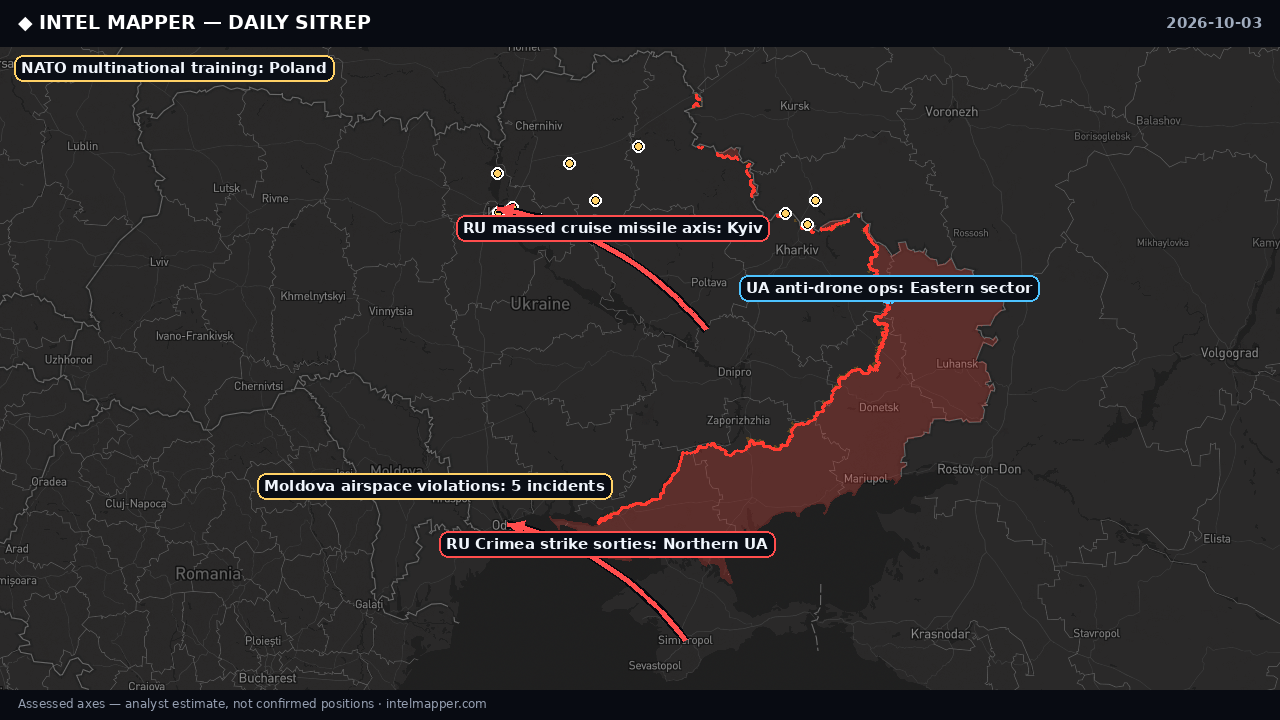
- Russia launched sustained cruise missile and ballistic missile campaigns against Ukrainian infrastructure; nine Kh-47 missiles detected en route to Odesa; ballistic missiles transited Kyiv Oblast.
- Russian kamikaze drones conducted unprecedented incursions into Moldova with five airspace violations and multiple explosions, escalating operations beyond Ukraine's borders.
- Turkey announced Tayfun Block-4 ballistic missile capability (1,000 km range) and signed $1.4 billion armored vehicle export contract while Erdoğan invoked Ottoman military strength rhetoric.
- UK arrested dual British-Iranian national near RAF Fairford on terrorism suspicion; NATO's Operation Legio continued training Ukrainian forces in Poland; Greece plans 522 new fortifications.
Middle East 30 tracked events
Diplomatic friction between Washington and Tehran intensified as the U.S. State Department expelled two Iranian diplomats from New York following the UN General Assembly, marking a hardening of confrontational posture. Concurrently, U.S. Defense Secretary Pete Hegseth delivered stark warnings to Iran, asserting American control over the Strait of Hormuz and threatening military action if Iran does not surrender nuclear and strategic leverage. These statements reflect sustained U.S. pressure campaigns against Iranian regional influence, coupled with assertions of naval dominance over critical Persian Gulf chokepoints. Iranian responses included military commander Amir Nakdi's conditional warning that if the U.S. acts irrationally while Iran is cornered, unpredictable consequences could follow—classic deterrent rhetoric masking underlying vulnerability to U.S. military superiority.
Israeli military operations targeting Hamas leadership continued with precision airstrikes on Gaza City, killing Ali al-Amoudi, deputy chairman of Hamas's political bureau and Yahya Sinwar's deputy, alongside two Palestinian Islamic Jihad commanders in Shejaia. Concurrently, Houthi forces conducted a ballistic missile strike on an Aramco oil facility in Riyadh, with satellite imagery documenting a smoke plume extending approximately 107 kilometers—indicating significant munition yield and infrastructure penetration. The Saudi-led coalition responded with sustained airstrikes on Houthi positions near Sanaa and telecommunications infrastructure in Sadaa. These escalations underscore persistent asymmetric warfare patterns: Israeli air dominance enabling targeted eliminations, Houthi maritime and air capabilities posing supply-line risks to Saudi energy infrastructure, and Saudi air superiority maintaining pressure on rebel positions without achieving strategic breakthrough.
Turkish regional positioning evolved through military modernization announcements and revisionist rhetoric. President Erdoğan stated Turkey should return to Ottoman Empire roots emphasizing national self-sufficiency and military strength, while defense officials highlighted NATO's second-largest military with fourfold greater personnel than Greece and an expanded long-range missile arsenal including the Tayfun Block-4 ballistic missile with approximately 1,000 km range. Turkish defense contractor Otokar simultaneously signed a $1.4 billion armored vehicle export contract, reflecting sustained international demand for Turkish military equipment. These developments signal Turkish efforts to position itself as a regional military power independent of traditional security frameworks, though without explicit territorial claims.
Israeli incursions into Syria continued with artillery strikes on Maaria village in Daraa Governorate and inspection operations in Wadi al-Raqad, while detaining individuals in Al-Hamidiyah village in Quneitra Governorate. Separately, Israeli intelligence warned U.S. military of potential Iran-backed attacks on American bases in Europe. Somalia's President Hassan Sheikh Mohamud alleged Israeli plans to establish a naval base in Berbera to project power toward the Persian Gulf and Iran, claims that reflect regional anxieties over Israeli strategic expansion. These dynamics illustrate Israel's sustained operational presence in Syria's buffer zones and intelligence sharing with Western allies regarding Iranian threat assessments.
- U.S. expelled two Iranian diplomats from New York after they ignored State Department orders to depart followi
- Senior Iranian MP Ebrahim Azizi declares Iran's expulsion from Afghanistan and Iraq is imminent, warning of to
- Explosions reported in Sanaa as Saudi Arabian warplanes conducted airstrikes targeting Houthi positions near Y
- US Secretary of Defense Pete Hegseth declares the United States controls the Strait of Hormuz, not Iran, asser
- IDF and Shin Bet airstrike on Gaza City residential building killed Ali al-Amoudi, Hamas political bureau depu
- US Defense Secretary Pete Hegseth threatens Iran with military action if it does not surrender nuclear/strateg
Ukraine 30 tracked events
Ukrainian forces executed deep strikes into Russian territory, targeting military infrastructure systematically. President Zelensky confirmed strikes on Russian Iskander missile systems in Bryansk Oblast and authorized targeting of Russian oil refineries in response to attacks on Ukrainian bridges and energy infrastructure. Ukrainian long-range strikes reportedly struck Belgorod city, a Kaluga radio tube plant producing military electronic components, and Russian military supply depots in Belgorod Oblast. These operations represent Ukraine's sustained strategy of degrading Russian logistical capacity and revenue-generating military-industrial targets. The campaign reflects Ukrainian doctrine of asymmetric retaliation—matching Russian strikes on civilian infrastructure with precision strikes on military-industrial nodes within Russian territory.
Russian air and missile campaigns targeting Ukrainian infrastructure continued with intensity. Nine Kh-47/Kalibr subsonic cruise missiles detected en route toward Odesa region; ballistic missiles transited Kyiv Oblast with westward trajectory; and four Kh-47 Banderol missiles targeted the Kyiv Reservoir area. Russian kamikaze drone operations expanded unprecedentedly into Moldova, with five airspace violations documented and at least four explosions across Moldovan territory—representing escalation beyond Ukraine's borders into NATO-adjacent airspace. Moscow issued threats urging foreign nationals and embassies to evacuate Ukraine while pledging continuation of large-scale strike campaigns. These patterns indicate sustained Russian effort to break Ukrainian civilian morale and infrastructure resilience through attrition.
Collateral regional impacts from the Ukraine conflict expanded. Russian kamikaze drones struck Moldova multiple times, prompting security concerns in NATO-adjacent territory. UK authorities detained a 25-year-old dual British-Iranian national near RAF Fairford on suspicion of preparing terrorist acts, potentially indicating Iranian efforts to disrupt NATO support for Ukraine or conduct secondary theater operations. Greece announced plans for 522 new fortifications along the Evros border and Aegean islands, drawing strategic lessons from the Ukraine conflict. NATO's Operation Legio, a Norwegian-led multinational training initiative involving nine NATO nations, continued combat-realistic instruction for Ukrainian forces at Camp Jomsborg in Poland. These cascading effects illustrate how the Ukraine conflict has become a catalyst for broader regional military modernization and NATO posture adjustments.
- Ukrainian President Zelenski confirms strike on Russian Iskander missile system in Bryansk Oblast. Long-range
- Ukrainian long-range strike (likely Oreshnik or similar ballistic missile) reported in Belgorod Oblast, Russia
- Russian kamikaze drones struck Moldova. This is the same unprecedented incursion previously reported involving
- UK authorities detained a 25-year-old dual British-Iranian national on suspicion of preparing terrorist acts n
- Ukrainian long-range strikes targeted Russian military installations in Samara region and cargo vessels in Bla
- Nine Russian cruise missiles (Kh-47/UMPC-5 or Kalibr variants) detected en route toward Odesa region. Continua
What to watch
Monitor whether U.S.-Iran confrontational rhetoric translates into kinetic military action or remains deterrent posturing. Track Houthi capability to sustain ballistic strikes on Saudi energy infrastructure and Saudi air defense effectiveness. Observe Iranian response to U.S. threats and whether nuclear escalation escalates or stabilizes. In Ukraine, assess whether Russian cruise missile campaign achieves attrition goals against civilian morale; monitor Ukrainian deep strike sustainability and whether Russian border regions experience degraded air defense coverage. Track whether Russian drone incursions into Moldova escalate or remain episodic—potential NATO Article 5 trigger if casualties mount. Monitor NATO reinforcement of Poland and eastern members in response to expanded Russian drone operations.