Iran escalates maritime attacks; Ukrainian FPV drones strike Russian helicopter as regional tensions peak
Key developments
- Iranian-associated vessel GFS PRIDE struck a mine in the Strait of Hormuz and reportedly sank; AIS had been disabled ten days prior, consistent with Iranian maritime operations.
- Ukrainian FPV drone successfully struck a Russian Mi-28N attack helicopter mid-flight, marking a significant tactical escalation in aerial warfare.
- Ukrainian air defenses intercepted 4 of 39 Russian ballistic/cruise missiles and 115 of 128 drones overnight 13–14 October.
- SpaceX speed cap on military-grade Starlink terminals above 100 mph disrupted Ukrainian drone and fast-moving vehicle operations.
- Israeli Defense Minister threatened severe military consequences if Hezbollah joins Iran in attacking Israel, warning of territorial losses in southern Lebanon.
- FBI Director Kash Patel arrived in Moscow for high-level talks with Russian FSB, indicating renewed U.S.-Russia bilateral engagement.
- Russian strikes on Ukrainian civilian targets killed at least nine people; Houthi claims cite direct hit on King Khalid International Airport in Riyadh.
Middle East 30 tracked events
The Strait of Hormuz remains the focal point of Iranian maritime escalation. On 14 October, a UAE-flagged container ship, GFS PRIDE, struck a mine in the southern Strait corridor with three sailors reportedly injured and the vessel identified as sinking. The ship's AIS had been disabled for ten days prior to the incident, consistent with patterns of Iranian mine-laying and maritime interdiction operations. Concurrently, U.S. forces reportedly destroyed an Iranian-affiliated dhow conducting surveillance and targeting operations against American Navy vessels in the Gulf of Oman on 6 October, indicating sustained maritime friction. A U.S. drone strike also wounded three Iranian fishermen off Sirik. These incidents reflect an asymmetric naval campaign by Iran designed to raise risk premiums on Gulf shipping and demonstrate anti-access capabilities.
Israeli Defense Minister Israel Katz issued explicit threats of severe military consequences if Hezbollah joins Iran in attacking Israel, warning of territorial losses and displacement in southern Lebanon—language suggesting potential escalation beyond current parameters. Simultaneously, Israeli forces conducted airstrikes near Tebnine in southern Lebanon and artillery strikes on the Syrian border village of Taranah. Israeli President Herzog held a rare public meeting with Bahrain's Foreign Minister in Baku, signaling diplomatic outreach to Gulf states. However, these diplomatic gestures contrast sharply with military posturing. U.S. Air Force airlift activity to the Middle East has surged, suggesting reinforcement or contingency preparations. Intelligence assessments indicate the U.S., Israel, and Iran are in heightened alert posture, with Iranian ballistic missile tests continuing and Israeli air defenses repositioned.
Saudi Arabia faces renewed Houthi pressure following claims of direct hits on King Khalid International Airport and a confirmed ballistic missile interception near Riyadh. Houthi claims cite 42 Saudi airstrikes in 24 hours, bringing cumulative totals to 2,323 strikes since escalation began. A substantial fire damaged Saudi Aramco headquarters in Dhahran, though operations continued via remote work arrangements. Regional leaders are addressing preparedness: Qatar's Emir issued cautionary remarks on worst-case scenarios, while Egyptian President Sisi affirmed maritime security commitments tied to Gulf stability. President Trump stated the U.S. would 'do a number on Iran,' while Iranian Parliament Speaker Ghalibaf stated Tehran aims to drive enemies into desperation to accept Iranian demands—rhetoric indicating neither side perceives near-term de-escalation.
- Israeli Defense Minister Israel Katz threatens severe military consequences for Hezbollah if it joins Iran in
- Iranian naval attack in Strait of Hormuz results in ship damage/sinking. Reports indicate one or more merchant
- UAE-flagged container ship GFS PRIDE identified as vessel that struck mine in southern Strait of Hormuz corrid
- Iranian Parliament Speaker Ghalibaf states Iran is not seeking endless war or prolonged negotiations, but rath
- Israeli President Herzog held a rare public meeting with Bahrain's Foreign Minister in Azerbaijan near the Ira
- U.S. Air Force airlift activity surge detected to the Middle East. Increased strategic asset mobility suggests
Ukraine 30 tracked events
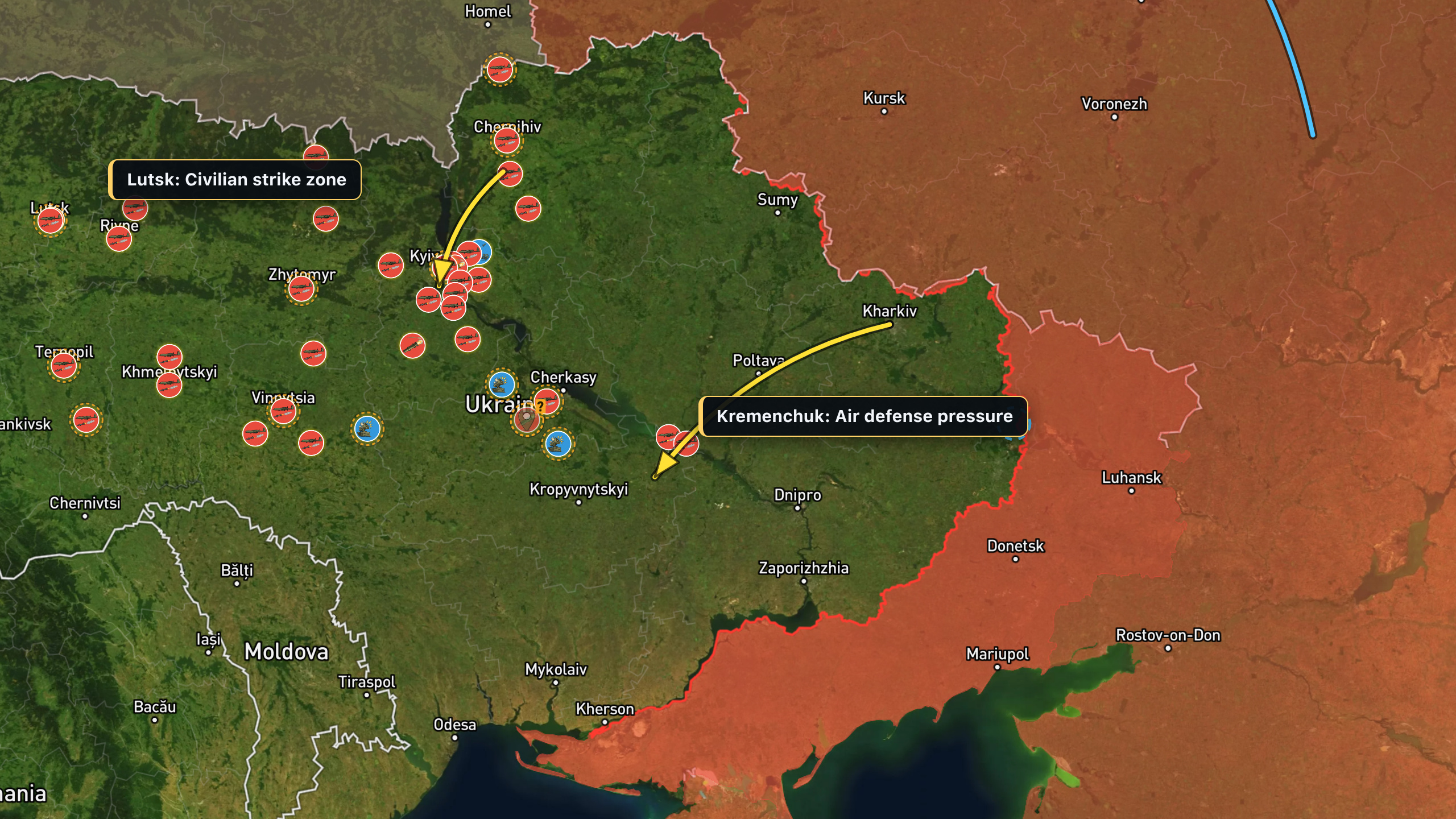
Ukrainian air defenses intercepted 4 of 39 ballistic and cruise missiles and 115 of 128 attack and reconnaissance drones during overnight bombardment of 13–14 October, reflecting continued Russian attrition pressure but also significant Ukrainian interception effectiveness. A notable tactical development occurred when Ukrainian forces successfully deployed an FPV drone to strike a Russian Mi-28N attack helicopter in mid-flight, marking an escalation in aerial warfare complexity. Ukrainian forces also launched a major attack on Borisoglebsk airfield in Voronezh Oblast, with damage assessment pending. These strikes indicate Ukrainian drone warfare capabilities remain operationally effective despite emerging constraints from third-party technology restrictions. Russian ballistic missiles struck civilian targets in Kyiv, Kharkiv, and Lutsk, killing at least nine civilians and injuring additional non-combatants.
Logistical complications emerged affecting Ukrainian operations when SpaceX imposed speed caps on military-grade Starlink terminals above 100 mph, disrupting Ukrainian drone and fast-moving vehicle operations. Concurrently, two masked individuals deliberately set fire to eleven of seventeen Starlink antennas at a reportedly secret facility near Sofia, Bulgaria, targeting communications infrastructure supporting Ukraine's war effort. These incidents underscore Ukraine's vulnerability to supply-line disruptions and external operational constraints. UK Prime Minister Andy Burnham announced acceleration of approximately 200 LMM air-defense missile deliveries to Ukraine. Ukrainian President Zelensky met with UK King Charles III, continuing diplomatic engagement despite expressions of regret over reduced U.S. support and statements reaffirming Ukraine's determination to maintain independence.
Diplomatic dynamics shifted with FBI Director Kash Patel's arrival in Moscow for high-level engagement with Russian FSB intelligence, signaling renewed U.S.-Russia bilateral contact. Kremlin spokesman Dmitry Peskov stated Russia will continue targeting Ukrainian energy infrastructure despite U.S. sanctions and claimed the Trump administration is working toward peaceful resolution while asserting Europeans obstruct peace efforts. Zelensky rejected foreign interference in Ukrainian elections, including from the U.S., and reaffirmed Ukraine's resolve regardless of international support fluctuations. NATO Secretary General Rutte emphasized NATO's critical role in defending the Euro-Atlantic region against Russian threats. Russian Deputy PM Novak reported Ukrainian drone strikes on oil refineries in Saratov and Ryazan regions, confirming continued Ukrainian energy infrastructure targeting despite absence of ceasefire progress.
- Ukrainian FPV drone struck a Russian Mi-28N attack helicopter mid-flight while it was launching an LMUR guided
- Ukrainian air defense confirmed destruction of 4/39 ballistic/cruise/anti-ship missiles (Iskander-M, KN-23, Zi
- Two masked individuals deliberately set fire to 11 of 17 Starlink antennas at a secret facility near Sofia. Th
- FBI Director Kash Patel arrived in Moscow for high-level diplomatic meeting with Russian FSB intelligence serv
- UK accelerating delivery of ~200 LMM air-defense missiles to Ukraine. Andy Burnham announces British-made air
- SpaceX imposed speed cap on military-grade Starlink terminals (above 100 mph), disrupting Ukrainian drone and
What to watch
Monitor developments in the Strait of Hormuz over next 24–48 hours for additional Iranian maritime operations or vessel incidents affecting commerce. Watch for responses to Israeli Defense Minister's threats regarding Hezbollah escalation and any Hezbollah military activity along the Lebanon-Israel border. Track outcomes of FBI Director Patel's Moscow discussions for signals of U.S.-Russia diplomatic movement. Observe Russian ballistic missile and drone attack patterns against Ukrainian infrastructure and Ukrainian countermeasures. Monitor for additional third-party interference with Ukrainian logistics, particularly Starlink infrastructure. Watch for statements from Iranian leadership regarding imminent U.S. military action, which intelligence assessments reportedly characterize as imminent.