Israel-Lebanon-Syria Tensions Persist as Iran Rhetoric Rises; Russian Drone Waves and Deep Strikes Continue
Key developments
- Israeli reconnaissance flights over Daraa and a patrol in Quneitra indicate continued Israeli military presence in southern Syria.
- Iran's Armed Forces claimed US forces are about 500 km from Iranian shores, while Trump said there are no US troops on the ground in Iran.
- A tanker fire in the Gulf of Oman, after the vessel reportedly entered a prohibited area east of Hormuz, has an unconfirmed cause.
- Yemeni forces reportedly repelled a Houthi assault on Mount Han west of Taiz, and Saudi Arabia appealed to the UN Security Council over Houthi weapons.
- Russia launched 149 drones on Ukraine, with 114 downed or suppressed and 27 hits at 24 locations.
- Ukrainian drones reportedly forced Moscow airspace restrictions for six consecutive days, and Moscow industrial sites were reportedly hit.
- Ukraine reportedly rejected Trump's energy strike ceasefire, while Zelensky said Putin does not want the war to end.
Middle East 26 tracked events
Israeli military activity was the most visible feature of the Middle East theatre on 16 October. Reconnaissance aircraft were reported flying over Daraa Governorate in southern Syria, and a five-vehicle Israeli patrol was reported advancing west of Saida al-Hanut in the Quneitra countryside. Lebanese reports said Beit Yahoun and Al-Mansouri in southern Lebanon were under Israeli fire, with the weapon type unspecified. Israeli air defenses also conducted an interception near the Lebanese border and neutralized the incoming threat, though no target or weapon details were released. In Gaza, the IDF said a strike in northern Gaza killed Hamas weapons-production commander Mohammed Hala, and a second strike in Khan Younis killed a Palestinian Islamic Jihad operative. In the West Bank, Washington Post photojournalist Heidi Levine, 63, was reportedly injured during a settler attack in Abu Falah near Ramallah. Netanyahu, speaking in Jerusalem, said Israel is not the obstacle to peace and will not gamble its survival.
The Iran dimension was dominated by rhetoric and maritime incidents. Iran's Armed Forces claimed US forces are about 500 km from Iranian shores and pledged operational plans to push them further back. Iranian media, citing Tasnim, said Iran has strengthened its air defenses since the recent war. A report from ConflictTR indicated Iran moved tanks to Abadan, near the Iraq-Kuwait border, though this remains single-sourced. In the Gulf of Oman, another tanker was reported burning; the Iranian Navy said the vessel had switched off tracking and entered a prohibited area east of Hormuz, and the cause remains unconfirmed. Trump said he sees no US troops on the ground in Iran, did not rule out the use of the conventional 'Mother of All Bombs' possibly after the US midterms, and stated he would not use nuclear weapons. Iranian parliamentary security commission chief Ebrahim Azizi rejected the bomb threat as an insult to Iran's civilization. Foreign Minister Araghchi, in Yerevan, said Tehran is concerned about any US presence in the region but trusts Armenia not to act against Iranian security.
The wider regional picture showed continued maritime and Yemeni fronts alongside diplomatic activity. In Yemen, Yemeni Government forces reportedly repelled an overnight Houthi ground assault on Mount Han west of Taiz, with significant Houthi losses claimed by local military sources. Saudi Arabia's Foreign Ministry urged the UN Security Council to help block Houthi weapons access, and a Saudi early warning alert in Yanbu Governorate was followed by reported explosions near the port, with the origin unconfirmed. In the Gulf of Aden, the Japanese destroyer Takanami reported checking 111 merchant ships during a 24-day anti-piracy patrol without unusual incidents. Japan's Joint Staff also released September intelligence-gathering figures for the Middle East. In Syria, security forces reportedly arrested Ali Kayali, known as Meraj Oral, in al-Bayda village in Baniyas. At a UN Security Council open debate, the EU welcomed Syria's progress in dismantling the Assad-era chemical weapons program. Russia separately stated it will not hand over former president Bashar al-Assad to Syrian authorities. Turkey, meanwhile, planned a 229 percent increase in its 2027 weapons procurement budget.
- Netanyahu says Israel is not the obstacle to peace, rejects peace built on illusions, and will not gamble its
- Intensive Israeli military reconnaissance aircraft flights reported over Daraa Governorate airspace, southern
- Residents gathered in al-Bayda village, Baniyas, to celebrate the arrest of Ali Kayali, known as "Meraj Oral."
- Another tanker is burning in the Gulf of Oman. Iranian Navy says it had turned off tracking and entered a proh
- Washington Post photojournalist Heidi Levine, 63, was injured in a settler attack during a pogrom in Abu Falah
- Iran's Armed Forces claim US forces are 500 km from Iranian shores and vow operational plans to push them furt
Ukraine 30 tracked events
Diplomacy around the war remained complicated on 16 October. President Zelensky said European allies hold enough Patriot interceptors to carry Ukraine through the winter, which reduces the urgency of an anti-ballistic request tied to an energy ceasefire. The Dutch Prime Minister said US-restored Starlink imagery is aiding Ukraine and that Europe will discuss independent satellite imagery with France. Zelensky also said Starlink speed limits for Ukrainian forces were lowered, while restrictions on military use remain in place and are not fully lifted. He argued that Putin does not want the war to end, that Donbas will not satisfy him, and that Moscow may accept certain sanctions and negotiation formats. The DVB Telegram channel reported that Ukraine rejected the energy strike ceasefire proposed by Trump, though the source did not detail the terms. EU foreign policy chief Kaja Kallas said Europe should not offer Russia-related concessions without reciprocal Russian concessions. Trump, for his part, called Ukrainian strikes on Russian oil refineries a disgrace and said Kyiv has no need to hit them, and he questioned the whereabouts of an estimated $350 billion in US funds and equipment sent to Ukraine.
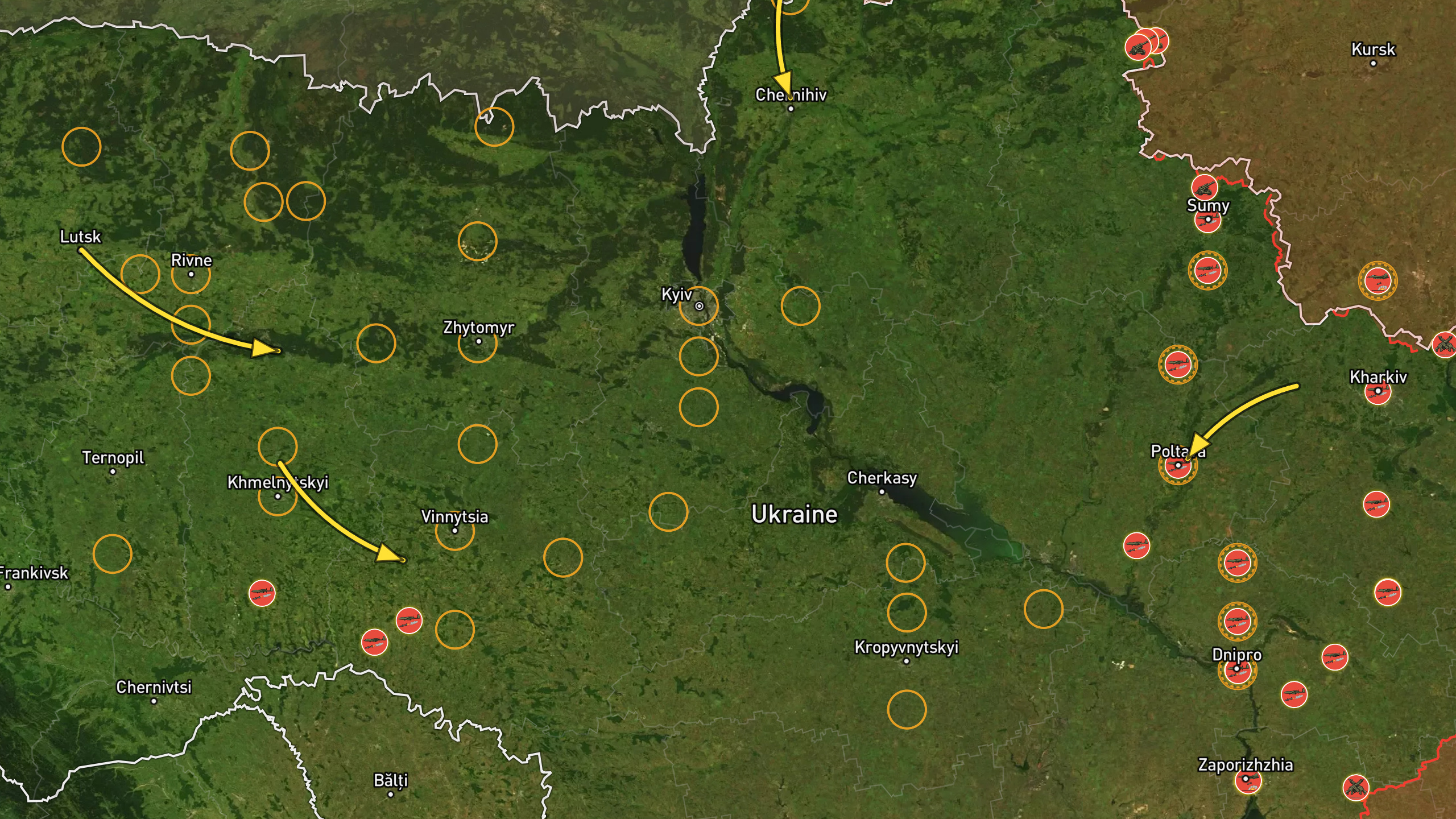
The air dimension was marked by a large Russian drone launch and sustained transit tracking. Ukrainian air monitoring reported that Russia launched 149 Shahed-type, Gerbera and decoy drones from Oryol, occupied Donetsk and Crimea. Of these, 114 were downed or suppressed, while 27 hit targets at 24 locations. Separate monitoring reports tracked numerous individual and small-group drones moving across central and northern Ukraine, including toward Kremenchuk, Poltava Oblast, Chernihiv Oblast, Rivne, Lutsk, Khmelnytskyi Oblast, Vinnytsia Oblast, Zhmerynka and Bila Tserkva. Several of these were identified as jet-powered Geran-3 variants, which are generally faster and harder to intercept than piston-engine Shaheds. The distribution of tracks across western, central and northern oblasts indicates routes designed to stress air defense coverage over a broad area rather than a single axis. Such dispersed activity typically forces alert cycles that strain civil infrastructure and mobile fire groups, though the reports do not provide damage assessments for most individual tracks.
Deep-strike activity against Russian targets was also reported. Ukrainian drones have reportedly forced Moscow airspace restrictions for six consecutive days, disrupting commercial air travel, and a single-source claim describes a broader covert Ukrainian campaign. Separate reports said Ukrainian drones attacked Moscow and hit industrial and warehouse facilities, though impact details remain unconfirmed. In Khanty-Mansi, the Surgut condensate stabilization plant, a Gazprom-linked facility about 35 km from Surgut, was reported attacked, but the attacker and weapon were not identified. On the Ukrainian side, the army unveiled a new medium-range UAV, the 'Thor Hammer', which is reported to have a range of up to 600 km and a 50 kg warhead capacity. Zelensky said Ukraine was attacked, that people were killed, and that it has the right to defend itself. Taken together, the reporting shows both sides extending the geographic reach of long-range drone operations, while the lack of confirmed damage data limits firm conclusions about their effects.
- Zelensky says European allies hold enough Patriot interceptors to carry Ukraine through the winter, reducing t
- EU's Kaja Kallas says Europe should not give Russia-related concessions without reciprocal Russian concessions
- Ukrainian drone attacks have forced Moscow airspace restrictions for six consecutive days, disrupting commerci
- Dutch PM Jetten says US-restored Starlink imagery is aiding Ukraine and Europe will discuss independent satell
- Trump calls Ukrainian strikes on Russian oil refineries a "disgrace" and says Kyiv has no need to hit them, ci
- Trump questions the whereabouts of an estimated $350 billion in US cash and equipment sent to Ukraine, allegin
What to watch
Over the next 24 to 48 hours, attention should focus on whether the Israeli military activity in southern Syria and southern Lebanon expands beyond reconnaissance and localized fire. Any confirmed cause for the Gulf of Oman tanker fire, and whether Iranian maritime restrictions near Hormuz are enforced further, could shape the risk environment for shipping. Statements from Washington and Tehran on the 'Mother of All Bombs' rhetoric should be monitored for any shift from rhetoric to operational signaling. In Ukraine, watch for Russian mass drone launches, the duration of Moscow airspace restrictions, and any official response to the reported energy ceasefire proposal. Verification of the Surgut and Moscow impact reports would also clarify the scale of deep-strike activity.