Houthi strikes hit Saudi targets as Iran-Israel rhetoric hardens
- Houthis claimed strike on Riyadh Defense Ministry headquarters, unverified
- Dammam King Fahd airport attack killed two people
- Aramco ordered Dhahran HQ staff to evacuate and work remotely
- Saudi coalition intercepted ballistic missile aimed at Najran
- Netanyahu says Israel acted without Trump's approval against Iran
What to watch: Over the next 24 to 48 hours, attention should focus on whether Houthi forces follow through on threats of further strikes on Saudi territory, particularly against energy and airport infrastructure in the Eastern…
Full analysis (703 words)
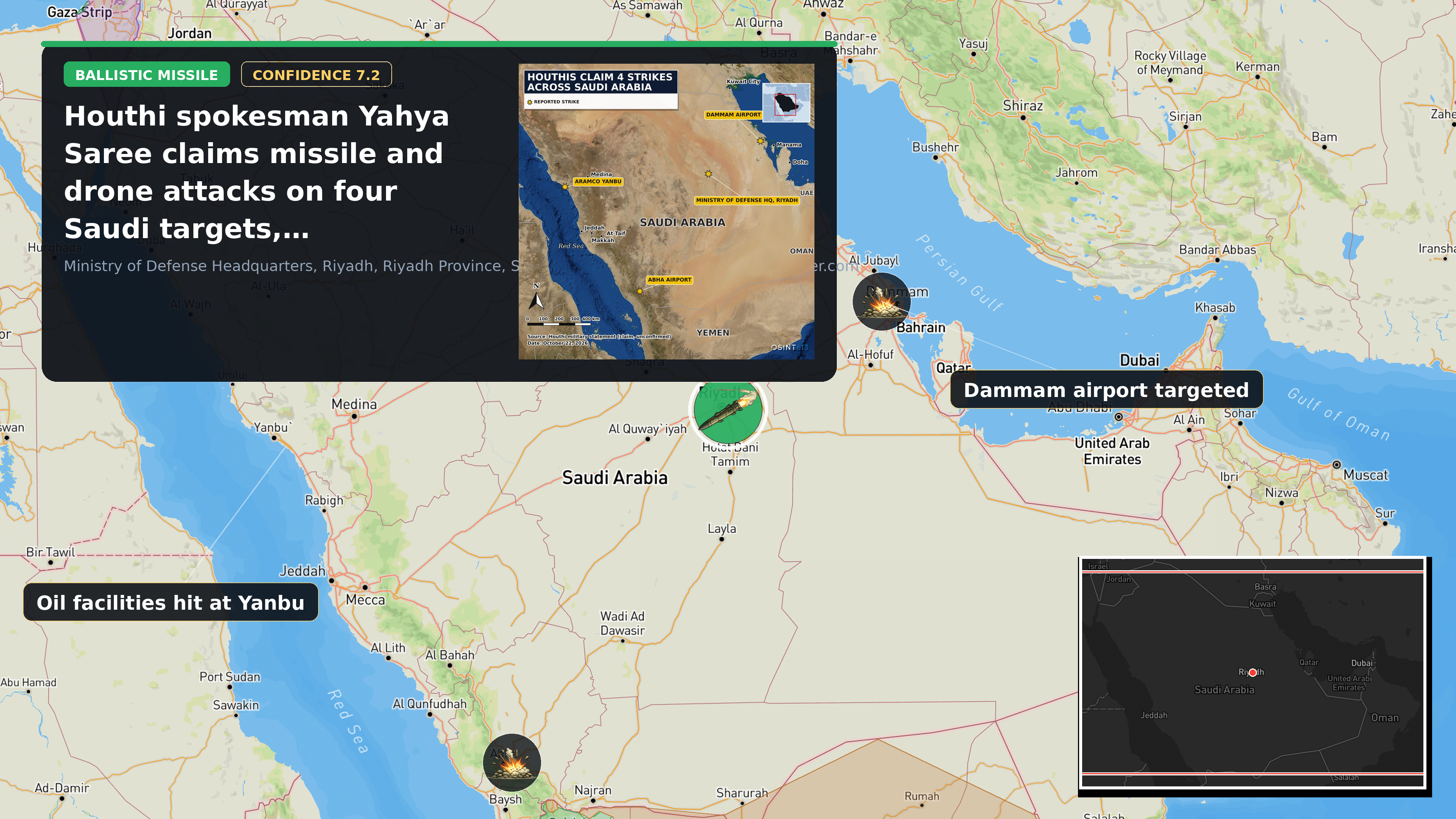
Houthi forces continued long-range attacks on Saudi Arabia on 22 October. Spokesman Yahya Saree claimed missile and drone strikes on four Saudi targets, including a direct hit on the Defense Ministry headquarters in Riyadh; these claims are not independently confirmed. In the Eastern Province, an attack on King Fahd International Airport in Dammam killed two people, and injured persons were taken to hospital, though the attacker has not been identified. Saudi Aramco ordered staff at its Dhahran headquarters to evacuate and work remotely, citing a Houthi strike on the headquarters earlier this month and attacks near Dammam airport and Shaybah that killed four. The Saudi-led coalition reported intercepting a ballistic missile aimed at Najran, where civil defence later declared an all-clear after an early warning. French President Macron pledged all necessary support to Riyadh. Separately, a Houthi fighter was filmed displaying a Turkish-made BMC Kirpi armoured vehicle reportedly captured from government forces at the Marib front, a visible sign of battlefield losses on that axis.
Rhetoric on Iran and Israel carried the most direct escalation risk. Prime Minister Netanyahu said he did not seek US President Trump's approval before attacking Iran, and argued that the only solution to the Iranian regime is its overthrow. He also publicly acknowledged that Israel bombed Qatar. From Tehran, the IRGC Navy warned that US bases across the region could be targeted if Washington keeps pushing vessels through a mined passage it considers illegal, and a senior official said Iran would treat US and Israeli targets as legitimate if Trump backs an Israeli attack. These statements signal deterrence and coercion, but the reporting contains no confirmed exchange of fire. On Gaza, Netanyahu vowed to destroy Hamas and said Israel was working with third countries on Palestinian displacement, while the IDF and Shin Bet claimed an airstrike in Khan Yunis killed a Popular Resistance Committees commander; that claim is unverified. Israel-Lebanon talks in Tampa ended without breakthrough, with Israel accusing the Lebanese army of failing to disarm Hezbollah.
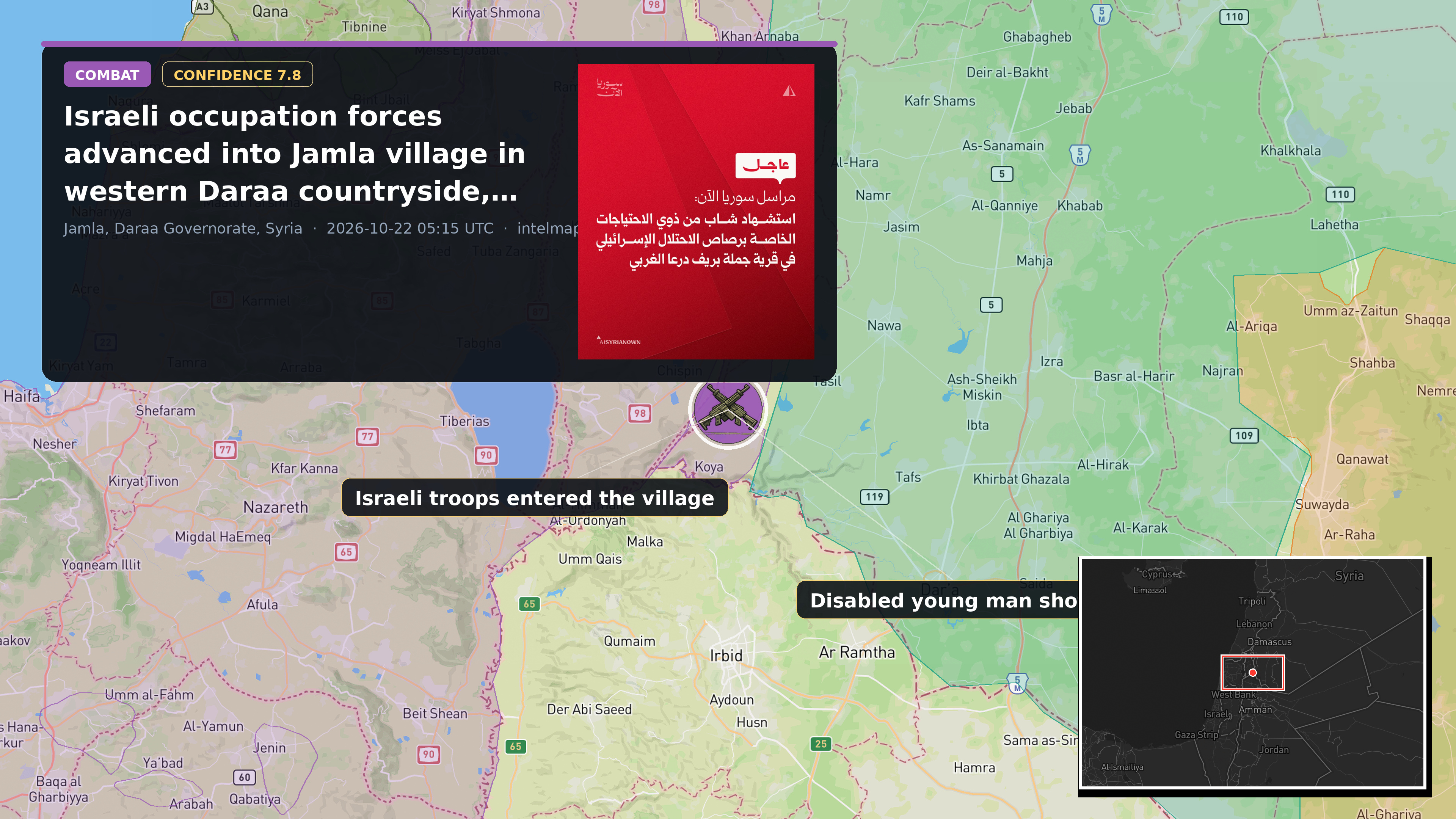
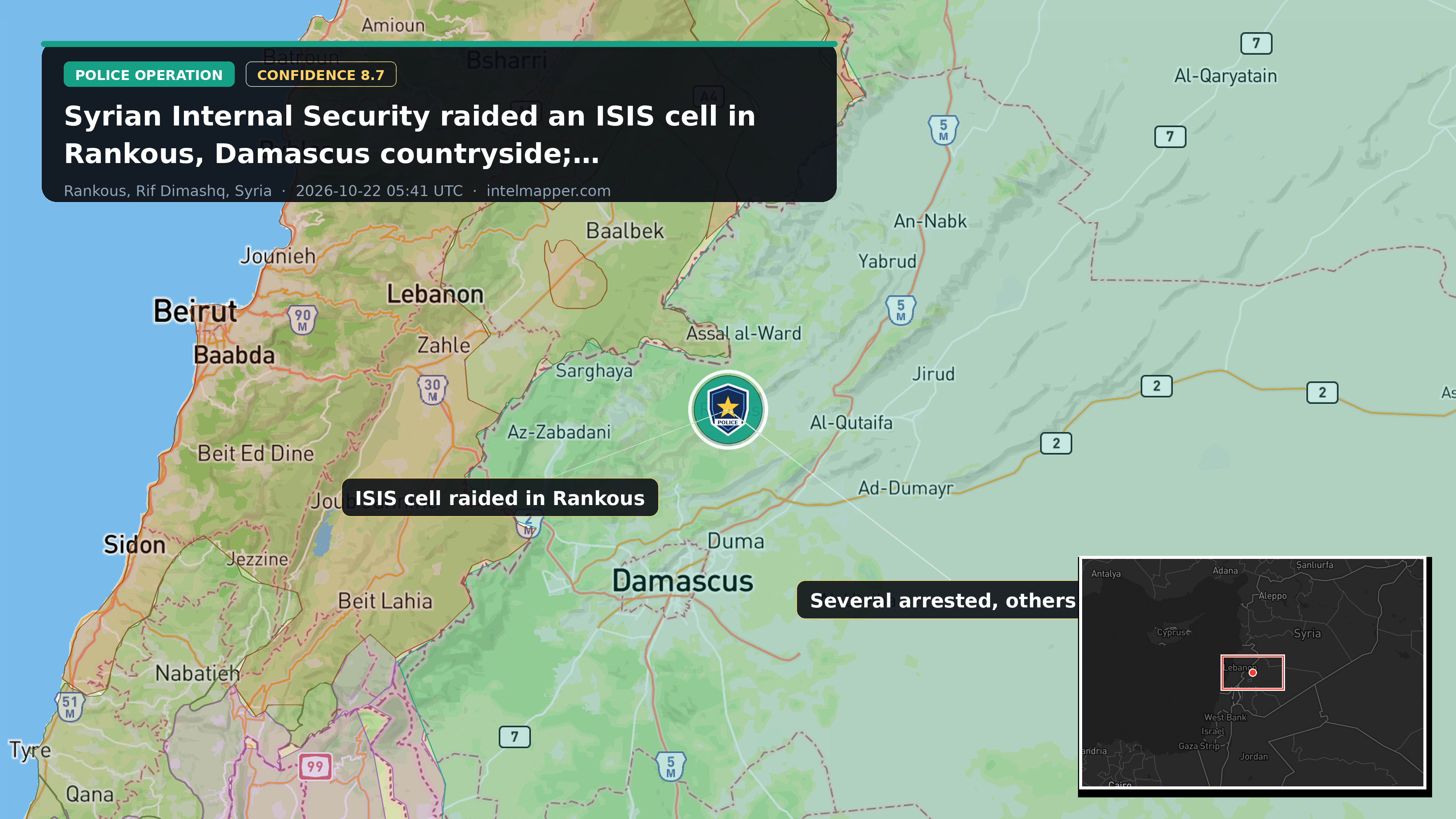
Several lower-level developments point to a wider pattern of pressure. Reports suggest damage to US facilities across the Gulf exceeds Pentagon disclosures, including an AWACS aircraft reportedly damaged at Prince Sultan Air Base, though these sources are single-outlet and unconfirmed. The US continues removing assets from Al Udeid Air Base in Qatar, a repositioning consistent with force-protection concerns. In Syria, Internal Security raided an ISIS cell in Rankous, Damascus countryside, arresting several operatives and reporting its own casualties, while Daraa authorities seized 641,000 captagon pills in a balloon-based smuggling operation. An Israeli patrol advanced into al-Hurriya village in Quneitra and conducted house-to-house searches. In Lebanon, the army foiled an arms smuggling operation at Akroum in Akkar, and an IDF strike hit alleged infrastructure in Bani Hayyan. Lebanese Forces ministers walked out of cabinet over the Hezbollah explosives case. Separately, Russian fishing vessels were reported suspected of surveilling and sabotaging undersea cables in the North Atlantic. Foreign ministers from six states are scheduled to meet in Istanbul on Friday under Turkish hosting.
Assessment
The day combined heightened Gulf escalation risk with a sustained, high-intensity strike campaign in Ukraine. Houthi attacks on Saudi targets and Iranian warnings toward US forces point to a widening regional confrontation, though most claims remain unverified and no confirmed Iran-Israel exchange appears in the reporting. In Ukraine, massed strikes and deep counter-strikes continued alongside attritional ground fighting, with diplomacy open in principle but substantively stalled. Developments warrant close monitoring for signs of escalation beyond current rhetorical and single-source reporting.
What to watch
Over the next 24 to 48 hours, attention should focus on whether Houthi forces follow through on threats of further strikes on Saudi territory, particularly against energy and airport infrastructure in the Eastern Province, and whether Riyadh responds militarily. Statements from Tehran on Strait of Hormuz transit and US bases bear watching for any operational step beyond rhetoric, as does any US decision on Israeli action against Iran. The Istanbul foreign ministers meeting on Friday may indicate whether diplomatic channels on regional escalation are gaining traction. In Ukraine, further large combined Russian strikes on Kyiv and Ukrainian long-range strikes on Russian defence industry are plausible, and any US response on Starlink access or security guarantees could shape front-line drone operations.
Sources (14)
This brief is compiled from the day's verified events; each entry links to the event page with media, confidence score and original reporting.
- Syrian Internal Security raided an ISIS cell in Rankous, Damascus countryside; several operatives arrested, ot (Police Operation, Rankous, Rif Dimashq, Syria)
- Netanyahu says he did not seek US President Trump's approval before attacking Iran, signalling Israel's willin (Statement, Jerusalem, Israel)
- Netanyahu says he is working extensively with third-party countries to facilitate the displacement of Palestin (Statement, Jerusalem, Israel)
- Netanyahu says the only solution to Iran's 'fanatical regime' is to overthrow it, comparing it to the Allies' (Statement, Jerusalem, Israel)
- Saudi Aramco ordered Dhahran HQ staff to evacuate and work remotely after a Houthi strike on the HQ earlier th (Security, Saudi Aramco Headquarters, Dhahran, Saud)
- Circulating footage shows warplanes flying at low altitude over the western Rif Dimashq countryside; operator (Combat Aircraft, Western Rif Dimashq countryside, Syria)
- Aerial footage shows SDF-dug tunnel networks, trenches and earthen berms around Ayn Issa in Raqqa countryside, (Report, Ayn Issa, Raqqa Governorate, Syria)
- Israeli occupation forces advanced into Jamla village in western Daraa countryside, killing a young man with d (Combat, Jamla, Daraa Governorate, Syria)
- Lebanese Army foiled an arms and ammunition smuggling operation at the Akroum border area in Akkar, coming fro (Police Operation, Akroum border area, Akkar, Lebanon)
- Drug control department in Daraa foiled a large balloon-based smuggling operation, seizing 641,000 captagon pi (Police Operation, Ghasm, Daraa Governorate, Syria)
- Israeli patrol of 6 vehicles and 25 soldiers advanced into al-Hurriya village in Quneitra countryside and cond (Security, Al-Hurriya village, Quneitra Governorate)
- Syrian Foreign Ministry strongly condemns Israeli forces' incursion into Jamla, western Daraa, which killed a (Statement, Damascus, Syria)
- King Abdullah II reiterated Jordan's rejection of Israeli attacks on Syrian territory while meeting Syria's fo (Diplomacy, Amman, Jordan)
- Israeli occupation forces blocked a UNDOF patrol from crossing the road in Tarnaja village, northern Quneitra (Security, Tarnaja, Quneitra, Syria)