Iran claims drone shootdowns as Syria-Saudi defense pact signed
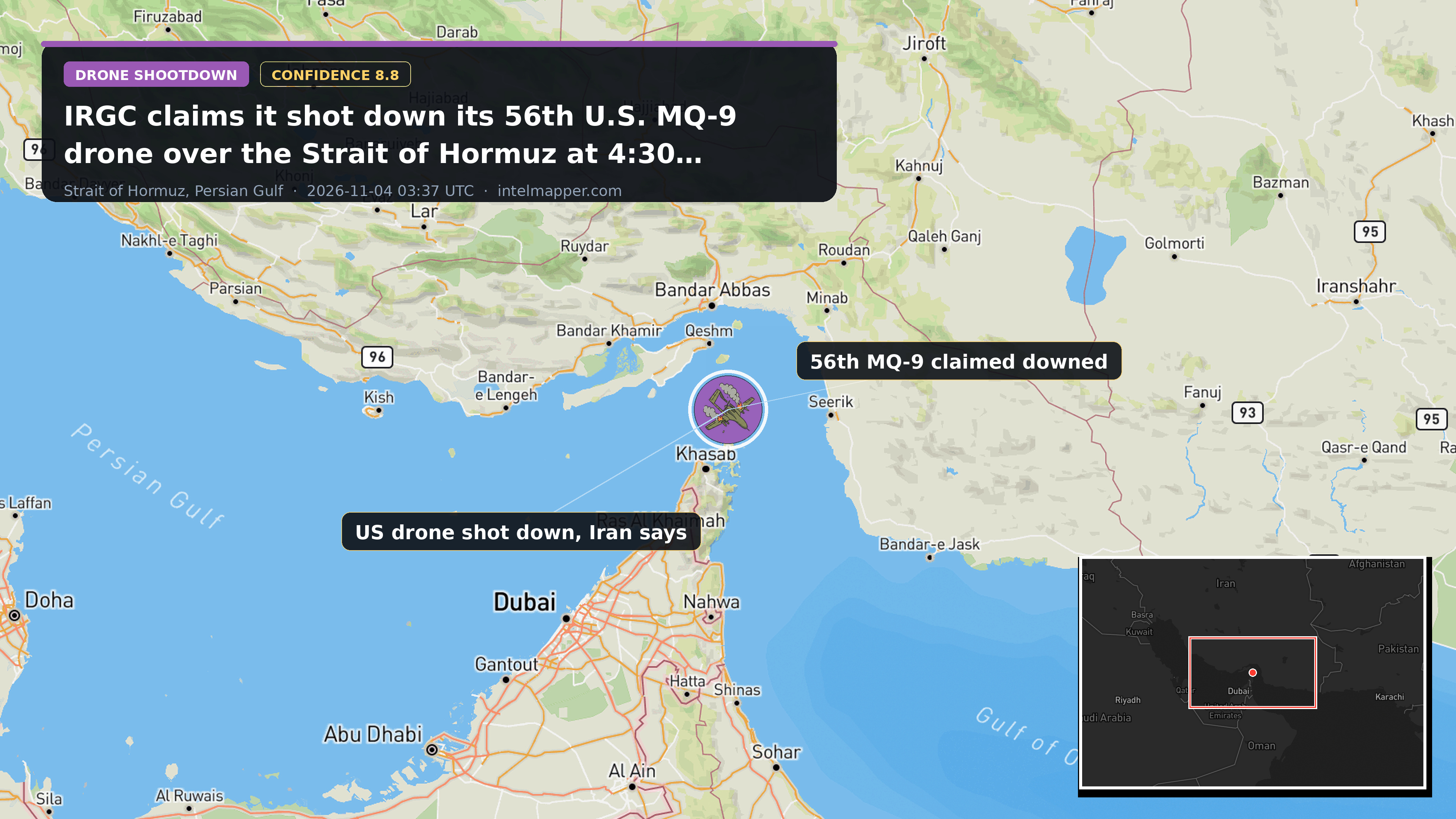
- IRGC claims MQ-9 shootdown over Strait of Hormuz at 4:30 a.m.
- IRGC claims MQ-1 downed near Hormozgan coast, Iran; unverified.
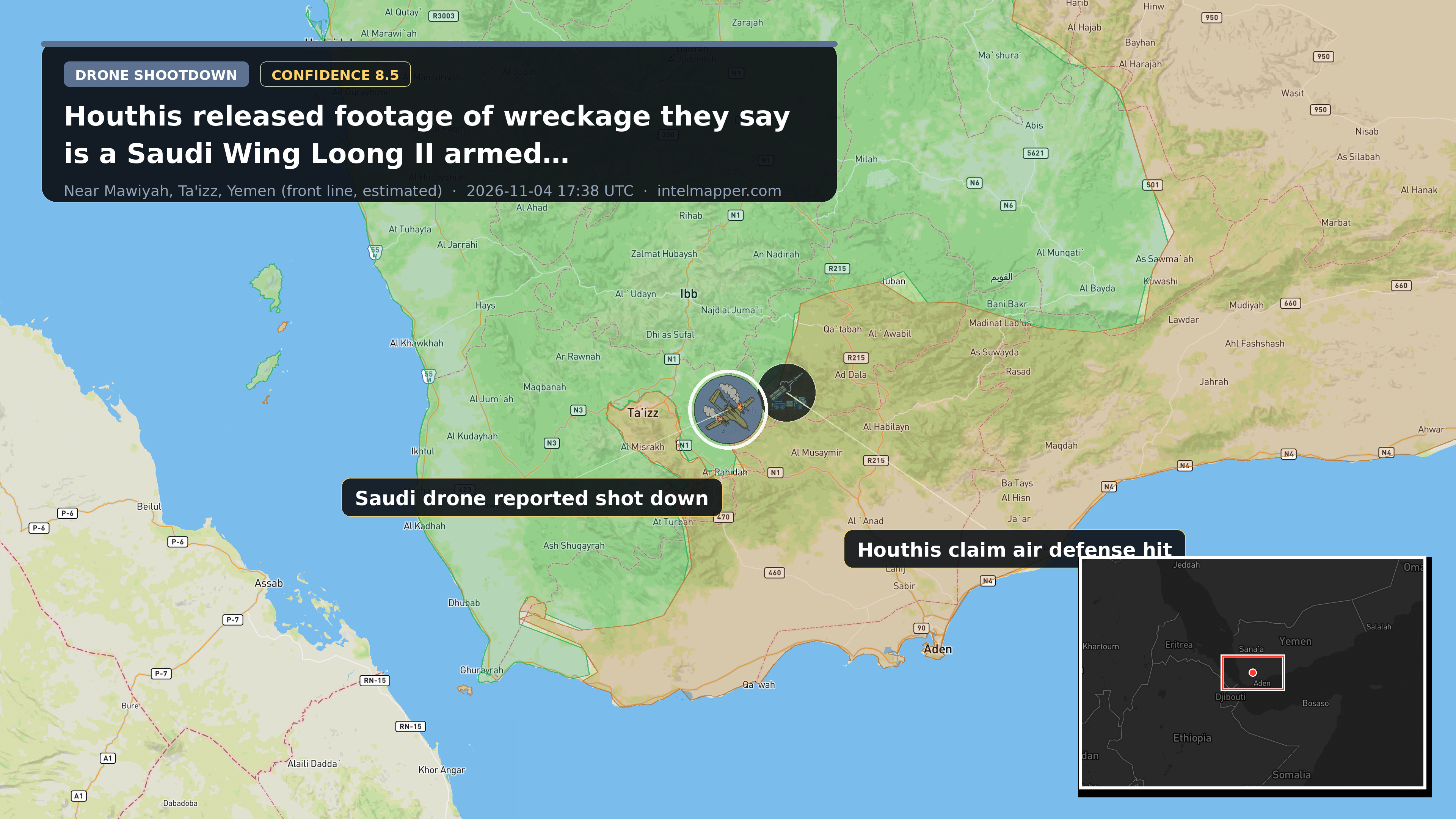
- Houthis publish footage of reported Saudi Wing Loong II wreckage in Taiz.
- Syria and Saudi Arabia sign defense and energy cooperation agreements in Riyadh.
- IDF strike in Gaza City kills Hamas intelligence operations chief Abu Saeed.
What to watch: Over the next 24 to 48 hours, the principal question is whether the IRGC and Houthi claims of drone shootdowns and strikes on Saudi targets receive independent confirmation, particularly from U.S.
Full analysis (643 words)
Iran's Revolutionary Guard Corps (IRGC) claimed it shot down a U.S. MQ-9 drone over the Strait of Hormuz at about 4:30 a.m., describing it as its 56th such claim. The claim is unverified by independent sources. A separate IRGC claim said a U.S. MQ-1 was downed near the Hormozgan coast, with reports placing the site either near Sirik or on Qeshm Island. In Yemen, Houthi-released footage reportedly shows wreckage of a Saudi Wing Loong II drone shot down over Taiz province; this too is unverified. Iranian leadership rhetoric hardened in parallel. Supreme Leader Mojtaba Khamenei reportedly ordered responses to any threat that are not geographically restricted, with timing left to the armed forces. Security Council Secretary Mohsen Rezaei claimed Iran had defeated the United States, and the Foreign Ministry called the conflict an unlawful war.
Several patterns stand out. First, claims of battlefield success, particularly drone kills, are circulating faster than any verification, and most rest on single-service or Telegram-originated material. Second, the Houthis are extending pressure toward Saudi Arabia. They called on international airlines to avoid Saudi airspace and claimed an attack on King Khalid International Airport in Riyadh; Saudi authorities have not confirmed any details. Third, Riyadh and Damascus deepened ties. Syrian President Ahmed al-Sharaa made his second visit to Riyadh in weeks, meeting Crown Prince Mohammed bin Salman, and the two states signed memoranda spanning energy, health, industry and a bilateral military cooperation agreement. Lebanon remained a flashpoint: Prime Minister Nawaf Salam warned Hezbollah against dragging the country into a new war, while an IDF strike in southern Lebanon reportedly killed one Hezbollah operative. Israel also killed Jamal Abu Saeed, a Hamas military intelligence operations chief, in Gaza City, according to a joint IDF and Shin Bet statement.
The significance lies largely in the accumulation of friction rather than any single event. Israeli forces conducted incursions, raids and gunfire across the Daraa and Quneitra countryside over a 48-hour period, and artillery shells reportedly landed near Al-Sammadaniya al-Sharqiya, raising pressure on the Syrian south. Syrian authorities enforced screening at the Al-Tanf crossing before Iraqi tankers entered Syria, indicating tighter control of cross-border energy flows. In Hasakah, a war remnant ordnance blast inside a school in Abu Rasin preliminarily killed one child and injured eight. Iranian officials also claimed their missiles could reach other continents, and a new IRGC and Basij training camp in Tehran was reportedly opened on November 2. Such claims are mainly signalling, but they add to the deterrence rhetoric that shapes regional calculations.
Assessment
The day was dominated by unverified battlefield claims from Iran and the Houthis, which increase rhetorical tension but do not yet establish new facts on the ground. Saudi-Syrian military cooperation and continued Israeli operations in southern Syria point to a regional security environment being reshaped by alignments and friction rather than a single decisive event. In Ukraine, the sustained volume of Russian drone and glide-bomb activity reflects an ongoing, wide-area strike pattern, with the Adygea incident and the proposed leaders' meeting the main unresolved developments. Confirmation remains the key constraint on most items reported today.
What to watch
Over the next 24 to 48 hours, the principal question is whether the IRGC and Houthi claims of drone shootdowns and strikes on Saudi targets receive independent confirmation, particularly from U.S. Central Command, the Saudi government or satellite imagery. Any verified loss of a U.S. drone in the Strait of Hormuz, or a confirmed strike at Riyadh's airport, would mark a substantive escalation and could prompt responses from Washington or Riyadh. Watch also for follow-up on Israeli activity in southern Syria and any Hezbollah response to Israeli statements on border infrastructure. On the Ukraine front, the frequency of Shahed and glide-bomb alerts is likely to continue, and the cause of the Adygea blasts may become clearer. Official reaction to any Putin-Trump-Xi meeting proposal would indicate whether that diplomacy is advancing.
Sources (14)
This brief is compiled from the day's verified events; each entry links to the event page with media, confidence score and original reporting.
- IRGC claims it shot down its 56th U.S. MQ-9 drone over the Strait of Hormuz at 4:30 a.m. (unverified). IRGC al (Drone Shootdown, Strait of Hormuz, Persian Gulf)
- Syrian President Ahmad al-Sharaa met Saudi Crown Prince Mohammed bin Salman in Riyadh, his second visit in wee (Diplomacy, Riyadh, Saudi Arabia)
- Houthis released footage of wreckage they say is a Saudi Wing Loong II armed reconnaissance drone shot down ov (Drone Shootdown, Near Mawiyah, Ta'izz, Yemen (front )
- Iran's SNSC Secretary Mohsen Rezaei claims Iran defeated Trump in battle, Hormuz and Washington, and warns att (Statement, Tehran, Iran)
- Iran's Foreign Ministry spokesman accuses Trump of launching an unlawful war against Iran and warns of far-rea (Statement, Tehran, Iran)
- Supreme Leader Mojtaba Khamenei says the US seeks Iran's unconditional surrender and warns that any concession (Statement, Tehran, Iran)
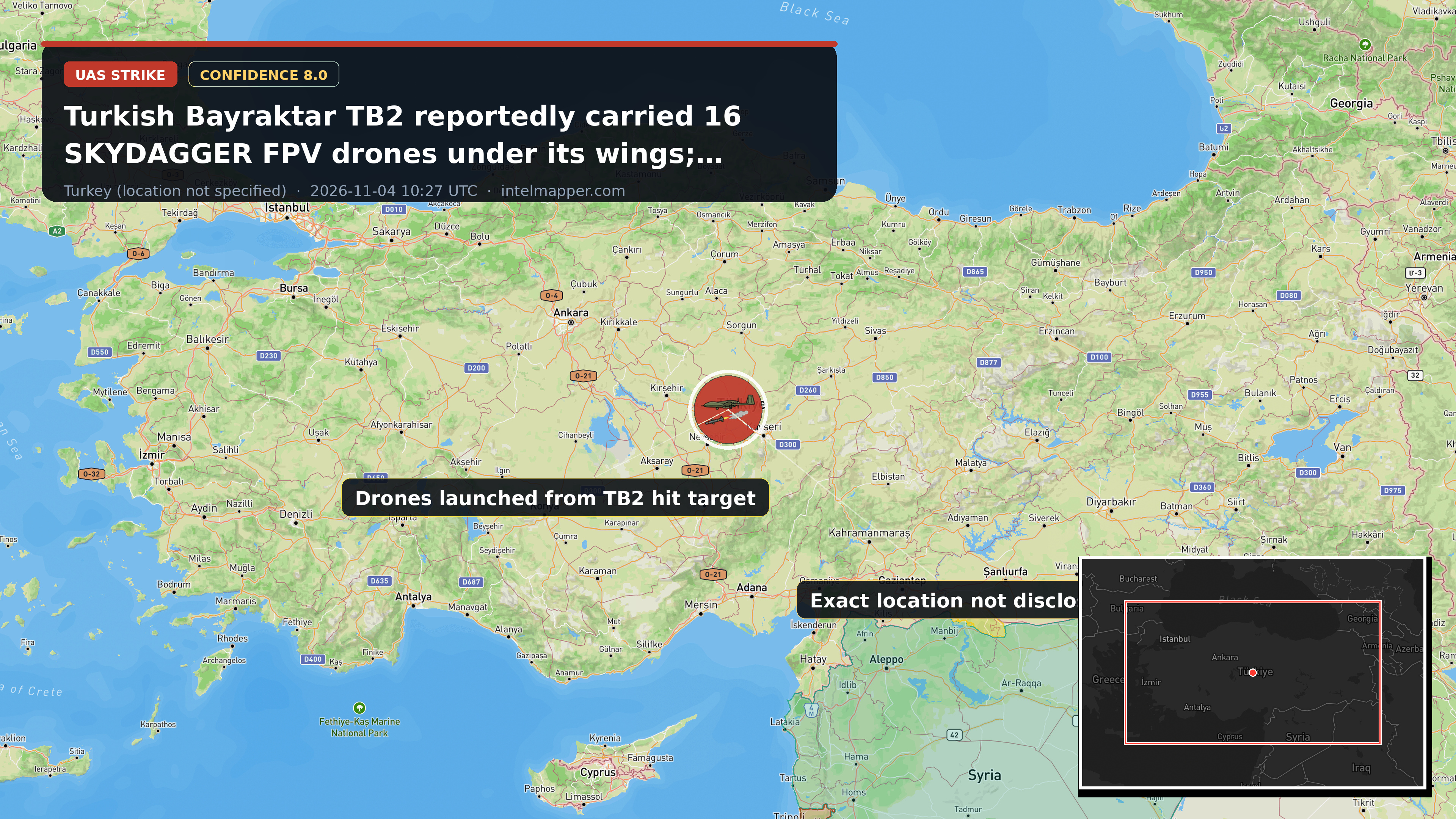
- Turkish Bayraktar TB2 reportedly carried 16 SKYDAGGER FPV drones under its wings; the FPV drones claimed succe (UAS Strike, Turkey (location not specified))
- Syria and Saudi Arabia signed MoUs spanning development, energy, health, industry, and military cooperation, i (Diplomacy, Riyadh, Saudi Arabia)
- Security screening procedures are being enforced at the Al-Tanf crossing before Iraqi tankers are allowed to c (Security, Al-Tanf Crossing, Homs Governorate, Syri)
- Former Asayish commander Joan Ibrahim, missing for nine years, has been announced killed; no details given on (Report, Hasakah, Hasakah Governorate, Syria)
- Preliminary toll: one child killed and eight injured when war remnant ordnance exploded inside a school in Abu (Explosion, Abu Rasin, Al-Hasakah, Syria)
- Unidentified explosion shakes the separation strip inside occupied Golan; origin and casualties not reported. (Explosion, Area of Separation, Quneitra Governorate)
- Circulating footage shows Israeli occupation forces' tanks positioned on the Jubata al-Khashab heights in Qune (Tank, Jubata al-Khashab, Quneitra, Syria)
- IRGC claims it shot down a U.S. MQ-1 drone near Sirik, Hormozgan, Iran. Claim is unverified by independent sou (Drone Shootdown, Qeshm Island, Hormozgan, Iran)