Syrian military engineer killed, second soldier injured clearing old-regime mines near al-Tanf
What happened
The Syrian Ministry of Defense's media and communication administration reported that a soldier from the army's military engineering directorate was killed and another was seriously injured while dismantling mines and explosive remnants left by the former regime in the al-Tanf area of the eastern Homs countryside. The statement, published in Arabic, is the only account in the event record. It gives no details of the device types, the number of devices cleared, or the exact time of the incident, beyond the reporting date of 17 October 2026. The event was logged from a Telegram report by @AJSyriaNow, which relayed the ministry wording. The source uses the phrase 'old-regime remnants', a term the Syrian authorities commonly apply to leftover material from the Assad period. Because the report describes an accident during clearance work rather than a hostile strike, it is logged as a report rather than an attack.
Context and assessment
Al-Tanf is a remote desert area near the borders with Iraq and Jordan. It has been a site of contested military presence for years, including a former garrison that drew attention during the campaign against ISIS. Clearance of abandoned ordnance in the Badia of eastern Homs is slow and dangerous, and the incident reflects a wider problem, since explosive remnants from former front lines and depots are scattered across many governorates. The event also sits within a cluster of Syria-wide items logged in the same days. Six incidents have damaged energy infrastructure across four governorates since mid-August, with perpetrators and causes not stated, and a police operation in the Banias countryside followed an arrest over a killing there. These entries do not share a documented cause with the al-Tanf report, and nothing in the record links them. Operationally, the report may indicate that government engineering units are actively clearing ordnance in eastern Homs and that the risk to personnel remains high even without hostile action. It may also suggest the ministry is publicizing its clearance work. Further reporting on the scale of the remnant problem would help clarify this.
Sources and confidence
Only one channel, Telegram @AJSyriaNow, is recorded, and it carries a Ministry of Defense statement rather than independent reporting. The confidence score of 7.6 reflects a clearly attributed official-origin statement that no second outlet has verified, and the single-source count keeps it below a higher score. Confidence would rise if the ministry's original post, a wire service, or local Homs reporting independently confirmed the death and injury, or if the names of those affected were published. It would fall if the statement were withdrawn, or if the incident were found to involve a different location or cause.
Location
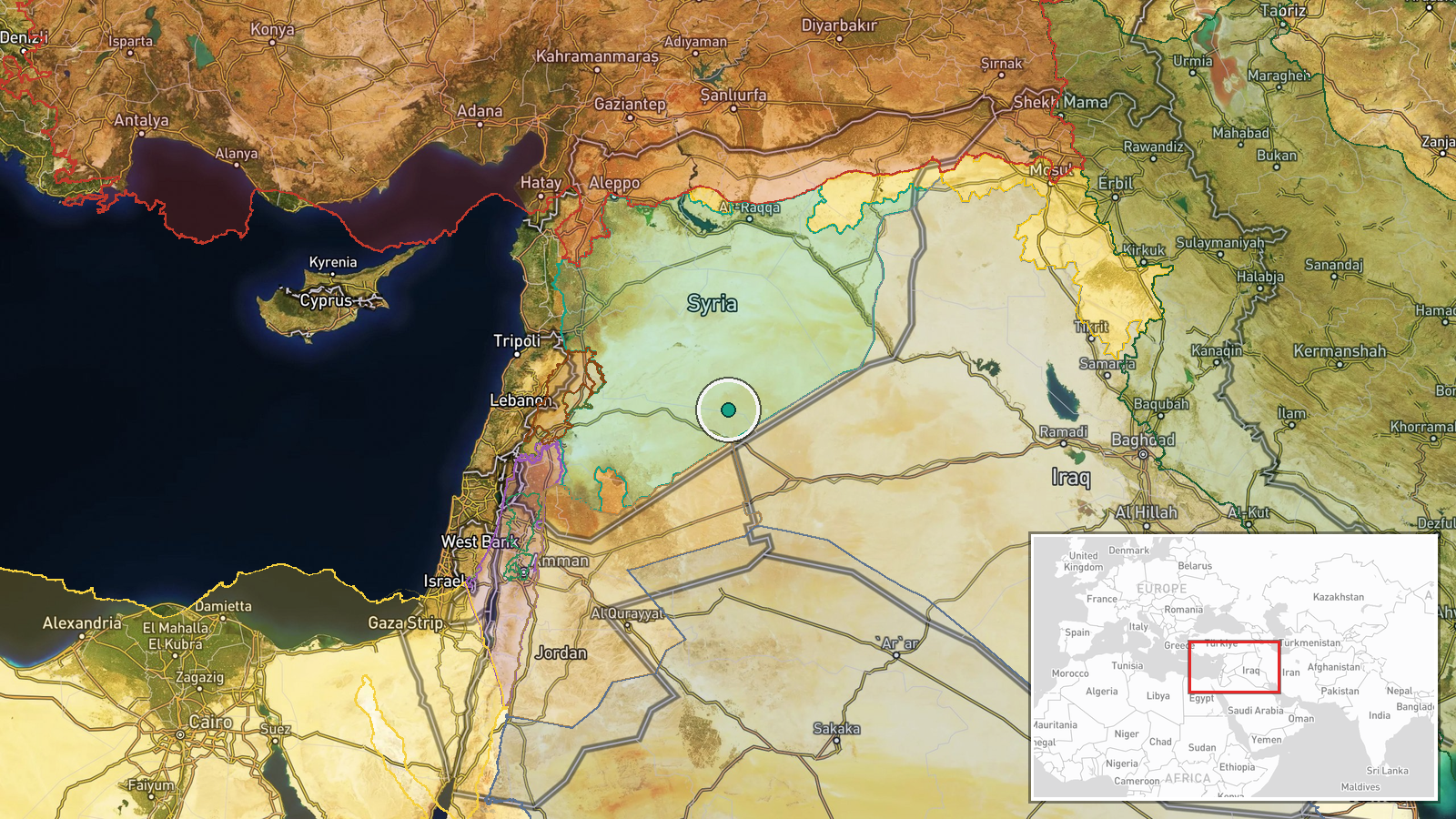
The location is recorded at settlement precision with low location confidence. The coordinates place the event at al-Tanf, a settlement and former military zone in the eastern Homs countryside near the Iraqi and Jordanian borders, rather than at the specific site where the devices were found. The surrounding landscape is open Badia desert with sparse settlement, and the area lies near the tripoint of the Syrian, Iraqi, and Jordanian frontiers.
Related events nearby
- Six incidents across four Syrian governorates have damaged the energy sector since mid-August; perpetrators an2026-10-16 19:43 UTC · Report · Syria
- Celebrations continue in Banias countryside after the arrest of Moaraj Oural, accused of killing Ali Kayali; S2026-10-16 16:30 UTC · Police Operation · Syria (location not reported)
▶ View this event on the live map

Intel Mapper aggregates open-source reports from monitored Telegram and X channels, geolocates them, cross-checks duplicates across sources and assigns a confidence score. Entries are updated as new confirmations arrive. Read how we verify events.