Ukraine reports destroying 161 Russian weapons in overnight strike across four oblasts
What happened
The Ukrainian General Staff reported that air defenses and electronic warfare systems neutralized 161 Russian targets during an overnight attack spanning October 6–7. The destroyed munitions included 5 ballistic missiles, 39 cruise missiles (Kh-101, Iskander-K, and Kalibr variants), and 117 drones (Shahed, Gerbera, and Parody decoy types). Strikes were recorded across Kyiv, Kharkiv, Poltava, and Dnipropetrovsk oblasts, with confirmed impacts on 18 locations. Russian systems launched from Rostov, Bryansk, Voronezh, Vologda, and Kursk oblasts as well as from the Caspian Sea.
Context and assessment
This massed overnight strike represents a continuation of Russia's sustained campaign against Ukrainian civilian and military infrastructure. The involvement of multiple launch platforms—aircraft, ground-based systems, and naval vessels—indicates coordinated efforts across Russia's western and southern military commands. The geographic spread of targets across four oblasts suggests either a broad targeting strategy or attempts to overwhelm air defenses through saturation. Related air monitoring reports from the same night confirm transit of ballistic missiles and cruise missiles over Kyiv Oblast and individual Shahed incursions. Such multi-vector attacks have become routine in recent months, though the scale of reported interceptions—if confirmed—would align with Ukrainian air defense modernization efforts.
Sources and confidence
The Ukrainian General Staff released the strike report via official Telegram channel on October 7 at 06:24 UTC. This represents a single authoritative source; cross-confirmation by independent observers is typically limited for claimed air defense successes. The confidence score of 8.0 reflects the source's official status and consistency with corroborating air monitoring reports from the same night, though actual intercept numbers cannot be independently verified. Confirmation from Russian sources or third-party monitoring would strengthen the assessment.
Location
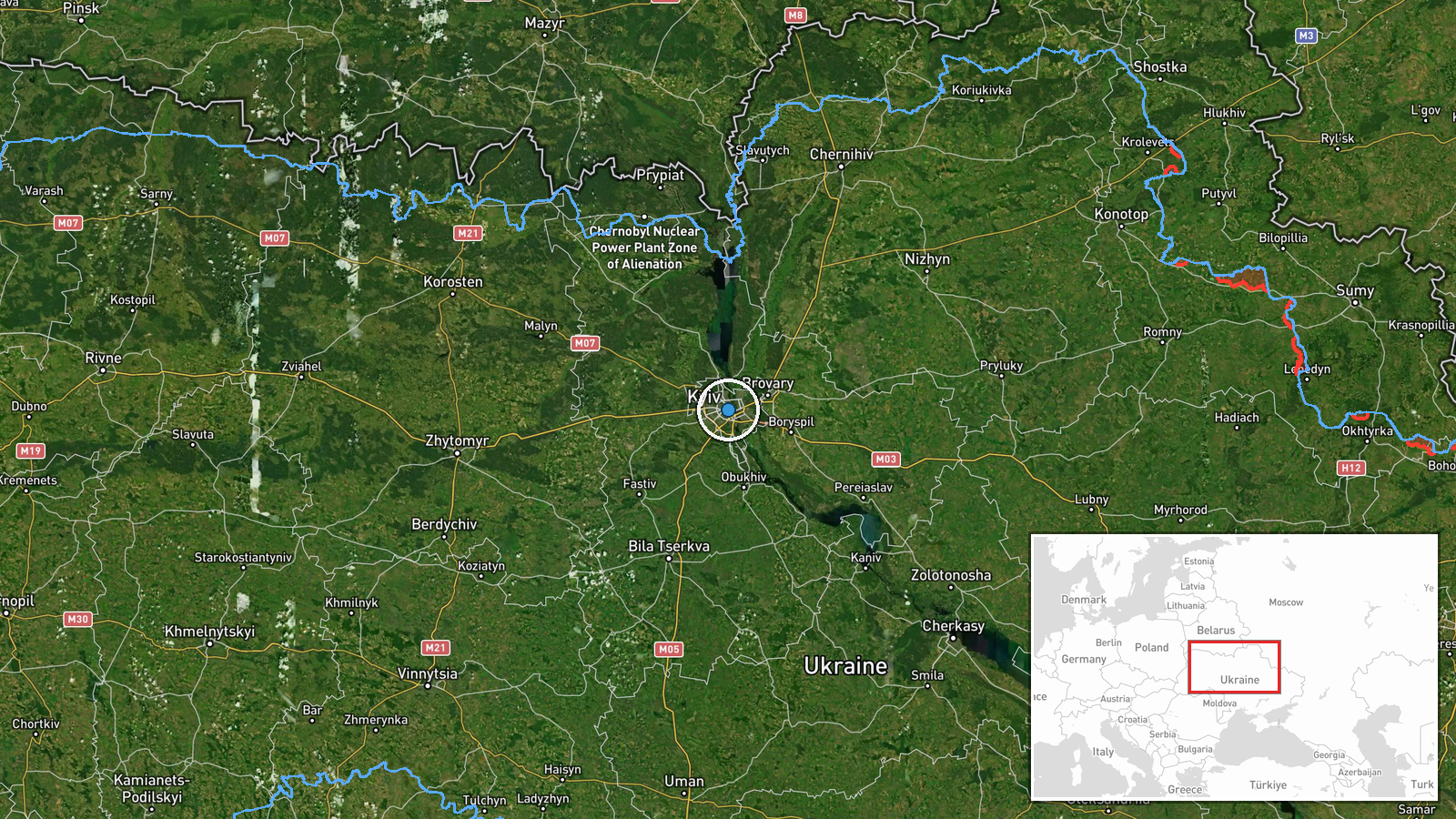
The attack targeted multiple oblasts across central and eastern Ukraine: Kyiv, Kharkiv, Poltava, and Dnipropetrovsk. Russian launch platforms operated from western Russian territory (Rostov, Bryansk, Voronezh, Vologda, Kursk oblasts) and the Caspian Sea, indicating stand-off ranges of 500–2,000 kilometers. Confirmed impact sites spanned 18 locations, though specific coordinates were not disclosed in the report.
Related events nearby
- Russia conducted massive overnight massed missile and drone strike across Ukraine on Putin's 74th birthday (Oc2026-10-07 05:00 UTC · Cruise Missile · Kyiv, Ukraine
- Ukrainian General Staff releases cumulative Russian casualty figures on Putin's 74th birthday: 1,545,950 perso2026-10-07 04:13 UTC · Report · Kyiv, Ukraine
- Ukrainian air monitoring: 1 Russian cruise missile passing Pyryatyn, heading toward Kyiv Oblast; 1 Russian cru2026-10-07 03:36 UTC · Cruise Missile · Kyiv Oblast, Ukraine
- Ukrainian air monitoring reports isolated Russian Shahed-type (reactive/jet-powered) drones transiting over Ky2026-10-07 02:37 UTC · Drone Transit · Kyiv, Ukraine
- Ukrainian air monitoring: 1 Russian ballistic missile over Kyiv.2026-10-07 02:16 UTC · Ballistic Missile · Kyiv, Ukraine
▶ View this event on the live map
Intel Mapper aggregates open-source reports from monitored Telegram and X channels, geolocates them, cross-checks duplicates across sources and assigns a confidence score. Entries are updated as new confirmations arrive. Read how we verify events.