Unconfirmed Telegram report of alarm near Domodedovo airport; no impact reported
What happened
On 22 October 2026 at about 01:13 UTC, a single Telegram channel, @supernova_plus, posted a short message reporting alarm and concern in the area of Domodedovo International Airport in Moscow Oblast, Russia. The original Russian wording is brief and, in substance, describes the airport area as alarming. It does not describe an explosion, a strike, a weapon type, casualties or damage. The entry is typed as a siren event, but the source does not state that a siren sounded, so the classification reflects how the report was categorised rather than a confirmed observation. No official statement about the airport or the surrounding district appears in the available data. The report is best read as an unverified indication of local unease rather than a documented incident.
Context and assessment
Moscow Oblast is a recurring target area in the wider drone campaign, and the day before this report a related entry records the region under what the source calls a massive attack, though its weapon type, targets and impact are unspecified. Domodedovo is one of the three main commercial airports serving the Russian capital, so any reported disruption there carries logistical and political weight beyond the immediate district. The timing also sits within a dense run of diplomatic activity. On 21 October the Kremlin reportedly warned Berlin through back channels that a failed drone attack on Leipzig-Halle Airport would not be the last, and the same day Kremlin aide Yuri Ushakov said Moscow was ready for trilateral talks with Washington and Kyiv in mid-November. Taken together, the sequence suggests that airport security and air-defence alerts in the Moscow region are being treated as sensitive, but nothing in the data links this specific Domodedovo report to a particular launch or to the Leipzig episode. Operationally, alarm reports around major airports often reflect temporary airspace restrictions or defensive activation, which can occur without any impact on the ground.
Sources and confidence
The entry rests on one Telegram channel, @supernova_plus, and no second outlet, official notice or independent observer is recorded, so cross-confirmation is absent. The confidence score of 5.5 is low because the content is vague, carries no impact or weapon detail, and comes from a single unverified channel whose track record is not provided in the data. Confidence would rise with corroboration from Russian aviation authorities or airport operators, reports of flight suspensions or diversions that can be matched to timestamps, regional official comment, or geolocated imagery. It would fall further if the channel is shown to have repeated unfounded alerts or if no supporting evidence emerges.
Location
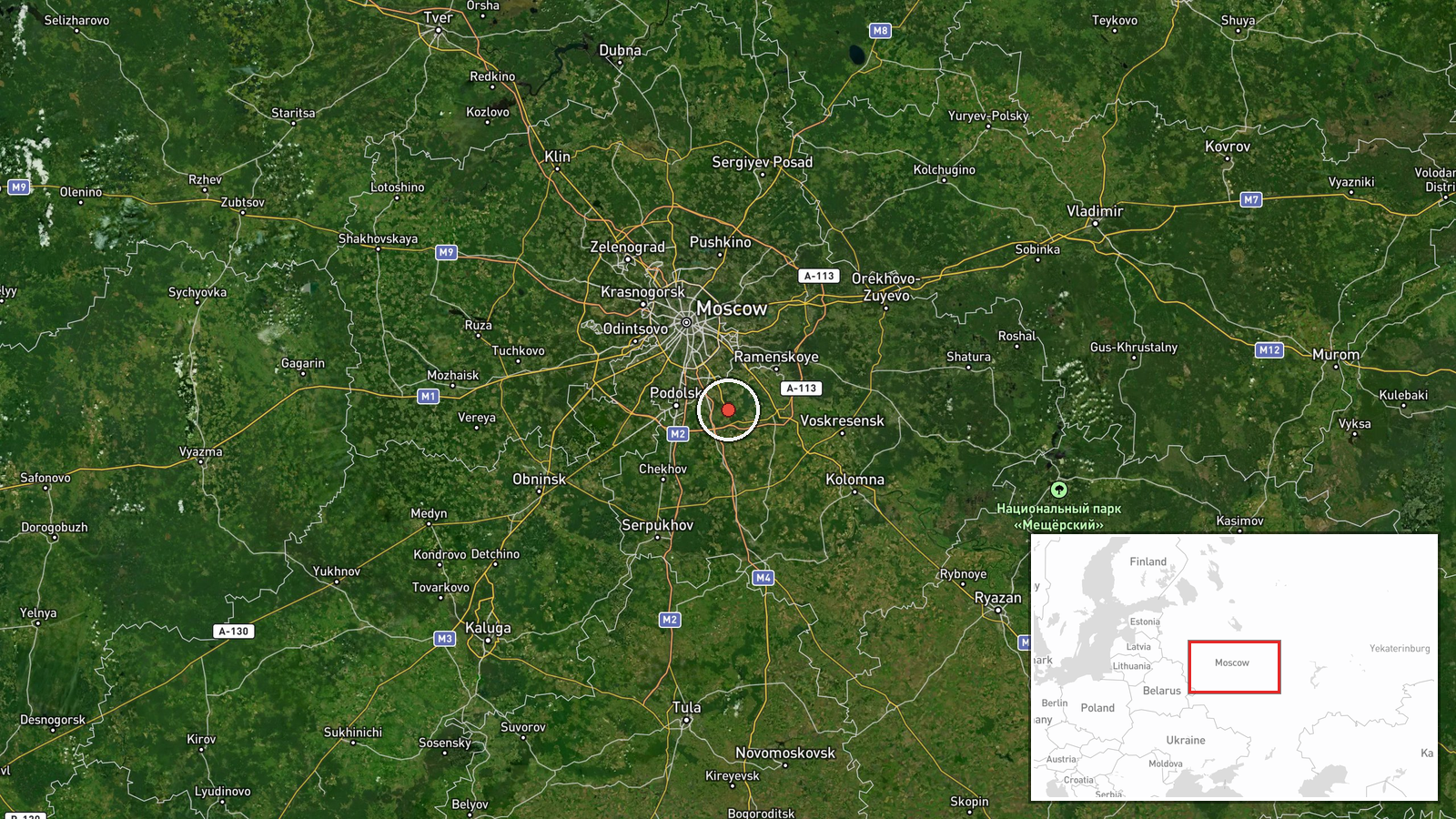
The location is recorded at settlement precision, placing the event at the Domodedovo airport area at approximately 55.4145 N, 37.8999 E, with high location confidence because the airport is a fixed, well-known facility. Domodedovo lies to the south-southeast of central Moscow, within Moscow Oblast. The surrounding terrain is largely flat, with a dense network of highways, including the M-4 Don motorway, and extensive airport infrastructure and warehousing near the runways. The coordinates identify the airport area as a whole and do not indicate any specific building or facility.
Related events nearby
- Unconfirmed Telegram report of an Oreshnik missile overflight above a logistics center in Domodedovo, Moscow O2026-10-22 01:39 UTC · Ballistic Missile · Domodedovo logistics center, Moscow Oblast, Russia
- Moscow Oblast reported under a massive attack; weapon type, targets and impact details are not specified in th2026-10-21 23:33 UTC · UAS Strike · Moscow Oblast, Russia
- Kremlin aide Yuri Ushakov says Moscow is ready for trilateral talks with Washington and Kyiv in mid-November. 2026-10-21 13:31 UTC · Statement · Moscow, Russia
- Per WSJ, the Kremlin warned Berlin via back channels that the failed Leipzig-Halle Airport drone attack would 2026-10-21 12:34 UTC · Statement · Moscow, Russia
- Kremlin says Putin will review and assess every proposal presented by U.S. envoy Steve Witkoff, amid Ukraine-w2026-10-21 10:41 UTC · Statement · Moscow, Russia
▶ View this event on the live map

Intel Mapper aggregates open-source reports from monitored Telegram and X channels, geolocates them, cross-checks duplicates across sources and assigns a confidence score. Entries are updated as new confirmations arrive. Read how we verify events.