Israel reportedly orders army to prepare full closure of West Bank after an attack
What happened
A Telegram channel, @warmonitors, reported on 23 October 2026 at 09:27 UTC that Israel had ordered its army to prepare to fully close the West Bank after an attack. The post was a short headline. It did not name the attack, its location, any casualties, or the official or document through which the order was issued. The wording 'orders army to prepare' describes a preparatory instruction rather than a completed closure, and the report does not say whether closure measures have begun. The accompanying text is a promotional banner for an online gambling service and adds nothing about the event. Because the report rests on one channel and no independent outlet or official statement appears in the record, the details should be treated as provisional.
Context and assessment
The West Bank has been subject to Israeli movement restrictions for decades, including checkpoints, permit systems and periodic full or partial closures that restrict Palestinian travel between towns. A full closure order therefore has a recognisable operational meaning: it would typically tighten control of roads, crossings and urban access points, and it would often be announced when authorities expect wider unrest or want to contain a fast-moving security situation. The surrounding record points to a heightened tempo. On 22 October 2026, Prime Minister Netanyahu was quoted in Jerusalem declaring that Israel would destroy Hamas and describing the goal as not difficult, which the record frames as an explicit threat of military action in Gaza. The same day, he said he had not sought US President Trump's approval before attacking Iran, and i24NEWS reported that there was no reason to attack Iran before elections unless preparations for an Iranian missile attack were detected. A Telegram headline also reported West Bank clashes that day, with no parties, casualties or specific location given. Taken together, these items suggest a period of elevated security concern across several fronts. They do not establish a causal link to any West Bank order, and the closure instruction may reflect contingency planning rather than a response to a specific incident.
Sources and confidence
The event is sourced to a single Telegram channel, @warmonitors, which is the only listed origin, and it carries a source count of one. No wire service, major newspaper, or Israeli official statement appears in the record to corroborate the order. The confidence score of 6.0 reflects a plausible claim from a non-verified channel with a terse, unsourced headline and no detail on the triggering attack. Confidence would rise with an official Israeli military or government statement, or with reporting from established agencies that describe the order and its scope. It would fall if the order cannot be located in official channels or if subsequent reporting contradicts the headline or attributes it to a different event.
Location
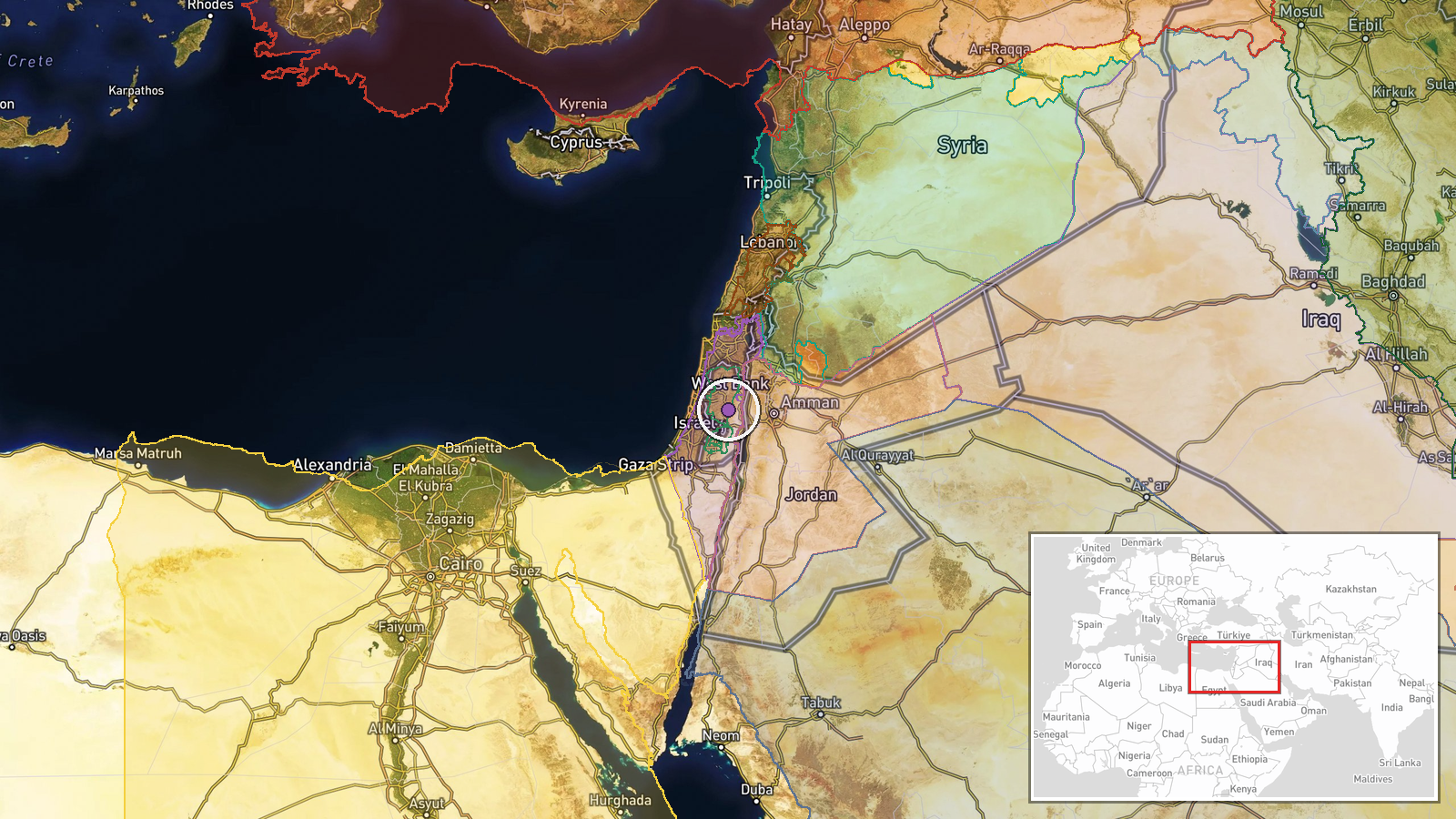
The coordinates (32.0, 35.3) are an approximate central point for the whole West Bank rather than a settlement, facility or road, and the location confidence is recorded as low. The order itself applies to a territory, so the region-level placement is appropriate but not precise. The point lies in the central and eastern part of the West Bank, broadly between the Ramallah area and the Jordan Valley. The terrain there is hilly, with dense Palestinian towns and villages, Israeli settlements and a network of bypass roads that closure orders typically target.
Related events nearby
- Two Hebron gunmen fired on an IDF checkpoint at Judea Junction; 5 Israelis wounded, both attackers killed. IDF2026-10-23 07:39 UTC · Security · Near Hebron, West Bank, Palestine (front line, est
- Israeli military reports a shooting attack near Yehuda Junction in the Yehuda Regional Brigade area. Details u2026-10-23 04:28 UTC · Combat · Yehuda Junction, West Bank
- Israeli forces killed two Palestinian gunmen near Hebron after a shooting attack wounded six Israeli soldiers,2026-10-23 06:17 UTC · Combat · Yehuda Junction, West Bank, Palestine
- Netanyahu publicly acknowledges that Israel bombed Qatar, adding that he was accused of being pro-Qatar.2026-10-22 19:47 UTC · Statement · Jerusalem, Israel
- Israeli PM Netanyahu declares Israel will destroy Hamas, calling the goal not difficult. Explicit threat of mi2026-10-22 18:23 UTC · Statement · Jerusalem, Israel
▶ View this event on the live map

Intel Mapper aggregates open-source reports from monitored Telegram and X channels, geolocates them, cross-checks duplicates across sources and assigns a confidence score. Entries are updated as new confirmations arrive. Read how we verify events.