Araghchi says Iran has no hostility toward Gulf states, backs Qatar and Oman role
What happened
Iranian Foreign Minister Abbas Araghchi said, in an interview with Al Jazeera, that Iran harbors no hostility toward the Gulf Cooperation Council states. According to the quoted text, Tehran appreciates the positive role played by Qatar and Oman and continues its dialogue with Saudi Arabia. Araghchi stated that the goal is new regional security arrangements carried out by the countries of the region themselves, away from any foreign military presence. The statement is datelined Tehran and was logged at 06:48 UTC on 3 November 2026. The only channel carrying it is an X account, @Osint613, which relays the text attributed to the minister. The summary condenses the quoted wording rather than reproducing a broadcast transcript.
Context and assessment
The statement is datelined Tehran, and it arrives within a dense cluster of Tehran-datelined messages over roughly 24 hours. Parliament Speaker Ghalibaf warned that any enemy miscalculation would bring an unpredictable Iranian response aimed at enemy assets beyond the immediate geography. State television broadcast a civil-defense video on nuclear attack, and an unnamed senior official told Reuters that Tehran and Washington are far from a deal, demanding Hormuz reopening conditions before nuclear talks. Mohsen Rezaei said there would be no further steps until the United States meets Iran's seven listed conditions, and IRNA quoted an official warning that U.S. aggression endangers fishermen after Iran claimed 13 Hormuz-transiting ships hit naval mines in 10 days. Read against that backdrop, the Gulf message appears designed to separate Iran's relations with its GCC neighbours from its standoff with Washington over the Strait of Hormuz, and to frame regional security as a matter for regional states. Qatar and Oman are named as useful intermediaries, while Saudi dialogue is presented as ongoing, which may signal an effort to keep channels open. A statement of this kind does not by itself indicate a change in military posture, and the hardline tone of the surrounding warnings sits uneasily with it, a mismatch worth watching in later reporting.
Sources and confidence
The item rests on a single channel, X account @Osint613, with a source count of one and no independent pickup in the record. The attribution to an Al Jazeera interview is not linked to a broadcast or transcript in the data. The confidence score of 6.5 out of 10 reflects a plausible attribution to a senior official, consistency with the surrounding Tehran messaging, and a clear time stamp, offset by single-channel relay and the absence of a primary source. Confidence would rise with the Al Jazeera broadcast itself, a publication by the Iranian Foreign Ministry, or wire pickup by Reuters, IRNA or similar agencies with matching wording. It would fall if the quote cannot be located in the interview or if the relaying account is shown to repost unverified text.
Location
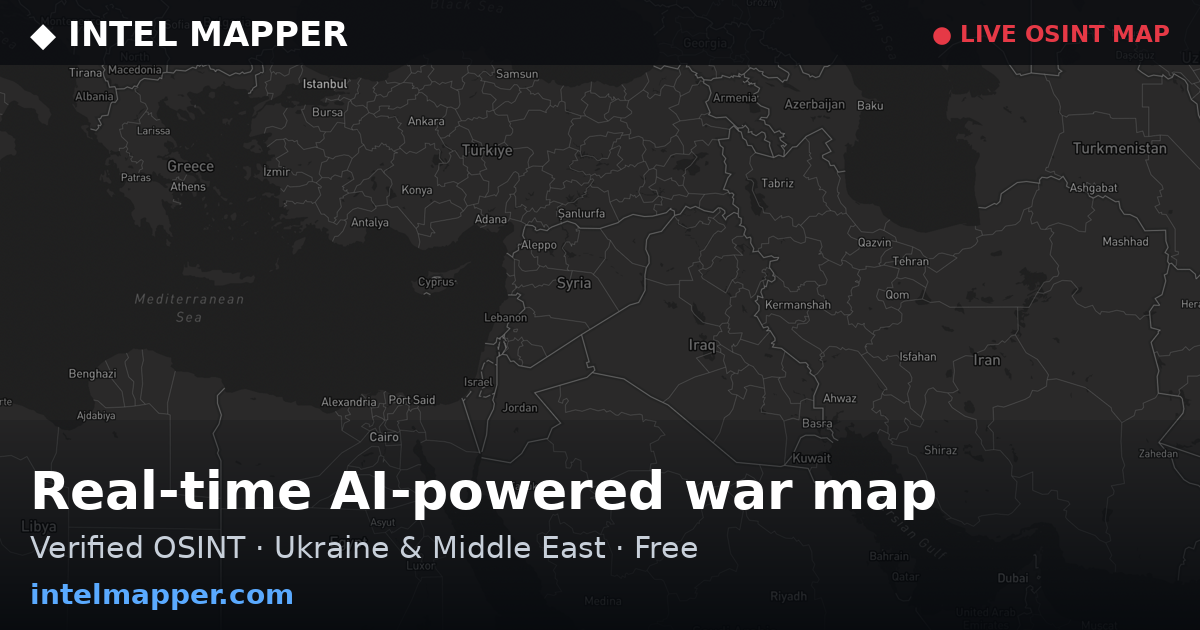
The coordinates are the centroid of Tehran, assigned at settlement precision because the statement is datelined to the city rather than to a specific building or facility. The record gives no separate location confidence value, so the point should be read as city-level only. Tehran sits on the southern foothills of the Alborz mountains, with the urban area running from the northern slopes down onto the plain toward the south. Its position in the basin makes the city the seat of national government and the usual origin point for official statements.
Related events nearby
- Unnamed senior Iranian official tells Reuters Tehran and Washington are far from a deal. Iran demands Hormuz r2026-11-03 06:52 UTC · Statement · Tehran, Iran
- Parliament Speaker Ghalibaf warns Iran's response to any enemy miscalculation will be unpredictable and target2026-11-03 06:37 UTC · Statement · Tehran, Iran
- Iranian state TV and news agencies broadcast civil-defense warning video on nuclear attack: shelter, avoid fla2026-11-03 05:34 UTC · Siren · Tehran, Iran
- Mohsen Rezaei says there will be no further developments or actions until the US meets Iran's seven conditions2026-11-02 18:46 UTC · Statement · Tehran, Iran
- IRNA quotes an Iranian official warning U.S. aggression endangers fishermen, after Iran claimed 13 Hormuz-tran2026-11-02 16:46 UTC · Statement · Tehran, Iran
▶ View this event on the live map

Intel Mapper aggregates open-source reports from monitored Telegram and X channels, geolocates them, cross-checks duplicates across sources and assigns a confidence score. Entries are updated as new confirmations arrive. Read how we verify events.